
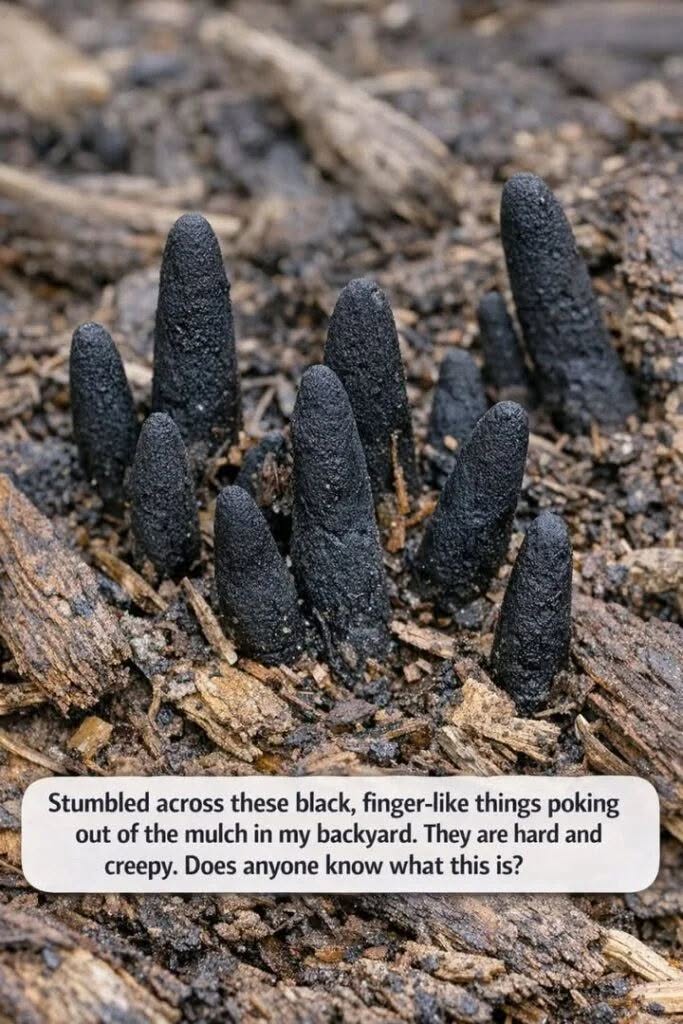
It is an eerie, almost cinematic experience: you are out in your yard, tending to your flower beds or spreading a fresh layer of wood mulch, when you suddenly spot strange, charcoal-black digits reaching up through the soil. They look unnervingly like miniature, petrified fingers reaching up from the underworld. Dark, club-shaped, and tough to the touch, these weird organisms frequently leave homeowners baffled, alarmed, and wondering if their garden has been infected by a dangerous parasite or toxic mold.
The viral image circulating online captures this exact phenomenon perfectly. Accompanied by the caption, “Stumbled across these black, finger-like things poking out of the mulch in my backyard. They are hard and creepy. Does anyone know what this is?”, it highlights a situation that plays out in thousands of suburban backyards every spring and autumn.
If you have stumbled upon these bizarre black protrusions in your own garden, there is no need to panic. You have not uncovered an alien invasion, nor is your property suffering from toxic environmental contamination. What you are witnessing is one of nature’s most fascinating, albeit macabre, fungal species: Xylaria polymorpha, commonly known around the world as Dead Man’s Fingers.
Understanding what this strange organism is, why it grows in wood mulch, whether it poses a danger to your home, plants, or pets, and how to manage it safely can give you peace of mind and help you protect your real estate investment.
What Exactly Is “Dead Man’s Fingers”?
To understand what is happening under your mulch, it helps to examine the biology of Xylaria polymorpha. This unique organism is an ascomycete fungus, a member of the sac fungi family. Unlike typical soft, umbrella-like mushrooms that sprout overnight and collapse within days, Xylaria polymorpha produces tough, woody, persistent fruiting bodies called stroma.
The species name polymorpha literally translates to “many forms,” which is an extraordinarily fitting description. These fungal growths rarely look identical to one another. They can appear as single, upright stalks, fused cluster growths resembling a deformed hand, or short, stubby, club-like bumps.
The Stages of Growth: From White-Tipped to Charcoal Black
Many gardeners fail to recognize Dead Man’s Fingers in their early stages because their appearance shifts drastically throughout their lifecycle:
- Spring Emergence (The Pale Stage): When the fungus first emerges from the decaying wood in early spring, it does not look black. Instead, it forms smooth, grayish, bluish, or pale brown club-shaped stalks. The tips of these stalks are often coated in a white, powdery layer. This white dust consists of asexual spores known as conidia.
- Summer Maturation (The Darkening Stage): As the weather warms up and the fungus matures, its surface texture turns rough, pimpled, and leathery. The color darkens from grayish-tan to deep brown, and eventually to a pitch-black, charcoal-like hue.
- Autumn and Winter (The Hardened Stage): By late summer or autumn, the fruiting body becomes completely black, rigid, and woody. Inside, the tissue remains solid and pale white, resembling the texture and density of an apple or a piece of balsa wood, while the outer crust houses thousands of microscopic perithecia (tiny spore-producing chambers).
Because these fruiting bodies are so hard and rot-resistant, they can remain standing in your garden bed for months—or even years—long after they have finished releasing their sexual spores (ascospores) into the air.
Why Is It Growing in Your Garden Mulch?
To understand why Dead Man’s Fingers suddenly appears in your landscaping, you have to look at the ecological role of saprophytic fungi.
Dead Man’s Fingers is primarily a saprophytic organism, meaning it feeds almost exclusively on dead, decaying organic matter. It plays an essential role in nature’s recycling system by breaking down complex organic polymers—specifically lignin and cellulose—that give wood its rigidity and strength.
The Mulch Connection
Wood mulch, tree bark chips, buried tree stumps, and decaying root systems provide the absolute perfect habitat for Xylaria polymorpha. Here is why your flower beds become prime real estate for this fungus:
- Abundant Food Source: Modern commercial wood mulch is created by grinding up tree limbs, wood waste, and hardwood remnants. This material is packed with lignin. As moisture saturates the mulch bed, fungal spores that were already present in the environment or carried in the mulch bag germinate and begin consuming the dead wood.
- Moisture Retention: Landscaping mulch is specifically designed to retain moisture in the soil to help plants thrive. Unfortunately, damp, shaded environments with high humidity are precisely what fungal mycelium needs to spread beneath the surface.
- Decaying Root Systems: If you recently removed a tree or shrub from your yard, the dead root network remaining under the soil provides an enormous underground reservoir of organic matter. Dead Man’s Fingers will happily consume these decaying roots, eventually sending its black fruiting bodies up through the soil and mulch layer above.
Is Dead Man’s Fingers Dangerous to Your Home, Pets, or Plants?
When homeowners spot these creepy black digits poking through their landscaping, their first instinct is often worry. Is it toxic? Will it rot my house? Will it kill my flowers? Let us break down the real risks associated with Xylaria polymorpha.
1. Risk to Living Trees and Shrubs: Soft Rot
While Xylaria polymorpha is mostly a saprophyte that eats dead wood, it can occasionally act as a opportunistic, weak plant pathogen. It is known to cause a structural plant disease known as black root rot or soft rot in stress-weakened trees.
- Target Trees: Apple trees, plum trees, maples, beeches, elms, and ornamental landscape trees are particularly susceptible.
- How It Attacks: If a living tree is already suffering from drought stress, physical injury (such as lawnmower damage to surface roots), poor drainage, or pest infestations, Xylaria can invade the stressed root tissues. The fungus slowly digests the structural lignin, turning the tree’s roots soft, spongy, and brittle.
- The Danger: Over time, this root decay deprives the tree of nutrients and water, leading to dieback in the canopy, yellowing leaves, and structural instability. A tree with severely decayed roots becomes a major safety hazard, as it can tip over during high winds or storms.
Note: If Dead Man’s Fingers is growing directly on the trunk or base of an upright, living tree, it is a clear warning sign that the tree has internal rot and may require evaluation by a certified arborist or property insurance risk inspector.
2. Risk to Garden Flowers and Vegetables
If the fungus is growing purely on hardwood mulch or buried wood scraps in a flower bed, it poses virtually no threat to healthy perennial flowers, annuals, or vegetables. It does not attack healthy, non-woody plant tissue. In fact, by breaking down the wood chips into fine organic material, it eventually enriches the soil with valuable nutrients.
3. Toxicity to Humans and Pets
Despite its terrifying appearance, Xylaria polymorpha is not considered aggressively toxic to the touch. You will not get sick simply by handling it or walking past it. However:
- Not Edible: It is widely classified as inedible due to its tough, wood-like, leathery texture and unpleasant taste.
- Pet Safety: While dogs and cats rarely attempt to eat these hard, woody stalks (since they lack any enticing odor or soft texture), it is always best practice to prevent pets from chewing on unknown fungi. Ingesting large quantities of tough fungal matter can cause gastrointestinal distress or blockages in smaller animals.
4. Risk to Home Foundations and Structures
Homeowners sometimes worry that fungi in mulch beds will spread to their house foundation, deck, or structural timbers. Xylaria polymorpha requires damp, decaying wood in contact with moisture and soil to survive. It will not crawl onto concrete foundations or dry framing lumber inside your home.
How to Manage and Eliminate Dead Man’s Fingers
If the sight of these black, finger-like structures gives you the creeps, or if you simply prefer a clean, pristine lawn, there are several simple, cost-effective methods to remove and manage Xylaria polymorpha.
Physical Removal (The Quickest Fix)
- Put on Gloves: Put on a pair of standard gardening gloves.
- Dig Beneath the Base: Do not simply snap the black fingers off at the surface. The fruiting body is connected to an extensive underground network of fungal threads (mycelium) attached to a piece of wood. Dig a few inches below the surface with a small hand trowel to extract the root block or decaying piece of wood the fungus is feeding on.
- Dispose Properly: Place the extracted fungal stalks and infected wood directly into a plastic trash bag and discard it with your regular household waste. Do not put it in your home compost pile, as the spores can survive and spread to other parts of your yard.
Environmental Controls (Long-Term Prevention)
Fungi thrive only when environmental conditions are ideal. By altering the landscape environment slightly, you can prevent Dead Man’s Fingers from returning:
- Reduce Watering: Overwatering flower beds creates a damp haven for fungi. Allow the top layer of mulch to dry out completely between waterings.
- Rake and Aerate Mulch: Periodically rake your mulch to fluff it up, increase airflow, and expose underlying layers to direct sunlight. Sunlight and air circulation inhibit fungal growth.
- Switch Mulch Types: Hardwood bark mulches are the primary food source for Xylaria. If fungal growth is a reoccurring issue, consider switching to pine straw, cedar mulch (which contains natural insect- and fungus-resistant oils), or inorganic ground covers like river rock, gravel, or crushed slate.
- Remove Old Tree Stumps: If you have an old tree stump decaying near your lawn, have it professionally ground down or removed. Old stumps are ground zero for Xylaria colonization.
Fascinating Facts About Xylaria Polymorpha
Beyond its eerie appearance, Xylaria polymorpha possesses some truly remarkable scientific qualities that make it a favorite among mycologists and nature enthusiasts:
- Violins and Wood Acoustic Magic: Scientists have discovered that certain wood-decaying fungi, including Xylaria species, can be used in controlled wood treatment processes (“spalting”) to alter the density and acoustic properties of tonewoods. Treated wood has been used by luthiers to construct violins that mimic the legendary sound quality of Stradivarius instruments!
- Natural Pigments and Spalting: Woodworkers highly prize wood infected with Xylaria because the fungus creates striking, jet-black lines (zone lines) throughout the grain. This decorative effect, known as spalted wood, is used to make luxury furniture, bowls, and artistic wood turnings.
- Long Spore-Release Window: While most mushrooms release their spores over a period of 24 to 48 hours before decaying, Xylaria polymorpha can continuously release spores over several months, ensuring its survival across changing weather conditions.
Conclusion: A Natural Marvel, Not a Nightmare
Finding black, finger-like stalks poking out of your garden mulch can certainly give you a momentary shock. However, far from being a sign of environmental catastrophe or toxic danger, Dead Man’s Fingers (Xylaria polymorpha) is simply nature doing its job as a master recycler.
By breaking down tough wood fibers and returning nutrients to the earth, this resilient fungus plays a valuable role in the forest ecosystem—and in your garden beds. Unless it is growing on a prized, weakened shade tree near your home, it poses little practical danger to your landscape.
Whether you choose to leave it as a fascinating biological conversation starter for visitors or shovel it into the trash to keep your garden looking immaculate, you can rest easy knowing your home, family, and garden remain perfectly safe.
If you are ever uncertain about fungal growth affecting mature trees on your property, consulting a certified arborist or local agricultural extension office is always a wise investment to protect your property’s value and safety.
Frequently Asked Questions
Q1: Is Dead Man’s Fingers poisonous if I touch it with bare hands?
A1: No, touching Xylaria polymorpha with your bare hands is not dangerous or poisonous. However, it is always a good hygiene habit to wear gloves or wash your hands thoroughly after handling any wild fungi or soil organisms.
Q2: Will chemical fungicides kill Dead Man’s Fingers in my lawn?
A2: Chemical fungicides are generally ineffective against Xylaria polymorpha. Because the main body of the fungus (the mycelium) lives deep inside the buried wood or mulch, surface sprays cannot reach it. The best treatment is physical removal of the fruiting bodies and the decaying wood source.
Q3: Why did Dead Man’s Fingers suddenly appear in my yard after years of nothing?
A3: Fungal spores can lie dormant in soil or wood for long periods until environmental conditions—such as specific moisture levels, temperature ranges, and decaying organic material—trigger germination. Spores can also be introduced to your yard through a newly purchased bag of commercial mulch.
Q4: Can Dead Man’s Fingers damage my home’s wooden deck or fence?
A4: Unlikely. The fungus requires constant high moisture and contact with active soil microbes to thrive. Well-ventilated, pressure-treated structural wood, fence posts, or decking materials that are kept dry are not susceptible to this type of fungal breakdown.
Q5: What should I do if Dead Man’s Fingers is growing on the base of a live tree?
A5: If you notice this fungus growing directly out of the bark, trunk base, or major root flare of a living tree, contact a certified arborist. It indicates that the tree has internal wood decay (black root rot), which could compromise the tree’s structural health and create a falling risk.
