
School uniform policies have long been a focal point of discussion among educators, parents, and students. Among all uniform components, skirt length remains one of the most frequently debated dress code standards globally.
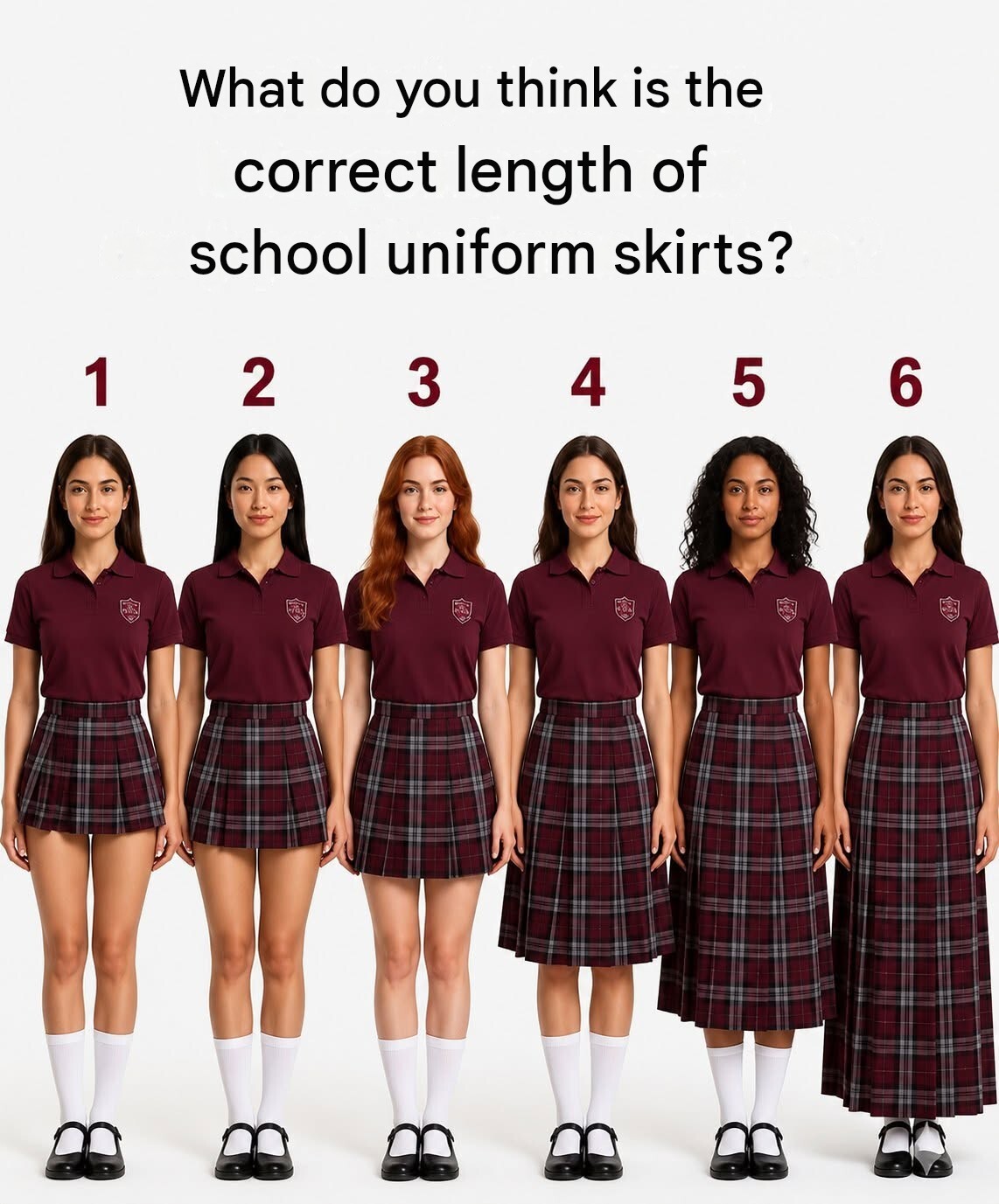
A viral social graphic—headlined “What do you think is the correct length of school uniform skirts?”—presents six side-by-side variations of a classic plaid pleated skirt uniform, ranging from a short mini-skirt (1) to a full ankle-length maxi skirt (6).
While dress codes aim to foster school unity, eliminate peer pressure, and maintain professional learning environments, finding the ideal balance between student comfort, mobility, and decorum varies by culture, climate, and school type.
Here is a full breakdown of the six distinct skirt lengths, standard international dress code guidelines, and why uniform policies matter.
Breakdown of the 6 Uniform Skirt Length Variations
The visual breakdown illustrates how different hemline lengths alter both aesthetics and practicality:
+-----------------------------------------------------------------------------------+
|                        SCHOOL UNIFORM SKIRT LENGTH COMPARISON                     |
+---------------+----------------------------+--------------------------------------+
| Style Option  | Hemline Position           | Common Context & Considerations      |
+---------------+----------------------------+--------------------------------------+
| 1 & 2         | High Thigh (Mini)          | Often seen in pop culture/fashion;    |
|               |                            | rarely meets standard school policy  |
| 3             | Mid-Thigh (Above Knee)     | Common in casual secondary schools;  |
|               |                            | often subject to fingertips policy   |
| 4             | Knee-Length / Below Knee   | Traditional standard across most     |
|               |                            | public and private dress codes       |
| 5             | Mid-Calf (Midi)            | Formal, conservative, or religious   |
|               |                            | educational institutions             |
| 6             | Ankle-Length (Maxi)        | Modest uniform standards / religious |
|               |                            | cultural exemptions                  |
+---------------+----------------------------+--------------------------------------+
1 & 2: High Thigh (Mini Length)
- Visual Profile: Ends well above the mid-thigh.
- Policy Reality: While popular in media, anime, and fashion trends, options 1 and 2 rarely comply with standard school dress codes due to mobility and modesty guidelines during active school environments.
3: Mid-Thigh (3–4 Inches Above the Knee)
- Visual Profile: Sits comfortably on the thigh above the knee.
- Policy Reality: Option 3 is frequently seen in high schools, often evaluated using the common “fingertip rule” (where hemlines must reach past the student’s fingertips when arms are relaxed at their sides).
4: Knee-Length (At or Just Below the Knee)
- Visual Profile: Rest on top of or slightly below the kneecap.
- Policy Reality: Option 4 represents the global standard across the vast majority of public, private, and prep school dress codes, providing a balance between freedom of movement and traditional formality.
5 & 6: Midi to Maxi Length (Mid-Calf to Ankle)
- Visual Profile: Covers the legs down to the shin or ankle.
- Policy Reality: Options 5 and 6 are standard in formal, conservative, or faith-based educational institutions, as well as schools accommodating specific cultural or religious modesty guidelines.
The Financial & Social Impact of Uniform Standards
Standardized school uniform policies carry significant practical benefits for families and school administration:
- Socioeconomic Equality: Uniform regulations eliminate brand-name competition and visible socioeconomic disparities among students, reducing peer pressure and bullying.
- Cost Efficiency for Families: Purchasing dedicated uniform sets is often significantly cheaper than maintaining an extensive everyday wardrobe for the entire school year.
- Focus on Education: Standardized guidelines reduce daily distractions regarding fashion trends, allowing students and teachers to focus primarily on academic learning.
Fascinating Facts About School Uniform History
- Origin of Uniforms: The earliest recorded usage of standardized school uniforms dates back to 16th-century England at Christ’s Hospital School in London (1552), where students wore long blue cloaks.
- Global Diversity: In Japan, sailor-style uniforms (seifuku) became iconic in the 20th century, whereas many Australian and British schools strictly mandate knee-length pleated skirts and blazers year-round.
Conclusion: Finding the Right Balance
While Option 4 (knee-length) remains the most universally accepted standard across educational institutions, the ideal uniform policy prioritizes student comfort, inclusivity, and an environment conducive to learning.
Frequently Asked Questions
Q1: What is the most common school uniform skirt length rule?
A1: Most schools require skirts to be no higher than 2 to 3 inches above the knee (Option 3 or 4) or long enough to touch the kneecap when standing straight.
Q2: What is the “fingertip rule” in school dress codes?
A2: The fingertip rule states that when a student stands with their arms relaxed at their sides, the hemline of their skirt or shorts must extend past the tips of their fingers.
Q3: Why do school dress codes regulate skirt lengths?
A3: Dress code policies aim to maintain a professional academic environment, ensure student comfort and modesty during physical activities, and prevent classroom distractions.
Q4: Are religious exemptions allowed for long skirts in public schools?
A4: Yes. Most educational systems accommodate religious or cultural dress requirements by allowing students to wear longer skirt styles (such as Options 5 and 6) or tailored pants.
Q5: How can students make uniform skirts fit comfortably?
A5: Choosing skirts with adjustable inner waistbands, stretch fabric blends, and pairing them with built-in modest bike shorts or tights ensures both compliance and active comfort throughout the school day.
