
Sensational online stories often pair dramatic kitchen mishaps with misleading advice. Understanding how modern home appliances work helps homeowners separate real safety hazards from viral myths.
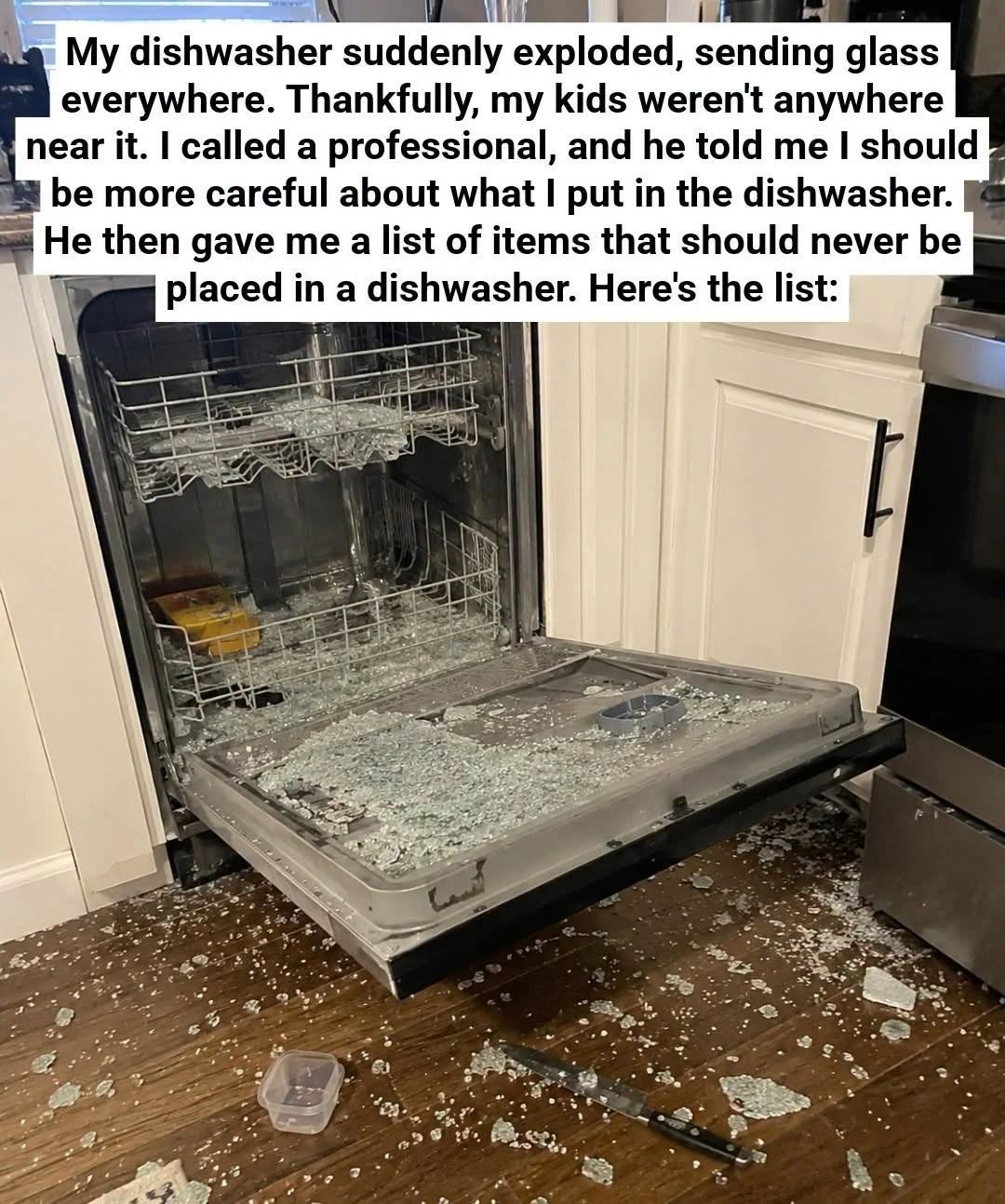
A viral social graphic shows an open dishwasher with a completely shattered glass front door panel, covering the kitchen floor in tiny safety-glass fragments. The overlay text reads: “My dishwasher suddenly exploded, sending glass everywhere. Thankfully, my kids weren’t anywhere near it. I called a professional, and he told me I should be more careful about what I put in the dishwasher. He then gave me a list of items that should never be placed in a dishwasher. Here’s the list:”
While loading improper items like wooden spoons or cast iron can ruin cookware, no dishware item loaded inside a dishwasher can cause the outer glass door panel to spontaneously explode. The shattering is almost always caused by spontaneous failure of the tempered glass door frame itself.
Here is a full breakdown of why dishwasher glass door panels break, items that genuinely shouldn’t go in a dishwasher, and appliance safety guidelines.
The Real Science Behind “Exploding” Tempered Glass Doors
+-----------------------------------------------------------------------------------+
|                     TEMPERED GLASS SHATTERING CAUSES OVERVIEW                     |
+-------------------+----------------------------+----------------------------------+
| Cause Factor      | Physical Mechanism         | Prevention & Identification      |
+-------------------+----------------------------+----------------------------------+
| Mechanical Impact | Micro-cracks from impacts  | Avoid slamming appliance doors or|
| Edge Damage       | weaken internal tension    | hitting glass edges with pots    |
| Thermal Expansion | Extreme temperature shifts | Ensure proper door ventilation & |
| Stress            | create rapid expansion     | avoid blocking front air vents   |
| Nickel Sulfide    | Microscopic manufacturing  | Rare spontaneous glass failure   |
| Inclusions        | impurities expand over time| covered under warranty service   |
+-------------------+----------------------------+----------------------------------+
1. Spontaneous Tempered Glass Spallation
Modern glass-fronted dishwashers and oven doors use tempered safety glass. Tempered glass is manufactured under extreme surface compression and internal tension, making it four to five times stronger than standard glass. However, if the outer edge receives a tiny, unnoticeable chip or scratch—or if microscopic nickel sulfide ($NiS$) inclusions exist from manufacturing—the internal stress can release suddenly, causing the entire panel to crumble into small, blunt granules.
2. Thermal Shock and Rapid Temperature Spikes
Dishwashers run high-temperature wash cycles followed by heated dry cycles. If a room is extremely cold or if a cold liquid strikes an overheated, micro-damaged tempered glass surface, thermal expansion stress can trigger a sudden fracture.
Items You ACTUALLY Should Never Put in a Dishwasher
While improper loading won’t shatter the glass door, certain items should be hand-washed to avoid damaging the items themselves or clogging the dishwasher pump:
- Cast Iron Skillets: High heat and harsh detergent strip away the protective polymerized oil seasoning, leading to immediate surface rust.
- Sharp Chef’s Knives: High-water-pressure jets bang knife edges against racks, dulling sharp blades. Additionally, harsh detergents pit high-carbon steel.
- Wooden Utensils and Cutting Boards: Soaking in hot water causes wood fibers to swell, warp, split, and harbor bacteria.
- Non-Stick Cookware: High wash temperatures and abrasive detergent salts degrade Teflon and ceramic non-stick coatings over time.
- Crystal and Fine Lead Glass: Strong wash jets can cause delicate stemware to chime together and crack, while heat causes permanent surface etching (cloudiness).
- Copper and Insulated Travel Mugs: Copper oxidizes and tarnishes rapidly, while dishwasher heat destroys the vacuum seal in insulated stainless steel tumblers.
Financial Impact: Appliance Warranties and Repairs
Handling glass panel damage cost-effectively:
- Checking Manufacturer Warranties: Spontaneous glass breakage due to tempered glass defects is often covered under manufacturer appliance warranties within the first 1 to 3 years.
- DIY Glass Replacement vs. Full Appliance Replacement: Replacing a shattered outer glass door panel typically costs between $100 and $250 for parts, which is far more economical than purchasing a new $800+ dishwasher unit.
Fascinating Facts About Safety Glass Physics
- Dicronite and Granular Shattering: Tempered glass is engineered specifically to fragment into tiny, blunt-edged cubes rather than sharp, jagged shards, drastically reducing the risk of severe laceration injuries during an accidental break.
- The “Dice” Pattern: The characteristic pebbled fracture pattern seen on shattered dishwasher doors and car side windows is called dice fragmentation, created by locked-in surface tension during rapid air-quenching fabrication.
Conclusion: Fact vs. Fiction in Kitchen Safety
A shattered dishwasher glass door is a scary event, but it is caused by tempered glass tension release or prior impact damage—not by placing the wrong bowl or cup on the top rack. Knowing what actually belongs in your appliance protects both your cookware and your kitchen peace of mind.
Frequently Asked Questions
Q1: Can items loaded inside a dishwasher cause the outer glass door to explode?
A1: No. Loading improper cookware might ruin the item or clog the filter, but it cannot exert the physical force required to shatter an external tempered glass panel.
Q2: Why did my dishwasher glass door shatter out of nowhere?
A2: Tempered glass doors shatter when microscopic edge damage, thermal stress from hot wash cycles, or factory impurities release internal structural tension.
Q3: Is the glass from a shattered dishwasher dangerous?
A3: Tempered safety glass breaks into rounded, blunt granules rather than large razor-sharp shards, making severe cuts far less likely, though care should still be taken during cleanup.
Q4: How should you safely clean up shattered tempered glass?
A4: Wear thick shoes and gloves, sweep up larger granules with a broom, and use a damp paper towel or vacuum with a hose attachment to pick up tiny glass dust particles.
Q5: Can you continue running a dishwasher if the outer glass breaks?
A5: No. The glass door panel provides structural weight, insulation, and moisture protection for internal electrical wiring. Stop using the unit until the panel is replaced.
