
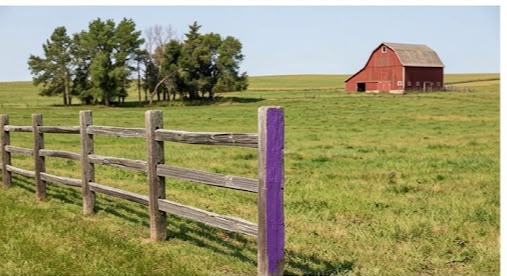
When traveling past rural farmland, country pastures, or homestead boundaries, you may notice wooden fence posts painted with bright purple stripes. While it might look like a casual decorative touch, purple paint on farm boundaries serves a critical, legally binding purpose across over 20 states.
In participating jurisdictions, a purple fence post serves as an official “No Trespassing” sign. Understanding the legal meaning, landowner benefits, and property rules surrounding purple paint helps travelers, hunters, and rural landowners stay informed.
In this guide, we will break down what purple farm fence posts signify, explore how Purple Paint Laws function, examine why farmers prefer paint over signs, and share essential boundary guidelines.
What Does Purple Paint on a Farm Fence Post Signify?
Under state “Purple Paint Laws,” vertical purple marks painted on boundary posts or fences legally serve as the equivalent of a posted “No Trespassing” or “No Hunting” sign.
1. Legally Recognized Private Property Notice
- Prohibited Entry: Purple paint signals to travelers, hunters, and anglers that the land beyond the fence line is private property and unauthorized access is prohibited by law.
- Full Legal Authority: In participating states, purple paint holds the exact same judicial weight as physical plastic or metal “No Trespassing” signs in court.
2. High-Visibility Boundary Indicator
Purple was selected by state lawmakers because it stands out starkly against green pastures, brown soil, and natural wooden fence posts, making it easily distinguishable at a distance.
Why Farmers and Landowners Prefer Purple Paint over Signs
Rural property owners and farmers choose purple paint over traditional metal or plastic signs for several practical reasons:
- Weather and Sun Resistance: Physical signs frequently rust, fade, tear, or blow away in high winds. Quality outdoor paint stays bright and visible on wooden or metal posts for years.
- Cost-Effective Coverage: Marking long farm perimeters with spray paint or exterior latex paint is significantly cheaper than buying dozens of heavy-duty metal signs.
- Protection Against Theft and Vandalism: Signs posted along remote property lines are often stolen or torn down by trespassers. Paint cannot be easily removed or stolen, ensuring uninterrupted legal protection.
Standard Legal Guidelines for Purple Fence Markings
State statutes outline specific requirements for marking fence posts along property perimeters:
- Vertical Line Dimensions: Paint marks must usually be vertical stripes measuring at least 8 inches long and 1 inch wide.
- Eye-Level Placement: Marks must be placed between 3 feet and 5 feet above the ground so they are clearly visible from outside the property line.
- Regular Spacing: Paint lines along farm fences are generally spaced no more than 100 feet apart in open pastures or farm fields.
Conclusion
Purple paint on a farm fence post is a legally binding notice indicating private property and “No Trespassing.” Recognizing these markings ensures you respect land boundaries, avoid accidental trespass violations, and stay safe while traveling through rural areas.
Frequently Asked Questions (FAQ)
What states recognize Purple Paint Laws?
Over 22 U.S. states have enacted Purple Paint Laws, including Texas, Arkansas, Missouri, Florida, Illinois, Indiana, Kansas, Maine, North Carolina, Pennsylvania, and Tennessee, among others.
Does purple paint on a farm fence mean no hunting?
Yes. Purple paint signifies no trespassing for any unauthorized purpose, including hunting, fishing, forage harvesting, camping, or motorized vehicle access.
How often do landowners need to reapply purple paint?
High-quality exterior fence paint typically lasts between 3 to 5 years before requiring a touch-up, depending on weather conditions and sun exposure.
