
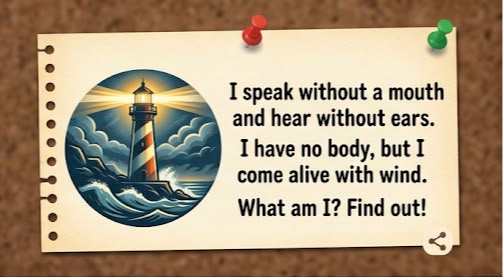
Classic riddles have a unique way of challenging our perception by using poetic imagery and personification. One of the most famous and enduring brain teasers asks: “I speak without a mouth and hear without ears. I have no body, but I come alive with wind. What am I?”
This riddle uses clever metaphors to describe a natural physical phenomenon that everyone has experienced.
In this guide, we will reveal the answer, break down the logic behind each line, explore similar popular riddles, and examine why solving riddles benefits mental agility.
What Is the Answer to the Riddle?
The answer to this classic brain teaser is an echo.
Decoding the Riddle Line by Line
- “I speak without a mouth…”
- An echo repeats words and sounds back into the air, creating the illusion of speech without needing physical vocal cords or a mouth.
- “…and hear without ears.”
- An echo “responds” directly to whatever sound or voice reaches it, acting as though it listened to the original sound without possessing biological ears.
- “I have no body…”
- An echo is purely an acoustic wave traveling through space—it has no physical form or tangible presence.
- “…but I come alive with wind.”
- Sound waves travel through air (wind), and atmospheric conditions like wind currents carry and amplify echoes across valleys, canyons, and open spaces.
The Science of Echoes: How Acoustic Reflections Work
An echo occurs due to the fundamental physics of sound:
- Sound Wave Reflection: When sound waves hit a hard, distant surface—such as a cliff face, cave wall, or large building—they bounce back toward the source.
- Time Delay: If the reflecting surface is far enough away (typically over 50 feet), the human ear perceives the reflected sound as a distinct, repeated audio signal rather than a simple reverberation.
Why Classic Riddles Remain Popular
Puzzles like the echo riddle continue to captivate audiences across social media and digital platforms for several reasons:
- Poetic Imagery: The riddle turns a scientific wave behavior into a mysterious character with human-like traits.
- Critical Thinking: Solvers must shift from literal interpretations to metaphorical thinking to find the solution.
- Brain Health: Engaging with word puzzles stimulates problem-solving pathways, improving focus and cognitive sharpness.
Conclusion
The “echo” riddle is a timeless brain teaser that blends physics with poetic personification. Next time you hear your voice bounce off a canyon wall, you’ll appreciate the science behind this classic puzzle!
Frequently Asked Questions (FAQ)
What is the origin of the echo riddle?
This puzzle is an ancient traditional riddle found in various forms across global folklore and literature, popularized over centuries through storytelling and riddle books.
Where can you experience the clearest echoes in nature?
The clearest natural echoes occur in canyons, mountain valleys, rocky caverns, and against tall, smooth concrete or stone walls.
What is the difference between an echo and reverberation?
An echo is a distinct, delayed repetition of a sound reflected from a distant surface, whereas reverberation is a continuous blending of sound reflections occurring in close spaces.
