
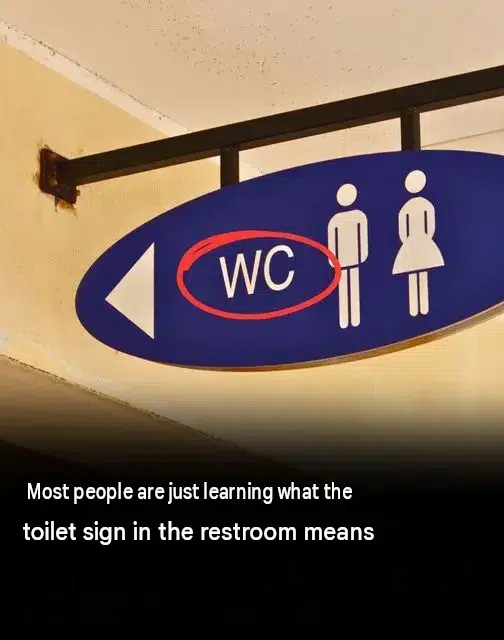
Public signage is a seamless part of daily life. From highway directions to exit signs, symbols and acronyms guide us effortlessly through unfamiliar buildings, airports, and restaurants. Among the most universally recognized abbreviations in the world is “WC,” found on restroom doors and directional signs across the globe.
While almost everyone instantly recognizes that the letters “WC” point toward the restrooms, a surprising number of people do not know what the acronym actually stands for or where it originated. In an era where modern English terms like “restroom” or “toilet” dominate, the traditional British term remains a fascinating linguistic relic.
In this comprehensive guide, we will explore the true meaning behind the “WC” sign, the history of indoor plumbing and sanitation terminology, and practical insights into travel, language, and public facility navigation.
The Origins of “WC”: Water Closet
The letters WC stand for Water Closet.
The term originated in 19th-century Britain during the early days of modern indoor plumbing development. Before plumbed indoor bathrooms became standard, sanitation facilities were typically outhouses or chamber pots. When indoor flushing toilets were first invented and installed inside residential and public buildings, they were compact, small separate rooms containing a flushing basin connected to a water supply pipe.
To distinguish these modern, water-supplied sanitation rooms from dry earth closets or outdoor privies, builders and architects referred to them as “water closets.” While the term largely faded from everyday American vocabulary in favor of “restroom,” “bathroom,” or “toilet,” it remained a staple standard across Europe, international travel hubs, and global signage.
10 Facts About Public Restrooms and Signage
1. International Universal Symbols
Beyond letters, modern restroom signs rely heavily on universal iconography—such as geometric figures or simplified silhouettes—to transcend language barriers for international travelers.
2. The Evolution of Sanitation
The invention of the water closet revolutionized public health by drastically reducing water-borne diseases and improving urban hygiene standards during the Industrial Revolution.
3. Accessibility Standards (ADA)
Public restrooms are legally required to feature clear, high-contrast signage complete with Braille lettering to ensure accessibility for individuals with visual impairments.
4. Gender-Neutral Restroom Designs
Many modern public facilities are shifting toward single-occupancy, gender-neutral restroom designations to maximize inclusivity and efficiency.
5. The Influence of Victorian Plumbing
Victorian-era engineers pioneered the trap-pipe systems and S-bends used in modern water closets to prevent sewer gases from entering living spaces.
6. Travel and Language Adaptations
International travelers quickly learn that recognizing “WC” is a universal key to locating essential facilities, regardless of whether the local language is French, German, Spanish, or English.
7. Maintenance and Hygiene Standards
High-traffic public restrooms require rigorous cleaning schedules, touchless fixtures, and proper ventilation to maintain optimal hygiene.
8. Financial and Business Considerations
Providing clean, well-marked public restrooms is a crucial factor for customer satisfaction and business retention in hospitality, retail, and travel industries.
9. Smart Restroom Technology
Modern commercial buildings increasingly utilize smart sensors to monitor water usage, track paper towel supplies, and automate cleaning cycles.
10. Cultural Differences in Restroom Etiquette
Customs surrounding public restrooms vary significantly across different cultures, making clear, universal signage like “WC” an invaluable global standard.
Comparison: Terminology Across Regions
To better understand how bathroom terminology varies around the world, review the following comparison table:
| Region / Country | Common Term Used | Signage Abbreviation |
| United Kingdom & Europe | Water Closet / Toilet | WC |
| United States & Canada | Restroom / Bathroom | Restroom / Men / Women |
| Australia & New Zealand | Toilet / Dunny | Toilets |
| International Airports | Restroom / Facilities | WC / Universal Symbols |
       ┌────────────────────────────────────────────────────────┐
       │     Encountering Public Signage & Finding Facilities   │
       └───────────────────────────┬────────────────────────────┘
                                   │
                                   ▼
       ┌────────────────────────────────────────────────────────┐
       │      Understanding "WC" (Water Closet) History         │
       └───────────────────────────┬────────────────────────────┘
                                   │
                    ┌──────────────┴──────────────┐
                    ▼                             ▼
       ┌────────────────────────┐    ┌────────────────────────┐
       │ Navigating Global Travel│    │ Appreciating Modern    │
       │ & International Spaces │    │ Plumbing & Sanitation  │
       └────────────────────────┘    └────────────────────────┘
Practical Tips for International Travel and Navigation
When traveling abroad, knowing local signage conventions ensures smooth navigation:
- Learn Basic International Symbols: Familiarize yourself with global acronyms like “WC” and universal pictograms to locate essential amenities quickly.
- Keep Essentials Handy: Carry travel tissues and hand sanitizer, as some public facilities abroad may not always provide them.
- Respect Local Etiquette: Observe local customs regarding queueing, tipping restroom attendants, and maintaining cleanliness in public spaces.
Fascinating Facts About Plumbing History
- The First Flush Valve: Invented in 1596 by Sir John Harington for Queen Elizabeth I, though it took over two centuries for the invention to become widely adopted.
- Thomas Crapper: Often mistakenly credited with inventing the toilet, Crapper was actually a prominent 19th-century sanitary engineer who popularized plumbing products and showroom displays in London.
- Water Conservation: Modern water closets feature dual-flush mechanisms, allowing users to choose between partial and full flushes to conserve water resources.
Frequently Asked Questions (FAQ)
What does “WC” actually stand for?
“WC” stands for Water Closet, a historical term originating in 19th-century Britain to describe a room containing a flushing toilet connected to a water supply.
Why is “WC” used instead of “Restroom” in Europe?
The term became the standard European shorthand for sanitation facilities during the development of indoor plumbing and remains widely understood across multiple languages.
Are “WC” signs still installed in modern buildings?
Yes, “WC” remains a standard international abbreviation used on architectural plans, public building directories, and directional signs worldwide.
Conclusion: A Global Sign with Deep Roots
The next time you see a “WC” sign pointing down a corridor, you’ll know the fascinating history behind those two little letters. From Victorian engineering breakthroughs to modern international travel, the water closet remains one of the most important innovations in human history!
