
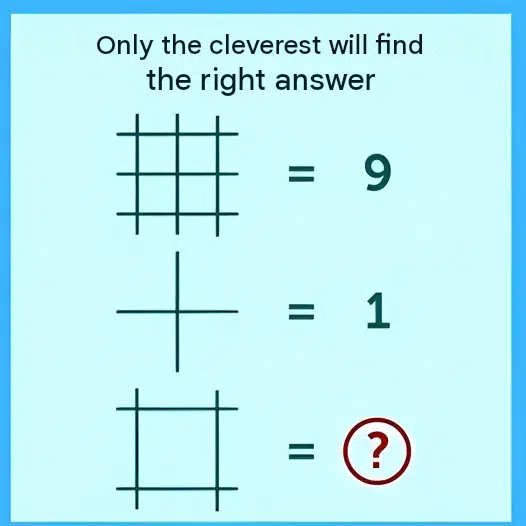
In the digital age, viral riddles and visual math puzzles have become a massive phenomenon across social media networks. These brain teasers challenge our cognitive flexibility, forcing us to look past superficial appearances and discover hidden mathematical patterns. The clever puzzle presented above is a prime example of how simple geometric lines can conceal a surprisingly elegant logical rule.
At first glance, many viewers jump to conclusions, counting squares, line segments, or guessing randomly. However, arriving at the correct answer requires careful observation and precise pattern recognition. In this comprehensive guide, we will break down the exact solution to this viral puzzle, explore the underlying mathematics of geometric intersections, discuss the cognitive benefits of brain teasers, and examine how analytical problem-solving skills translate into professional fields like Education, Technology, Finance, and Investment.
Breaking Down the Puzzle: Step-by-Step Analysis
To solve this visual riddle correctly, we must examine the relationship between the visual elements on the left side of each equation and the numerical values on the right.
Equation 1: The Grid
- Visual Element: A grid formed by three horizontal lines and three vertical lines intersecting each other.
- Result: Equals 9.
- The Logic: If you count the points where the horizontal lines cross the vertical lines, you will find 3 rows of 3 intersection points, totaling 9 intersections ($3 \times 3 = 9$).
Equation 2: The Single Cross
- Visual Element: One horizontal line intersecting one vertical line to form a simple cross.
- Result: Equals 1.
- The Logic: There is exactly 1 point where the horizontal line crosses the vertical line ($1 \times 1 = 1$).
Equation 3: The Target Question
- Visual Element: Two horizontal lines crossed by two vertical lines forming an open framework.
- Result: ? (The missing answer).
- The Logic: Following the established rule of counting intersection points, we have two horizontal lines intersecting two vertical lines. This creates a $2 \times 2$ grid of intersections, resulting in 4 intersection points.
The Correct Answer is 4!
The Core Mathematical Concept: Geometry and Intersections
This puzzle is a brilliant exercise in combinatorial geometry and topology. Instead of focusing on area, perimeter, or enclosed shapes (like counting the single large square in the final figure), the puzzle tests whether the solver can isolate a specific property: intersection nodes.
Why Most People Get It Wrong
Human brains are naturally wired to recognize whole objects, such as squares and rectangles. When looking at the third figure, the eye immediately registers an empty square or frame, leading people to guess “1” (one square) or “0” (no filled space).
This psychological bias demonstrates why critical thinking and attention to detail are so valuable. True analytical reasoning requires stripping away distractions to focus purely on the governing rules of a system.
The Cognitive Benefits of Solving Daily Puzzles
Engaging with math riddles, visual puzzles, and logic games on a regular basis offers profound benefits for brain health and cognitive longevity.
1. Enhancing Neuroplasticity
Challenging your mind with novel problems stimulates neural pathways, encouraging the brain to adapt, form new connections, and maintain cognitive flexibility as you age.
2. Improving Working Memory
Puzzles require you to hold multiple rules in your head simultaneously—such as remembering how the first equation was solved while analyzing the second and third equations. This actively strengthens short-term working memory.
3. Stress Reduction and Focus
Diving into a captivating puzzle provides a healthy mental escape, shifting your focus away from daily stressors and into a state of engaged concentration.
Practical Applications of Analytical Problem-Solving
While a geometric puzzle is fun for entertainment, the underlying analytical skills are directly applicable to high-value professional sectors.
Technology and Software Engineering
Programmers and software developers rely heavily on pattern recognition, logical deduction, and systematic rule-following to debug complex code and build efficient algorithms.
Finance, Investment, and Business Strategy
In Finance and Investment, analysts must look past surface-level market noise to identify core underlying metrics. Just as this puzzle requires isolating intersection points from surrounding lines, financial experts isolate key economic indicators to forecast trends and manage risk.
Legal Services and Risk Management
Professionals in Legal Services analyze intricate contracts, case laws, and evidentiary patterns. Spotting subtle inconsistencies or hidden rules requires the exact same meticulous attention to detail practiced in solving logical brain teasers.
Tips for Solving Visual Math Riddles Faster
If you want to sharpen your problem-solving speed when tackling viral puzzles online, keep these strategies in mind:
- Test Multiple Hypotheses: If counting squares doesn’t work, test other geometric properties like line intersections, endpoints, enclosed regions, or symmetry.
- Compare Constants: Look closely at what changes between the first example and the final question to isolate the variable being tested.
- Avoid Rushing: Take a few seconds to verify your count before jumping to conclusions.
Interesting Facts About Puzzles and Mathematics
- Ancient Roots: Mathematical puzzles date back thousands of years. The Rhind Mathematical Papyrus from ancient Egypt contains some of the earliest recorded word problems and riddles designed to test intellect.
- Graph Theory: The study of points (vertices) and connecting lines (edges)—like the intersections in this puzzle—forms the foundation of a major branch of mathematics called Graph Theory, which is used today to map internet networks and social media connections.
- The Power of Viral Logic: Puzzles that seem simple often generate the highest social media engagement because they bridge generational gaps, inviting everyone from students to retirees to test their wits.
Conclusion
The geometric intersection puzzle is a fantastic reminder of how perspective changes everything. What looks like an empty square at first glance is actually a matrix of intersecting lines totaling 4 intersection points.
Sharing and solving these brain teasers is a wonderful way to keep your mind sharp, spark lively discussions with friends, and appreciate the underlying logic of mathematics in everyday life!
Frequently Asked Questions (FAQ)
Why doesn’t the final figure equal 1 because it’s a square?
The puzzle does not measure the number of enclosed shapes or squares. The governing rule established by the first two equations is to count the exact number of line intersection points. Therefore, two horizontal and two vertical lines yield 4 intersections.
Are visual puzzles good for children’s development?
Yes! Visual puzzles help children develop spatial awareness, pattern recognition, patience, and foundational geometry skills in an engaging, low-pressure format.
How can I find more puzzles like this to test my brain?
You can explore logic puzzle books, mathematical recreational websites, or follow viral puzzle communities online that specialize in daily optical illusions and brain teasers.
