
In an era dominated by digital distractions, keeping our minds sharp through logic puzzles, mathematical riddles, and brain teasers has become more than just a pastime—it is an essential cognitive workout. Whether you are balancing household accounts, evaluating long-term Investment portfolios, navigating complex Business strategies, or preparing for advanced Education, structured thinking and numerical fluency are indispensable skills.
Puzzles like geometric grid challenges, algebraic riddles, and spatial reasoning tests force our brains to look beyond surface-level appearances. By deconstructing visual problems into fundamental rules, we enhance our problem-solving capabilities, boost working memory, and sharpen our overall mental agility. In this comprehensive guide, we will explore the psychology of puzzle-solving, the history of mathematical logic, and practical ways to integrate brain training into your daily routine.
The Cognitive Science Behind Mathematical Puzzles
When presented with a visual equation or grid puzzle, the human brain engages in several layers of cognitive processing simultaneously. Understanding how these processes work can help you approach complex problems with greater confidence and speed.
Pattern Recognition and Logical Deduction
The human brain is an organic pattern-matching machine. From an evolutionary standpoint, recognizing patterns allowed early humans to track prey, predict weather shifts, and identify hazards. In modern contexts, pattern recognition is the cornerstone of mathematics, Technology, and analytical Legal Services.
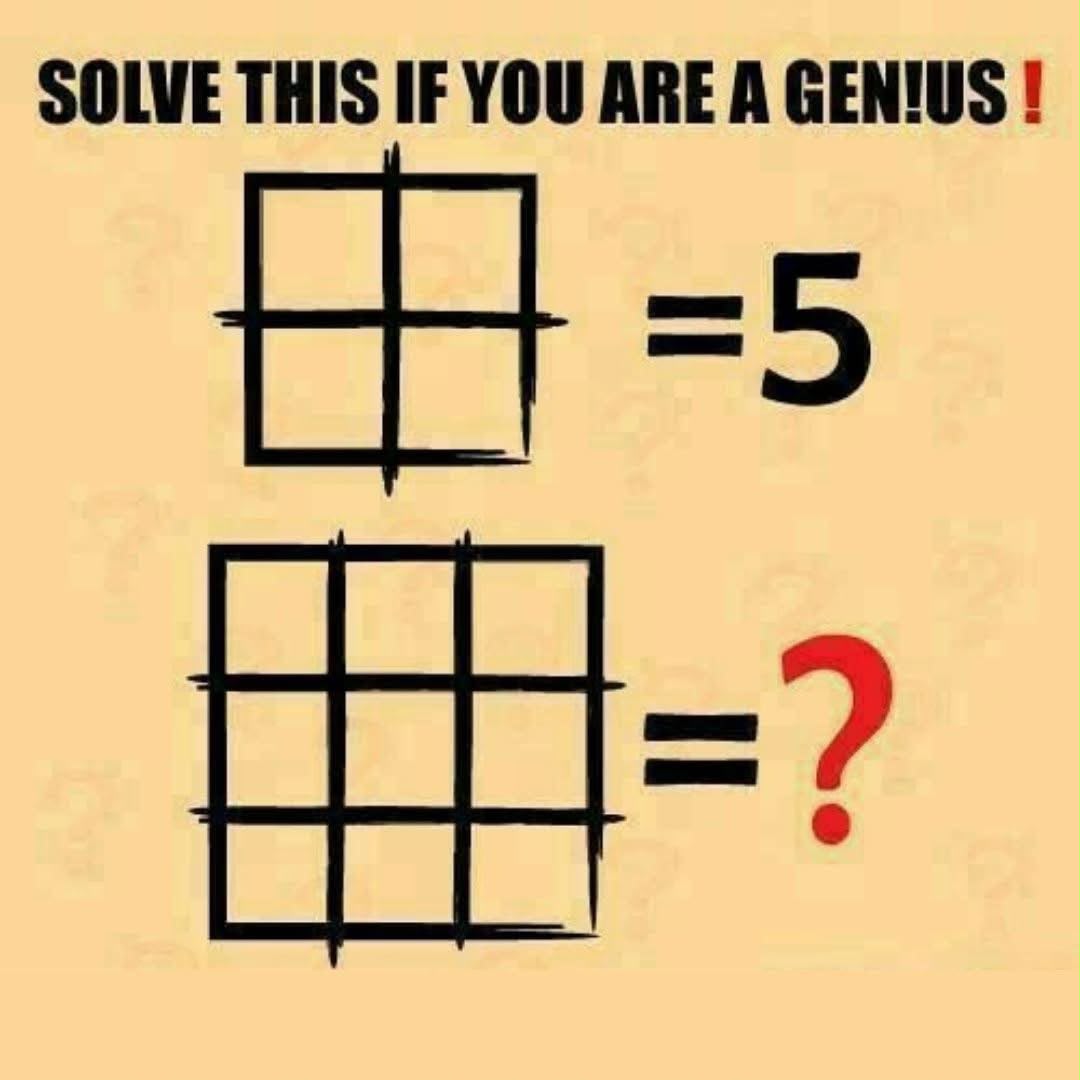
- Inductive Reasoning: Observing specific examples within a puzzle (such as a 2×2 grid equalling a specific number) to form a broader rule or hypothesis.
- Deductive Reasoning: Applying that established rule to a new scenario (such as a 3×3 or 4×4 grid) to arrive at the correct solution.
- Spatial Working Memory: The ability to mentally manipulate shapes, count intersecting lines, and visualize geometric sub-components without losing track of the main objective.
Grid Puzzles and Counting Mechanics: How They Work
Geometric grid puzzles often appear deceptively simple. A standard square grid intersected by gridlines can represent various mathematical quantities depending on the specific rule being tested—such as counting individual squares, calculating intersecting vertices, or evaluating combinatorial matrices.
Analytical Breakdown of Grid Puzzles
| Grid Type | Primary Components | Common Puzzle Rules | Target Application |
| 2×2 Grid (4 cells) | 4 small squares, 1 large outer square, intersecting lines | Counting total geometric shapes ($4 + 1 = 5$) | Quick logic assessment |
| 3×3 Grid (9 cells) | 9 small squares, 4 medium squares, 1 large square, etc. | Advanced sub-grid combinations and matrix counting | Deep analytical reasoning |
| Custom Matrices | Variable rows and columns | Multi-layered algebraic or geometric sequences | Competitive aptitude testing |
When evaluating puzzles, experts recommend breaking down the composite shapes rather than guessing blindly. Much like an Attorney reviewing a complex contract clause or a financial analyst evaluating a Mortgage amortization schedule, attention to fine detail ensures absolute accuracy.
The Practical Benefits of Daily Brain Training
Just as physical exercise builds muscle tone and cardiovascular endurance, regular mental exercise strengthens neural pathways. Engaging in daily puzzles offers numerous psychological and professional benefits:
- Enhanced Problem-Solving Speed: Regularly tackling lateral thinking puzzles trains your brain to pivot quickly when encountering unexpected roadblocks at work or in daily projects.
- Stress Reduction: Concentrating on a structured puzzle acts as a form of active meditation, pulling your focus away from daily stressors like Insurance paperwork, upcoming Loan deadlines, or general Health anxieties.
- Improved Memory Retention: Logic exercises stimulate neuroplasticity, helping to maintain sharp memory and cognitive vitality as you age toward Retirement.
- Heightened Focus: In a world of constant notifications, sitting down to solve a challenging riddle rebuilds your attention span and deep-work capacity.
Interesting Facts About Mathematics and Puzzles
- Ancient Origins: Mathematical puzzles date back thousands of years. The Rhind Mathematical Papyrus from ancient Egypt contains arithmetic and geometric riddles used for training scribes.
- The Power of Visual Math: Studies show that visual puzzles activate both the left hemisphere (logical and analytical) and the right hemisphere (creative and spatial) of the brain simultaneously.
- Brain Plasticity: Neuroscientists have proven that adult brains can continue to grow new neurons and strengthen synaptic connections through challenging cognitive activities like puzzles and strategy games.
Conclusion
Mathematical puzzles and visual logic tests are much more than viral internet trends; they are powerful tools for keeping our minds agile, creative, and resilient. By cultivating a habit of daily problem-solving, you enhance your analytical skills across all areas of life—whether you are managing personal finances, pursuing professional Education, or simply enjoying a relaxing mental challenge. Keep questioning, keep solving, and embrace the lifelong journey of cognitive growth.
Frequently Asked Questions (FAQ)
1. How do grid-counting puzzles actually work?
Grid puzzles typically require counting all possible geometric formations within the figure—including individual small squares, medium grouped squares, and the large outer boundary—following a consistent mathematical rule.
2. Can doing brain puzzles improve my daily productivity?
Yes. Regular engagement with logic puzzles enhances working memory, speeds up decision-making processes, and improves your ability to focus on complex, multi-step tasks.
3. Are mathematical puzzles beneficial for older adults?
Absolutely. Engaging in mental exercises and number riddles stimulates neuroplasticity, helping to preserve cognitive function, memory, and mental sharpness over time.
