
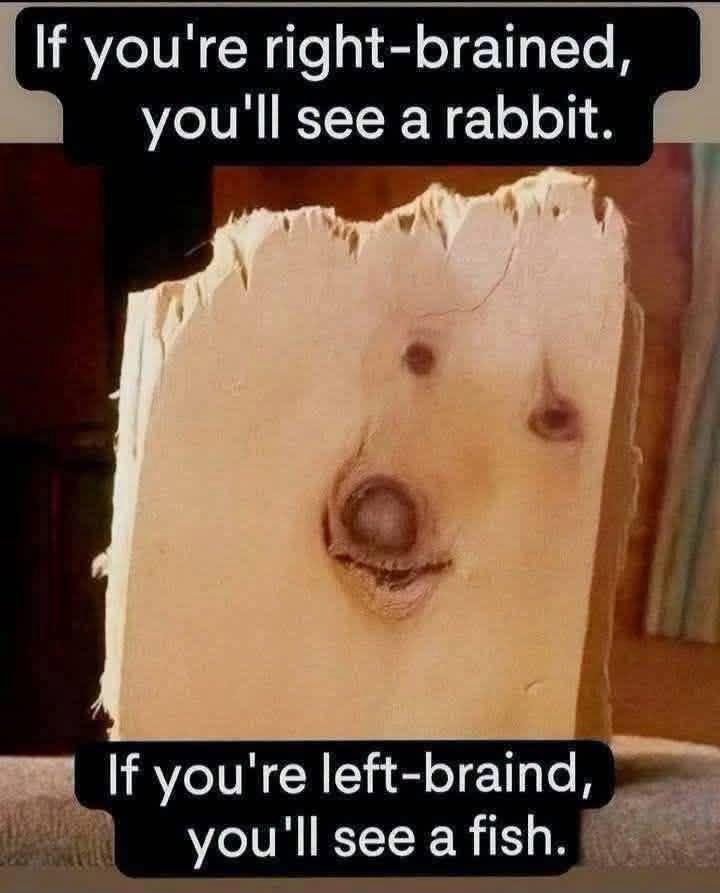
Viral brain teasers claiming that seeing specific shapes in an image determines whether you are “right-brained” or “left-brained” are wildly popular across social media. The optical illusion featuring a piece of wood grain often asks viewers if they see a rabbit or a fish. However, most people immediately spot something else entirely: the uncanny face of a dog (specifically a Golden Retriever or Labrador) formed by natural wood knots and grain patterns.
Understanding the phenomenon of pareidolia, debunking common myths about left-brain versus right-brain dominance, and recognizing how cognitive health supports visual perception can help you appreciate how your brain interprets the world.
What Is Pareidolia? The Science Behind Seeing Faces
The reason millions of people instantly perceive a dog’s face in a simple piece of wood comes down to a well-documented neurological trait called pareidolia.
1. Evolutionary Brain Hardwiring
Human visual processing is evolutionary wired to detect faces in everyday environments. The visual cortex processes facial features—eyes, nose, and mouth—in fractions of a second, helping humans quickly identify social cues, emotions, and potential threats.
2. Pattern Recognition and Wood Knots
In this visual illusion, dark circular knots in the wood align perfectly with the positions of eyes and a snout, while light shading mimics the contours of a dog’s muzzle. Your brain automatically fills in the missing details to complete the image of a face.
Debunking the Left-Brain vs. Right-Brain Myth
Social media captions often claim that seeing certain shapes proves right-brain creativity or left-brain logic. However, modern neuroscience shows that visual perception is far more complex.
1. Integrated Brain Hemisphere Activity
While certain functions are localized, the human brain works as an integrated network. Complex visual processing, spatial awareness, and face detection involve both the left and right hemispheres communicating simultaneously through the corpus callosum.
2. Suggestion and Priming
Viral posts use text captions (“If you’re right-brained, you’ll see a rabbit”) to prime your mind. Mentioning animals tricks your visual search mechanisms into looking for features that resemble rabbits or fish, creating a funny contrast when the brain instantly identifies a dog instead.
Vision Care, Cognitive Wellness, and Insurance Benefits
How clearly and quickly you process visual details relies on both optimal optical clarity and healthy brain function.
Visual Health and Comprehensive Eye Exams
Experiencing frequent eye fatigue, difficulty focusing on digital images, or visual distortions can indicate routine vision changes. Standard health and vision insurance plans cover annual comprehensive eye exams to verify visual clarity and check for underlying ocular conditions.
Supporting Cognitive Health
Engaging in visual puzzles, reading, and spatial games stimulates neural pathways and supports cognitive reserve. If you notice sudden changes in visual perception or spatial awareness, consulting a physician ensures early medical evaluation.
Practical Tips for Improving Visual Focus
- Practice Scanning Techniques: When viewing optical illusions, tilt your screen or alter your viewing angle to observe how light and shadow change pattern perception.
- Reduce Screen Glare: Maintain adequate ambient room lighting and adjust display contrast to prevent eye strain during digital puzzle-solving.
- Follow the 20-20-20 Rule: Take a 20-second break every 20 minutes by looking at an object 20 feet away to relax visual muscles.
Frequently Asked Questions (FAQ)
What do most people actually see in the piece of wood image?
Although the text mentions a rabbit or a fish, the vast majority of viewers instantly recognize a dog’s face formed by the dark knots and wood grain.
Does seeing a face in an object mean you are right-brained?
No. Pareidolia is a universal human visual trait, not an indicator of right-brain or left-brain dominance.
Does vision insurance cover routine eye exams?
Yes. Most standard vision insurance plans cover annual eye examinations and provide coverage for prescription lenses and frames.
