
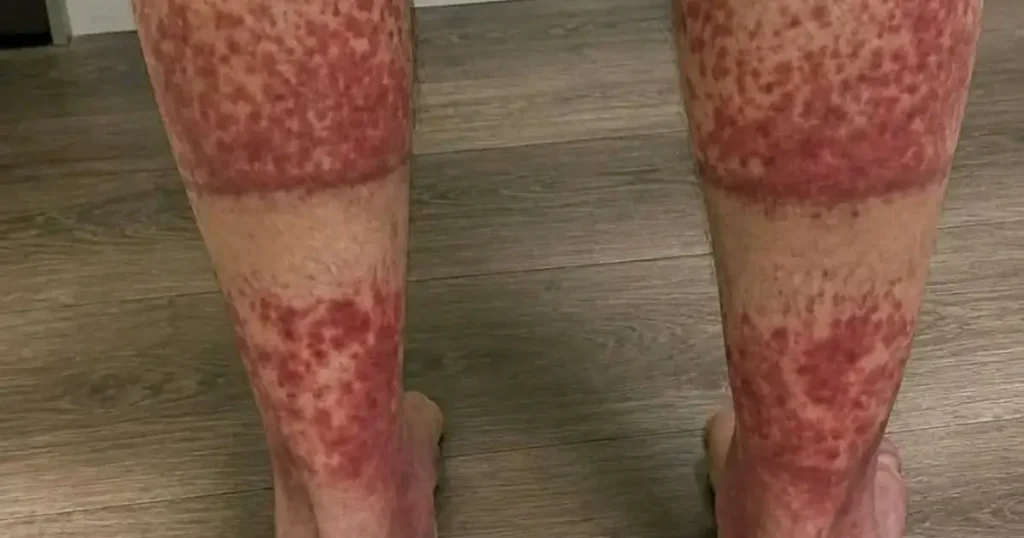
At first glance, the changes in the legs shown in this image can look alarming. The lower legs are covered with numerous reddish-purple spots and patches, with some areas appearing darker and more concentrated than others. The changes are visible on both legs, particularly around the calves and lower legs.
A photograph alone cannot determine exactly what caused these skin changes. However, a widespread red or purple rash on the legs can have many possible explanations, ranging from relatively minor skin irritation to conditions that require medical evaluation. why an unusual rash that appears suddenly, spreads, persists, or is accompanied by other symptoms should not simply be dismissed as “just a skin problem.”

What Are Those Red and Purple Spots?
One important question doctors ask when evaluating a rash like this is whether the redness is actually caused by inflammation in the skin or by blood or blood products beneath the skin.
Some red or purple spots can represent petechiae or purpura—small areas of bleeding under the skin.
Unlike ordinary redness caused by irritation, these spots may not disappear when pressure is applied to the skin.
There are many possible reasons for petechiae or purpura, including problems involving blood vessels, platelets, medications, infections, inflammation, or other medical conditions.
However, the appearance of spots in a photograph is not enough to establish that they are petechiae or purpura.
Other skin conditions can produce similar colors and patterns.
That distinction is important because treatment depends entirely on the underlying cause.
Why Does the Rash Appear So Strongly on the Lower Legs?
The lower legs are a common
That is location for several types of skin and vascular conditions.
Gravity plays an important role in circulation.
Blood returning from the legs has to travel upward toward the heart, and the veins, surrounding muscles, and valves work together to help accomplish this.
Problems affecting circulation can sometimes produce changes in the skin around the ankles and lower legs.
For example, chronic venous insufficiency can contribute to swelling, aching, itching, skin discoloration, and other changes around the lower legs.
But that is only one possibility.
A rash affecting both legs could also be related to inflammation, an allergic or medication reaction, infection, bleeding beneath the skin, or another dermatological condition.
Possible Causes of Red or Purple Spots on the Legs
1. Skin Irritation or Contact Dermatitis
Sometimes the cause is relatively straightforward.
A new soap, detergent, lotion, fabric, cleaning product, or other substance can irritate the skin.
Contact dermatitis may cause:
- Redness
- Itching
- Burning
- Dryness
- Scaling
- Small bumps
- Swelling
The distribution of the rash can sometimes provide a clue.
For example, if the rash corresponds to an area that came into contact with a particular product or material, contact irritation becomes more plausible.
2. Allergic Reactions
An allergic reaction can also produce widespread skin changes.
The appearance may vary considerably, from raised itchy welts to patches of redness or other types of rash.
Potential triggers include medications, foods, insect bites, cosmetics, and environmental exposures.
A sudden widespread rash accompanied by swelling of the lips, tongue, or throat, difficulty breathing, dizziness, or fainting is an emergency and requires immediate medical attention.
3. Vasculitis
One condition doctors may consider when someone develops certain patterns of red or purple spots is vasculitis, which refers to inflammation of blood vessels.
Some forms of vasculitis can affect small blood vessels in the skin and produce palpable purpura—small purple-red spots or patches that may feel slightly raised.
Depending on the specific condition, other symptoms may occur, including:
- Joint pain
- Abdominal pain
- Fatigue
- Fever
- Blood in the urine
- Swelling
- Other systemic symptoms
Importantly, not every purple rash represents vasculitis.
A clinician may need to examine the skin closely and, depending on the presentation, perform blood or urine tests or other investigations.
