
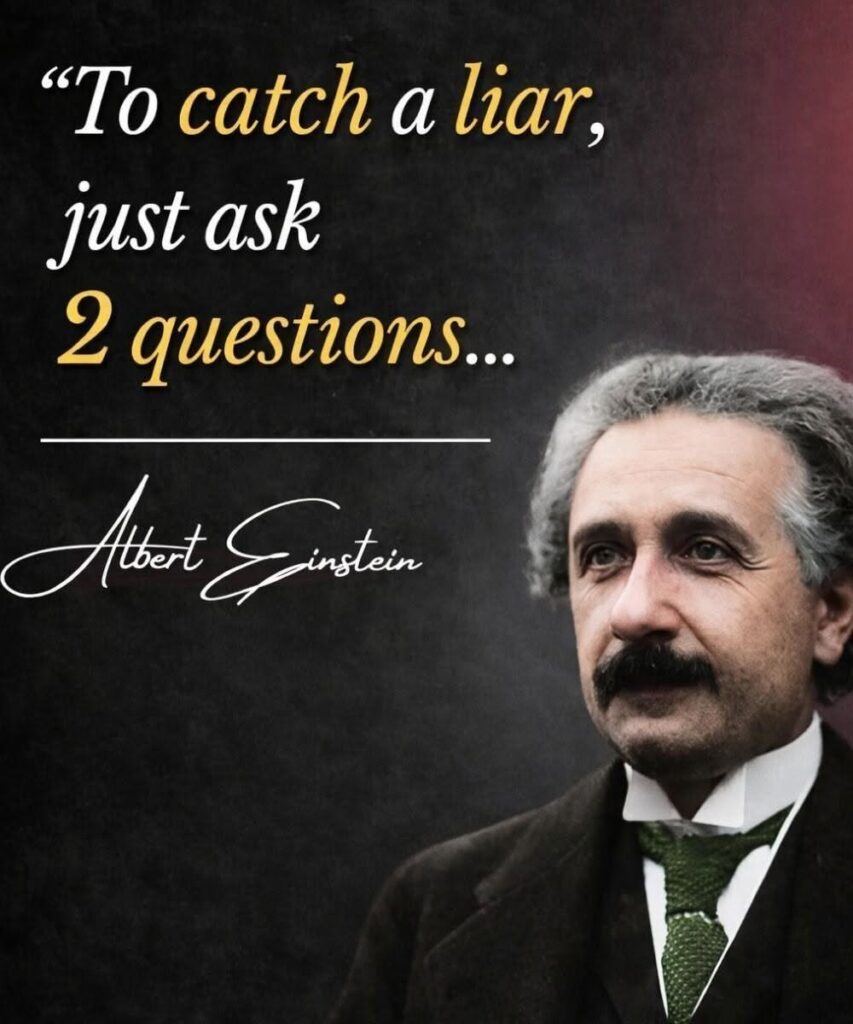
Social media is full of intriguing quotes attributed to historical figures, often pairing a portrait of a famous genius with profound-sounding advice.
A popular viral graphic features a portrait of Albert Einstein alongside the caption: “To catch a liar, just ask 2 questions…” with a signature reading Albert Einstein.
This image sparks immediate curiosity: Did Albert Einstein—the theoretical physicist renowned for his theories of relativity—actually write or say this about deception? And more importantly, can asking two specific questions truly reveal whether someone is lying?
Here is a closer look at the origin of this viral quote, the truth behind its attribution, and how modern behavioral psychology actually detects deception.
Did Albert Einstein Really Say This?
The short answer is no. There is no historical record, letter, speech, or publication in which Albert Einstein discussed asking two specific questions to detect a liar.
Albert Einstein’s extensive writings and speeches focused on theoretical physics, philosophy, international peace, education, and humanitarian issues.
Why Do Fake Einstein Quotes Spread So Easily?
- Authority Bias: Attributing psychological or philosophical wisdom to a recognized genius like Einstein instantly gives the claim credibility and increases social media sharing.
- Clickbait Hook: Promising a simple “2-question trick” appeals to human curiosity and our desire for quick solutions to complex social interactions.
The Psychology of Deception: Can 2 Questions Catch a Liar?
While Einstein never uttered this phrase, the idea of using specific questioning techniques to uncover dishonesty is a major focus of modern investigative psychology and behavioral science.
Forensic psychologists and law enforcement interrogators do not rely on “magic questions.” Instead, they use questioning techniques designed to increase cognitive load on a suspect.
+-----------------------------------------------------------------------------------+
|                        DECEPTION DETECTION TECHNIQUES                             |
+-------------------+----------------------------+----------------------------------+
| Technique         | How It Works               | Why It Exposes Deception         |
+-------------------+----------------------------+----------------------------------+
| Reverse Order     | Ask for story backwards    | Lying takes more mental effort   |
| Unanticipated Qs  | Ask detailed, unexpected Qs | Liars only rehearse main plot    |
| Clarification     | Ask for precise timeline   | Inconsistencies emerge naturally |
+-------------------+----------------------------+----------------------------------+
2 Psychological Questions That Help Reveal Inconsistencies
If you want to apply psychological principles to detect potential deception in daily conversations, experts recommend focusing on unexpected details and timeline consistency:
1. “Can you tell me what happened in reverse order, starting from the end?”
- Why it works: Lying requires significant mental energy because the speaker must invent details and monitor their own credibility. Asking someone to recount an event backward forces them to process information non-chronologically, making scripted falsehoods crumble under cognitive pressure.
2. “Can you explain this specific detail in more depth?”
- Why it works: Truthful people easily recall sensory details, surrounding context, and minor nuances because they are drawing from actual memory. Fabricated stories usually lack peripheral details, and asking for unexpected specifics often causes liars to hesitate or contradict earlier statements.
Signs of Deception to Watch For
Behavioral analysts look for clusters of behavioral changes rather than relying on a single visual cue:
- Verbal Inconsistencies: Contradicting previous statements or altering key details when asked to re-tell a story.
- Evasion and Deflection: Responding to simple questions with defensive statements or changing the subject.
- Cognitive Delay: Taking unusually long to answer straightforward, simple questions about an event.
Financial and Personal Impact: The Cost of Misinformation
Understanding the reality behind viral memes helps protect individuals in daily life:
- Avoiding Scams: False claims about simple tricks can make people overly confident in their ability to spot deceit, leaving them vulnerable to financial frauds, relationship issues, or romance scams.
- Valuing Verifiable Truth: Checking facts before sharing online media prevents the spread of digital misinformation across social networks.
Fascinating Facts About Albert Einstein and Misattributed Quotes
- The Most Misquoted Man: Einstein is among the most frequently misquoted historical figures on the internet, along with Mark Twain, Winston Churchill, and Abraham Lincoln.
- Famous Genuine Quote: One of Einstein’s actual verified quotes regarding truth and honesty is: “Whoever is careless with the truth in small matters cannot be trusted with important matters.”
Conclusion: Critical Thinking Over Quick Tricks
While Albert Einstein never authored the famous “2 questions” quote, the science behind detecting deception remains a fascinating area of human psychology.
Rather than looking for shortcut tricks or fake historical quotes, relying on critical thinking, active listening, and verifying facts will always be the best way to uncover the truth.
Frequently Asked Questions
Q1: Did Albert Einstein write any books on human behavior?
A1: No. Einstein wrote extensively on physics, scientific philosophy, world affairs, and ethics, but he never authored books or studies on criminal interrogation or behavioral psychology.
Q2: What is the best way to tell if someone is lying?
A2: Looking for inconsistencies in their narrative, asking unexpected detail questions, and comparing their statements against verifiable facts are much more reliable than watching for body language alone.
Q3: Are body language cues like crossing arms accurate indicators of lying?
A3: Not on their own. Physical gestures like fidgeting or crossing arms often indicate nervousness, stress, or temperature discomfort rather than outright deception.
Q4: Why are quotes so frequently misattributed to Einstein?
A4: Attributing quotes to Einstein adds instant authority and prestige to a graphic, making it far more likely to go viral on social media platforms.
Q5: What is cognitive load in interrogation?
A5: Cognitive load refers to the total amount of mental effort being used in working memory. Because lying requires inventing details and keeping track of falsehoods, increasing cognitive load makes it difficult for a liar to maintain a consistent story.
