
When flying domestically or internationally, receiving a boarding pass usually signals smooth sailing through the airport terminal. However, discovering four bold letters printed on your ticket—SSSS—can cause immediate panic and concern.
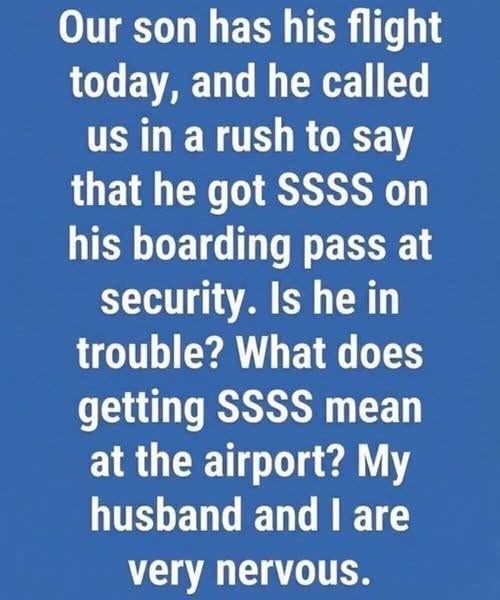
A worried parent recently posted a question online alongside a simple text graphic: “Our son has his flight today, and he called us in a rush to say that he got SSSS on his boarding pass at security. Is he in trouble? What does getting SSSS mean at the airport? My husband and I are very nervous.”
If you or a loved one receives an SSSS designation on a boarding pass, the most important thing to know right away is: No, he is not in trouble or under arrest.
Here is a complete look at what SSSS stands for, why passengers get selected for it, what happens during the security process, and how to handle it smoothly.
What Does SSSS Stand For?
SSSS stands for Secondary Security Screening Selection (or Secondary Security Screening Selectee).
It is an enhanced security measure managed by the Transportation Security Administration (TSA) in the United States and aligned security agencies worldwide. When SSSS appears on a boarding pass, it indicates that the passenger has been selected for additional security screening before being cleared to board their flight.
Why Do Passengers Get Selected for SSSS?
Passengers are designated for SSSS for a variety of reasons. Selection can occur through automated security risk algorithms, specific booking patterns, or completely random selection.
Common Reasons for Receiving SSSS
- Random Computer Selection: A significant percentage of SSSS selections are entirely random computer-generated picks designed to maintain unpredictable airport security protocol.
- One-Way International Flights: Booking a last-minute or one-way international flight often triggers automated security flags.
- High-Risk Origin or Destination: Traveling to or returning from countries flagged by security databases for heightened vigilance.
- Cash Payments: Purchasing flight tickets using cash or non-standard payment methods shortly before departure.
- Name Match Issues: Sharing a similar name or date of birth with someone listed on government watchlists or security databases.
- Inability to Check-In Online: If you receive an error message while attempting to print your boarding pass or check in via a mobile app, it frequently means you have been selected for SSSS and must print your pass at the airport ticket counter.
What Happens During the SSSS Screening Process?
Receiving SSSS does not mean a passenger is detained or arrested. It simply adds roughly 15 to 30 minutes to the standard airport security process.
+-----------------------------------------------------------------------------------+
|                           STANDARD vs. SSSS SECURITY SCREENING                     |
+-------------------+----------------------------+----------------------------------+
| Screening Step    | Standard Security Lane     | SSSS Enhanced Screening Lane     |
+-------------------+----------------------------+----------------------------------+
| Boarding Pass     | Scanned at Checkpoint      | Marked & Verified by TSA Officer |
| Carry-On Luggage  | Standard X-Ray Scanner     | Full Manual Hand Search of Bags  |
| Personal Search   | Body Scanner / Metal Gate  | Full Body Pat-Down & Explosives  |
| Tech Devices      | Swiped or X-Rayed          | Swabbed for Explosive Traces     |
+-------------------+----------------------------+----------------------------------+
The Step-by-Step SSSS Procedure
- Dedicated Screening Area: The traveler is directed to a separate security lane or an enclosed screening booth within the security area.
- Comprehensive Carry-On Inspection: TSA officers manually unpack every item in the passenger’s carry-on luggage, opening zippers, pouches, and containers.
- Explosive Trace Detection (ETD): Security officers swab hands, shoes, belts, bag handles, and electronic devices (laptops, phones, tablets) to test for trace elements of explosives.
- Full Body Pat-Down: A TSA agent of the same gender conducts a thorough physical pat-down inspection.
- Electronic Device Power-On: Travelers may be asked to turn on their electronic devices to prove they are functioning normally.
- Ticket Stamping/Signing: Once the officer clears the traveler, they will stamp, initial, or electronically clear the boarding pass, allowing the passenger to proceed to their boarding gate.
Practical Tips: How to Handle Getting SSSS
If you or a family member discovers an SSSS code on a boarding pass, stay calm and follow these steps:
- Arrive at the Airport Early: Allow an extra 30 to 45 minutes of buffer time to ensure enhanced screening does not cause you to miss your boarding call.
- Remain Calm and Cooperative: Remember that TSA officers are simply executing standard protocols. Courteous cooperation makes the process go quickly and smoothly.
- Keep Electronics Accessible: Have your laptop, phone, and tablet readily accessible so officers can inspect and swab them easily.
- Apply for a Redress Number (if it happens repeatedly): If you receive SSSS every time you fly, apply for a DHS Redress Control Number through the Department of Homeland Security Traveler Redress Inquiry Program (DHS TRIP). This helps clear up false name-matching issues in traveler databases.
Financial and Travel Impact: Avoiding Delays
Understanding SSSS helps travelers manage their schedules and avoid missed flights:
- Preventing Missed Connections: Passengers with tight layovers or short check-in windows are at risk of missing flights if SSSS occurs at international connection gates. Arriving early eliminates missed flight expenses.
- Redress Program Savings: Applying for a Redress Number is free of charge through official government portals, saving frequent travelers time and stress on future trips.
Fascinating Facts About SSSS
- Introduced Post-9/11: The SSSS system was implemented by the TSA following the September 11 attacks to enhance aviation security and passenger tracking.
- Gate-Side Screening: On certain international flights bound for the United States, SSSS screening may be conducted right at the gate immediately before stepping onto the plane.
Conclusion: Extra Screening, Not an Arrest
Getting SSSS on a boarding pass can be intimidating at first glance, but it is a routine security procedure designed to keep flights safe.
If your child or family member calls to say they got SSSS, assure them that they are not in trouble. By remaining patient and allowing a few extra minutes for bag checks and swabbing, they will be cleared to board their flight safely.
Frequently Asked Questions
Q1: Does getting SSSS mean my name is on a government watchlist?
A1: Not necessarily. Most SSSS selections are completely random or triggered by flight booking patterns (such as last-minute one-way tickets).
Q2: Can kids or minors get SSSS on their boarding pass?
A2: Yes, passengers of any age—including teenagers and children—can be selected for secondary security screening.
Q3: How long does SSSS security screening usually take?
A3: The additional screening process typically takes between 10 to 20 minutes, though arriving at the airport 45 minutes earlier than usual is recommended to avoid rushing.
Q4: Will TSA TSA PreCheck or Global Entry bypass SSSS?
A4: No. Even if you have TSA PreCheck or Global Entry, receiving SSSS overrides your expedited screening status for that specific flight, requiring you to undergo standard secondary screening.
Q5: What should I do if I am given SSSS on every flight I take?
A5: If you are flagged on almost every flight, file a claim through the Department of Homeland Security Traveler Redress Inquiry Program (DHS TRIP) to resolve potential database identity mix-ups.
