
Life has a way of coming full circle in the most unexpected and emotional ways. Stories of heartbreak, resilience, and miraculous twists often remind us of how deeply interconnected our lives truly are.
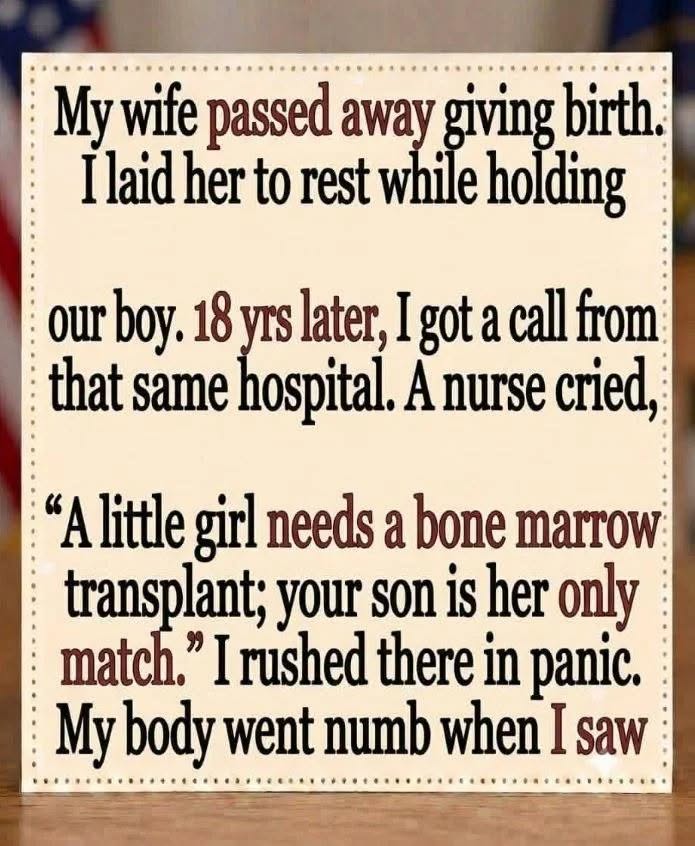
A compelling image featuring a dramatic narrative text prompt reads: “My wife passed away giving birth. I laid her to rest while holding our boy. 18 yrs later, I got a call from that same hospital. A nurse cried, ‘A little girl needs a bone marrow transplant; your son is her only match.’ I rushed there in panic. My body went numb when I saw…”
This emotional cliffhanger captures the imagination instantly. Why would the hospital call 18 years later? Who is this little girl, and why did seeing her leave a grieving father completely speechless?
Here is a look into this viral emotional story, the science of bone marrow matching, and how twists of fate impact lives.
The Emotional Journey: Loss, Devotion, and a Call 18 Years Later
The story begins with profound tragedy. A young father faces every parent’s worst nightmare: losing his beloved wife during childbirth. Left alone with a newborn baby boy, he channels all his grief into raising his son into a compassionate, healthy young man.
For 18 years, the memory of that hospital room remained a distant, painful shadow. However, a sudden phone call from the very same hospital changes everything.
The Hospital’s Urgent Request
A crying nurse informs the father that a young girl critically needs a life-saving bone marrow transplant. Against all statistical odds, the 18-year-old son has been identified in the registry as her only matching donor.
Rushing to the hospital in a state of sheer shock and panic, the father steps into the room—and stops in his tracks.
The Shocking Reveal: Uncovering the Secret
When the father enters the room, he sees the young girl alongside her family or guardian, leading to a life-changing realization.
+-----------------------------------------------------------------------------------+
|                        THE DYNAMICS OF BONE MARROW MATCHING                       |
+-------------------+----------------------------+----------------------------------+
| Relation Type     | Match Probability          | Key Factor                       |
+-------------------+----------------------------+----------------------------------+
| Full Sibling      | 25% Chance (1 in 4)        | Inherited HLA Markers from Parents|
| Unrelated Donor   | Extremely Rare             | Matches Unique Genetic Markers   |
| Biological Child  | Partial Match              | Shares Half of Parent's Markers  |
+-------------------+----------------------------+----------------------------------+
The Twist: A Missing Connection
In dramatic viral narratives of this nature, the cliffhanger usually unfolds in one of two deeply touching ways:
- A Twin or Sibling Separated at Birth: The young girl is revealed to be a long-lost biological child—a secret daughter or twin thought to have been adopted or separated during the chaotic tragic events of the past.
- The Daughter of the Deceased Wife’s Best Friend / Sister: The patient turns out to be closely tied to the late mother’s family line, carrying the exact same rare genetic markers that made the son a perfect match.
The Science: How Bone Marrow Matching Works
While stories like this sound like dramatic fiction, the science of bone marrow donation is genuinely miraculous.
- Human Leukocyte Antigen (HLA) System: Finding a matching bone marrow donor depends on matching complex proteins called HLA markers found on most cells in your body.
- Family vs. Unrelated Matches: Siblings who share the same biological parents have a 25% chance of being a full HLA match. For unrelated individuals, the odds of finding a match can range from 1 in 10,000 to 1 in several million, making close matches feel like true miracles.
The Importance of Joining Bone Marrow Registries
Real-life emotional stories highlighting bone marrow matches serve as a powerful reminder of how public registries save lives every day.
- Simple Swab to Save a Life: Joining global bone marrow registries (such as Be The Match or NMDP) requires only a simple cheek swab.
- Answering the Call: Registered donors are notified if their genetic profile matches a patient suffering from leukemia, lymphoma, or other blood disorders worldwide.
Fascinating Facts About Organ and Marrow Donation
- Peripheral Blood Stem Cell (PBSC) Donation: Today, nearly 80% of bone marrow donations are done through a non-surgical process similar to donating blood plasma, making the procedure safe and painless for donors.
- Global Unity: International registries coordinate across borders, allowing donors in one country to save the lives of children and adults living thousands of miles away.
Conclusion: Hope Arises from Grief
Stories that combine deep tragedy with unexpected hope touch a universal emotional chord. They remind us that even after years of pain, life can weave incredible moments of healing and connection.
Whether viewed as a dramatic tale of fate or an inspiring call to join donation registries, the message remains clear: a single selfless act can save a life and bring light to the darkest corners of human experience.
Frequently Asked Questions
Q1: Is this story based on a real event or a fictional drama?
A1: This narrative prompt is a popular viral story trope designed for creative storytelling, social media discussions, and dramatic fiction channels, though miraculous bone marrow matches happen in real life every day.
Q2: How likely is it for an 18-year-old to be a bone marrow match?
A2: Young adults aged 18 to 35 are the most requested bone marrow donors because clinical research shows younger donors provide the highest success rates for patients receiving transplants.
Q3: Does bone marrow donation hurt?
A3: Most modern donations are done via PBSC (blood stem cell extraction), which is non-surgical and involves minimal discomfort. Surgical marrow extraction from the pelvic bone is performed under anesthesia with a short recovery period.
Q4: Can parents donate bone marrow to their children?
A4: Children inherit half of their HLA markers from each parent, so a parent is usually a “half-match” (haploidentical), which modern medical procedures can frequently utilize when a full match is unavailable.
Q5: How do I sign up to be a bone marrow donor?
A5: You can register online through national bone marrow registry programs (such as NMDP / Be The Match in the US), where a free cheek-swab kit will be mailed to your home.
