
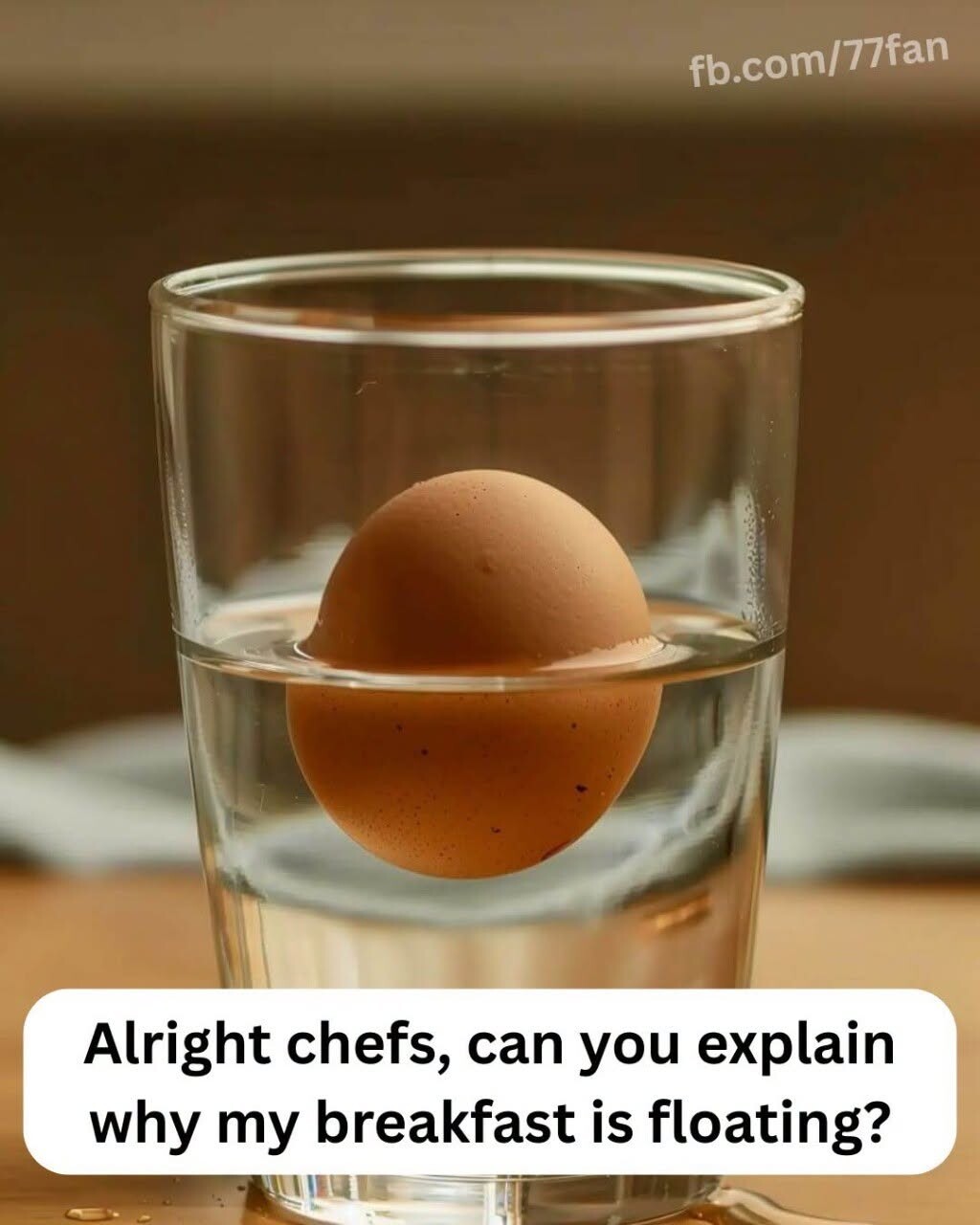
Few kitchen hacks are as famous as the water float test for eggs. Dropping an egg into a glass of cold water seems like an effortless way to check its quality before cracking it into your breakfast pan.
An engaging kitchen visual—titled “Why Is My Egg Floating? What the Float Test Really Tells You”—shows a brown egg floating clearly at the surface of a glass filled with water, accompanied by the question: “Alright chefs, can you explain why my breakfast is floating?”
While a floating egg is a reliable indicator of the egg’s age, many home cooks misunderstand what floating actually means regarding safety versus freshness.
Here is a complete look at the science behind why eggs float, what it indicates about freshness, and how to tell if a floating egg is still safe to eat.
The Science of the Egg Float Test: Why Do Eggs Float?
An eggshell might look completely solid, but it is actually a semi-permeable membrane containing thousands of tiny microscopic pores.
Over time, two natural processes occur inside the egg that change its buoyancy:
+-----------------------------------------------------------------------------------+
|                        EGG BUOYANCY & FRESHNESS STAGES                            |
+-------------------+----------------------------+----------------------------------+
| Water Behavior    | Age / Freshness Level      | Internal State                   |
+-------------------+----------------------------+----------------------------------+
| Sinks & Lies Flat | Very Fresh (1–2 weeks)     | Small air pocket, high density   |
| Stands Upright    | Slightly Older (3–5 weeks) | Growing air pocket, perfectly fine|
| Floats to Top     | Old / Aged (5+ weeks)      | Large air pocket, low density    |
+-------------------+----------------------------+----------------------------------+
1. Evaporation of Moisture
As an egg ages, moisture and liquid inside the egg white (albumen) slowly evaporate through the porous shell into the surrounding air.
2. Expansion of the Internal Air Cell
As moisture leaves the egg, air enters through the shell to fill the vacant space. This causes the internal air cell—located at the wide end of the egg—to expand significantly. As the volume of air inside increases, the overall density of the egg drops below the density of water ($1.0 \text{ g/cm}^3$), causing the egg to float!
Does a Floating Egg Mean It Is Spoiled?
Not necessarily! Floating indicates that an egg is old, but age alone does not equal spoilage.
- Age vs. Safety: An old, floating egg has lost moisture and developed a large air pocket, but it may still be completely safe to cook and consume if it has been continuously refrigerated.
- The Crack Test (The Ultimate Spoilage Indicator): To verify whether a floating egg is safe:
- Crack the egg into a separate small bowl.
- Smell it: A spoiled or rotten egg releases a strong, unmistakable sulfur odor (hydrogen sulfide) immediately upon cracking.
- Inspect it: Check for unusual discoloration (pink, green, or iridescent shades in the white) or sliminess.
- If there is no bad smell and the appearance is normal, the egg is safe to use—especially for baking!
Practical Culinary Uses for Older Eggs
Older, floating eggs actually possess unique texture qualities that make them superior for specific kitchen applications:
- Hard-Boiled Eggs That Peel Effortlessly: Super fresh eggs are difficult to peel because their low pH makes the inner membrane stick tightly to the shell. Older eggs have higher pH levels and larger air pockets, making their shells slip off easily after boiling.
- Baking: Older egg whites are slightly thinner, making them easier to whip into airy meringues and soufflés.
Financial Impact: Reducing Kitchen Food Waste
Relying solely on “Best By” dates leads to millions of safe, edible eggs being thrown into the garbage prematurely:
- Stretching Your Food Budget: Checking floating eggs with the crack-and-smell test before discarding them prevents wasting perfectly safe protein sources.
- Refrigeration Longevity: Stored properly in their original carton at 40°F (4°C) or lower, eggs routinely stay safe for several weeks past the stamped expiration date.
Fascinating Facts About Eggs
- Microscopic Pores: A single hen’s eggshell contains between 7,000 and 17,000 microscopic pores that allow oxygen to enter and carbon dioxide/moisture to exit.
- Saltwater Float Test: Adding salt to water increases the water’s density, which makes eggs float even faster than they do in plain tap water!
Conclusion: Don’t Rush to Throw It Away
A floating egg is simply a lesson in physics and moisture loss.
The next time your breakfast floats in a glass of water, don’t automatically toss it in the trash. Crack it into a bowl, give it a quick sniff, and if it smells fresh, enjoy your easy-to-peel boiled egg or delicious baked treat!
Frequently Asked Questions
Q1: Why do fresh eggs sink to the bottom of the water glass?
A1: Fresh eggs have very small internal air pockets and high liquid density, making them heavier than the volume of water they displace, so they sink and lay flat.
Q2: What is the smell of a rotten egg?
A2: Spoilage bacteria break down proteins inside the egg, producing hydrogen sulfide gas, which has a potent, sharp, and rotten smell that is instantly recognizable.
Q3: Can you freeze fresh eggs to make them last longer?
A3: You cannot freeze whole eggs in their shells (the expanding liquid will crack the shell), but you can crack eggs, beat the yolks and whites together, and freeze them in airtight containers or ice cube trays for up to 1 year.
Q4: Why do some recipe books specifically call for older eggs?
A4: Older eggs are preferred for hard-boiling because the enlarged air cell and altered pH prevent the white from sticking to the shell membrane during peeling.
Q5: Does washing eggs at home make them float faster?
A5: Yes. Washing eggs with warm water can remove the natural protective cuticle (“bloom”) on the shell, accelerating moisture loss and air cell expansion.
