
Love it or hate it, candy corn is an undeniable icon of autumn and Halloween season. Every year, millions of pounds of these tri-colored kernels fill candy dishes, sparking spirited debates over its sugary, waxy flavor profile.
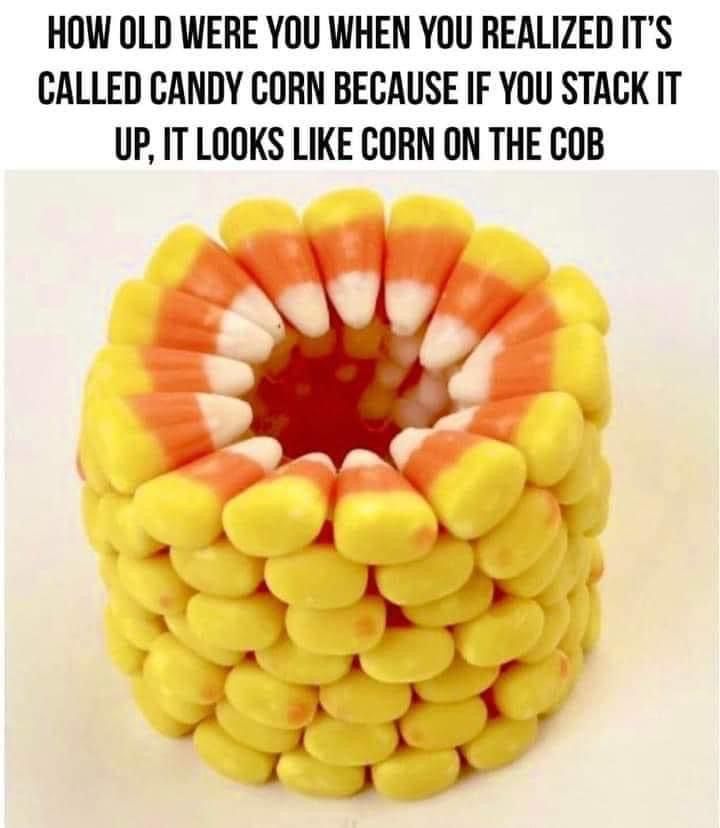
A viral image—titled “How old were you when you realized it’s called candy corn because if you stack it up, it looks like corn on the cob”—shows an ingenious arrangement of candy corn pieces stacked in a hollow cylinder, pointing inward. When arranged in a ring layer by layer, the yellow bases face outward and the white tips point inward, perfectly mimicking a freshly harvested cob of sweet corn.
Beyond this clever viral stacking trick, candy corn actually has a rich agricultural history that ties its unique tri-color shape directly to 19th-century farming roots.
Here is a full breakdown of why candy corn was created, how its shape came to be, and fascinating facts about this timeless autumn confection.
The Origin Story: Why Was It Named Candy Corn?
Candy corn was created in the late 1880s by George Renninger, an employee at the Wunderle Candy Company in Philadelphia. Shortly after, the Goelitz Confectionery Company (now known as the Jelly Belly Candy Company) began mass-producing it around 1898 under a very different name: “Chicken Feed.”
+-----------------------------------------------------------------------------------+
|                        CANDY CORN vs. HISTORICAL "CHICKEN FEED"                   |
+-------------------+----------------------------+----------------------------------+
| Feature           | Original "Chicken Feed"    | Modern Candy Corn                |
+-------------------+----------------------------+----------------------------------+
| Target Audience   | Agricultural Families      | Halloween & Autumn Enthusiasts   |
| Era               | Late 1800s – Early 1900s   | Modern Day                       |
| Visual Concept    | Corn Kernels for Poultry   | Iconic Tri-Color Layered Kernel  |
| Manufacturing     | Hand-poured with kettles   | High-speed automated mogul lines |
+-------------------+----------------------------+----------------------------------+
- Agricultural Theme: In late 19th-century rural America, corn was primarily viewed as livestock feed rather than human dining table fare. The candy was designed to look like individual dried corn kernels to appeal to agrarian families.
- The Tri-Color Innovation: At the time, multi-colored layered candies were revolutionary. Hand-pouring three separate liquid layers—yellow at the base, orange in the middle, and white at the tip—into starch molds created a distinct visual novelty that stood out in candy shop glass jars.
How Candy Corn Is Made Today
While the original recipe was mixed by hand in large copper kettles and poured using hand-held buckets, modern confectioners use automated production processes while keeping the core recipe nearly identical:
- The Sugar Base: Sugar, corn syrup, water, and marshmallow binder are cooked into a slurry.
- The Starch Mold: Cornstarch trays are stamped with thousands of kernel-shaped indentations.
- Layered Depositing: Automated nozzles inject the white tip first, followed by the orange center, and finally the yellow base.
- Polishing: After cooling and setting, the candy kernels are tumbled with confectioner’s glaze and mineral oil to give them their smooth, glossy sheen.
Financial Impact: The Economic Engine of Fall Confections
Candy corn remains a massive seasonal revenue generator within the global confectionery market:
- Massive Annual Sales: Over 35 million pounds (approximately 9 billion individual kernels) of candy corn are produced each year, generating tens of millions of dollars in seasonal autumn sales.
- High Margin Production: Composed primarily of accessible ingredients like sugar, corn syrup, and fondant, candy corn yields exceptionally high profit margins for confectioners during the Q3 and Q4 holiday push.
Fascinating Facts About Candy Corn
- National Candy Corn Day: October 30th—the day right before Halloween—is officially designated as National Candy Corn Day in the United States!
- Zero Fat: Candy corn is naturally fat-free, containing roughly 7 calories per individual kernel.
- Not Just for Halloween: Modern variations exist for almost every major holiday, including “Reindeer Corn” (red, green, white for Christmas), “Cupid Corn” (pink, red, white for Valentine’s Day), and “Bunny Corn” (pastel colors for Easter).
Conclusion: A Simple Treat with Lasting Cultural Impact
Whether you enjoy eating them layer-by-layer, tossing them into a bowl with salted peanuts for a sweet-and-salty mix, or stacking them into miniature corn cobs for social media, candy corn remains a timeless piece of American confectionery history.
Frequently Asked Questions
Q1: Who invented candy corn?
A1: Candy corn was invented in the 1880s by George Renninger, a candymaker at the Wunderle Candy Company in Philadelphia.
Q2: What was candy corn originally called?
A2: It was originally marketed and sold under the name “Chicken Feed,” packaged in boxes featuring a rooster logo.
Q3: How many calories are in a serving of candy corn?
A3: A standard serving of candy corn (about 19 pieces or 38 grams) contains roughly 140 calories and 28 grams of sugar.
Q4: Does candy corn contain real corn products?
A4: Yes. While it is not made from fresh corn, it uses corn syrup and cornstarch as primary binding and sweetening ingredients.
Q5: What is the best way to stack candy corn to look like corn on the cob?
A5: Place a ring of candy corn pieces on a flat plate with the wide yellow bases pointing outward and narrow white tips pointing inward. Build vertical layers on top, offsetting each piece slightly to create a cylindrical cob pattern.
