
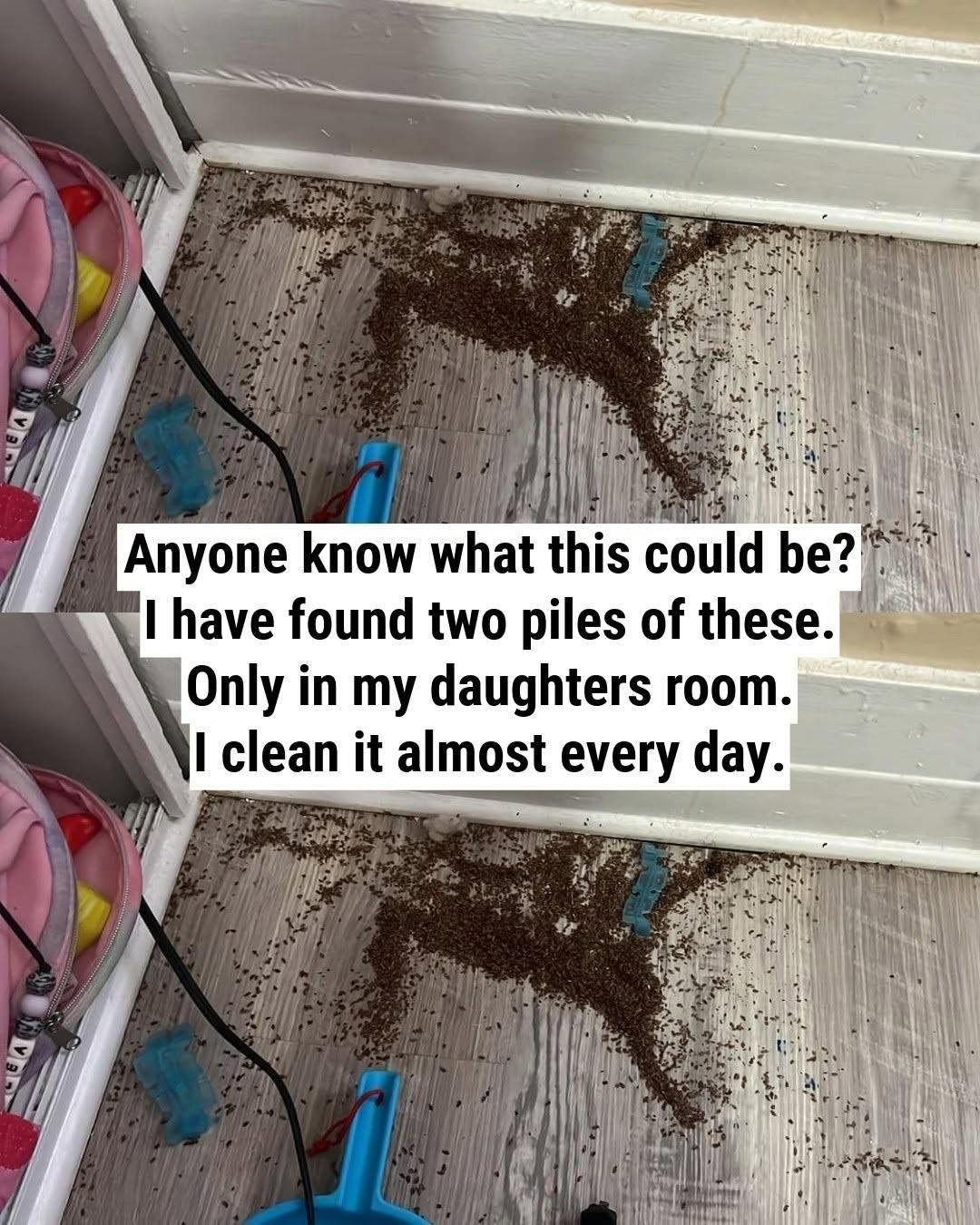
Finding unexplained piles of tiny dark particles along baseboards, under furniture, or near closet corners can be puzzling and concerning for homeowners.
A viral social graphic—captioned “Anyone know what this could be? I have found two piles of these. Only in my daughters room. I clean it almost every day.”—shows dark, granular debris scattered across a wooden floor alongside baseboard trim.
When recurring piles appear despite daily sweeping, it usually indicates activity overhead or inside the walls. The most common culprit behind these uniform piles is drywood termite frass (termite droppings) or ant debris kick-outs.
Here is a full breakdown of how to identify what is causing these piles, how to inspect your home, and the best steps to eradicate the problem.
Identifying the Culprit: Termite Frass vs. Other Pests
Determining what produced the debris determines the proper pest control treatment:
+-----------------------------------------------------------------------------------+
|                        PEST DEBRIS IDENTIFICATION GUIDE                           |
+-------------------+----------------------------+----------------------------------+
| Debris Type       | Appearance & Texture       | Source / Behavior                |
+-------------------+----------------------------+----------------------------------+
| Drywood Termite   | Hexagonal/oval pellets,    | Pushed out of small "kick-out"   |
| Frass             | uniform size, feel like sand| holes in drywall or wood trim    |
| Carpenter Ant     | Irregular wood shavings,   | Dumped from nests built inside   |
| Trash Piles       | insect parts, fibrous dirt | wall cavities or hollow doors    |
| Rodent Droppings  | Dark cylinder pellets,     | Left along travel paths & near   |
|                   | soft or hard, rice-sized   | food sources                     |
+-------------------+----------------------------+----------------------------------+
1. Drywood Termite Frass (Most Likely Cause)
Unlike subterranean termites that build mud tubes, drywood termites live entirely inside wooden structures. As they eat through wood framing or baseboards, they push their fecal pellets out of tiny pin-sized openings called kick-out holes.
- Key Visual Indicators: The pellets are very small (about 1mm), oval-shaped with six indented sides, uniform in size, and feel hard and gritty like coarse sand or coffee grounds. They accumulate directly beneath kick-out holes.
2. Carpenter Ant Debris (“Frass”)
Carpenter ants do not eat wood; they hollow it out to create nesting galleries. As they tunnel, they push out debris piles consisting of fine sawdust, dead ant parts, and dirt.
- Key Visual Indicators: The pile looks more like fibrous wood shavings or shredded insulation rather than uniform, individual pellets.
3. Mouse or Rodent Droppings
If the particles are larger (about the size of a grain of rice or small seed) and scattered along edges, they may be mouse droppings.
- Key Visual Indicators: Soft when fresh, turning hard and dark over time, but noticeably larger than tiny termite granules.
Step-by-Step Inspection & Action Plan
If you keep cleaning up piles that reappear in the exact same spot daily, follow these steps:
1. Look Straight Up Above the Pile
Inspect the ceiling, crown molding, door frames, or baseboard trim directly above where the pile forms. Look for microscopic pinholes (kick-out holes) that termites use to eject waste.
2. Tap the Wood Trim
Gently tap baseboards or wall studs near the debris with a screwdriver handle. Hollow or papery sounds indicate structural wood damage inside the wall.
3. Collect a Sample for a Professional
Sweep a small sample into a clear ziplock bag or container. A licensed pest control technician can instantly verify under magnification whether it is termite frass or carpenter ant frass.
Financial Impact: Early Identification Saves Thousands
Detecting termite or carpenter ant infestations early prevents catastrophic repair bills:
- Preventing Structural Damage: Ignoring termite frass allows colonies to grow unchecked, leading to thousands of dollars in structural wood replacement.
- Avoid Unnecessary Renovation: Professional spot treatments for early-stage drywood termites cost significantly less than full-structure fumigation or wall reconstruction.
Fascinating Facts About Termite Colonies
- Clean Freaks of the Insect World: Drywood termites strictly maintain clean galleries inside wood structures by constantly pushing waste out of designated kick-out holes.
- Perpetual Feeders: Termites operate 24 hours a day, 7 days a week, never sleeping while consuming cellulose inside home framing.
Conclusion: Act Quickly When Piles Reappear Daily
If sweeping away dark granules only results in a fresh pile appearing the next morning, don’t ignore it. Identifying termite frass early protects your home’s structural integrity and keeps your living space pest-free.
Frequently Asked Questions
Q1: Why do termite piles keep coming back after I sweep them?
A1: Termites inside the wall continuously push accumulated frass out of tiny kick-out holes to clean their nest, creating new piles daily.
Q2: What does termite frass look like up close?
A2: Termite frass consists of tiny, hard, oval pellets with six concave sides. They resemble ground coffee, poppy seeds, or coarse sand.
Q3: Are drywood termite droppings dangerous to human health?
A3: Termite frass is non-toxic and does not carry disease, but it can trigger mild respiratory irritation or allergies in sensitive individuals if inhaled.
Q4: How do I find the hole where the frass is coming from?
A4: Look directly above the pile on baseboards, drywall, or ceiling seams for tiny, round, pin-sized holes that may look sealed with tiny wood dust caps.
Q5: Can I get rid of drywood termites myself with store-bought spray?
A5: Surface sprays rarely work because the colony lives deep inside structural wood. Professional localized injection or tent fumigation is required to eliminate the entire colony.
