
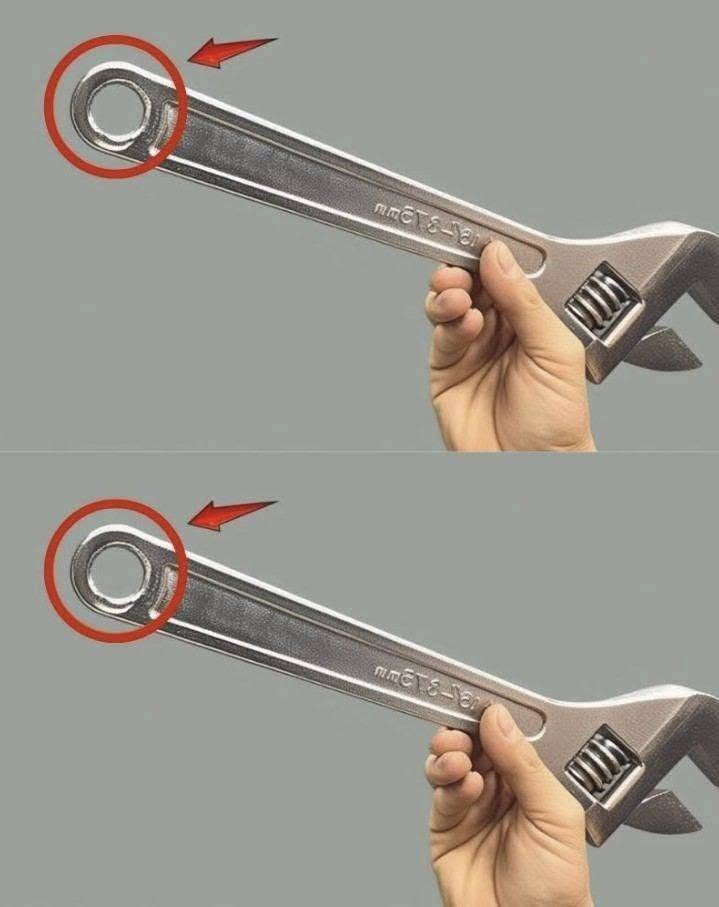
Every household tool kit contains an adjustable wrench, often known as a Crescent wrench. Whether you are tackling minor plumbing repairs under the sink, assembling furniture, or performing routine maintenance on a vehicle, this versatile hand tool is a essential staple for DIY mechanics and professional tradespeople alike. However, despite its ubiquitous presence in toolboxes around the world, most individuals overlook a subtle design detail located right at the end of the handle: the circular hole.
While the vast majority of homeowners assume this opening is strictly decorative or intended solely for hanging the tool on a workshop pegboard, tool manufacturers designed this feature with specific practical functions in mind. In this comprehensive hardware and maintenance guide, we will unpack the hidden purpose of the wrench hole, explore how to use it safely, examine common DIY mistakes, and highlight essential safety principles for home mechanics.
What Is the True Purpose of the Hole in a Wrench Handle?
Hand tools are designed around ergonomics, mechanical leverage, and workplace efficiency. Far from being a random manufacturing byproduct, the circular or hex-shaped hole integrated into the tail end of an adjustable wrench serves several distinct structural and mechanical purposes.
1. Increased Mechanical Leverage (The Extension Bar Hack)
The primary functional reason for the end hole on a wrench handle is to allow tradespeople to increase leverage when dealing with rusted, over-tightened, or frozen bolts. By inserting the pin of another tool, a specialized leverage bar, or linking a second box-end wrench through the hole, mechanics can extend the total handle length. According to fundamental physics, lengthening the leverage arm increases applied torque without requiring extra physical exertion from the user.
2. Built-in Box-End or Hex Socket Utility
Many modern combination and adjustable wrenches feature precision-machined, 6-point or 12-point hexagonal inner rings inside the handle hole. This allows the tail of the wrench to double as a fixed-size box-end wrench for standard nut sizes, enabling rapid fastening without needing to adjust the main jaw screw repeatedly.
3. Tool Tethering and Fall Prevention
In professional construction, industrial maintenance, and roofing applications, safety standards require tools to be secured when working at elevated heights. The end hole provides a reinforced anchor point for attaching drop-prevention lanyards or carabiners, ensuring that a dropped wrench does not endanger workers below or cause severe property damage.
How Wrench Handle Features Compare
Different hand tool designs incorporate handle openings for distinct operational advantages depending on the job site environment.
+---------------------------+---------------------------------------+---------------------------------------+
| Handle Feature            | Primary Engineering Function          | Common User Misconception             |
+---------------------------+---------------------------------------+---------------------------------------+
| Plain Round Hole          | Lanyard tethering & pegboard storage | Believed to be purely for hanging     |
| Machined Hexagon Hole     | Secondary fixed box-wrench function   | Thought to be decorative styling      |
| Tapered Alignment Spike   | Hole alignment in structural steel    | Misidentified as a pry bar            |
+---------------------------+---------------------------------------+---------------------------------------+
How to Safely Leverage Tools Without Causing Damage
Using mechanical leverage hacks can make tough repair jobs significantly easier, but applying excessive force improperly carries inherent risks. Understanding proper tool usage prevents injuries and preserves your equipment.
The Physics of Torque and Tool Integrity
Torque is calculated as force multiplied by distance ($T = F \times d$). Extending handle length multiplies torque exponentially. However, hand tools are forged from specific steel alloys designed to withstand rated force limits. Applying extreme force via an oversized extension bar can strip adjustable jaw gears, bend the tool shank, or snap bolt heads off completely.
+-----------------------------------+------------------------------------------------------------------------+
| Technique                         | Proper Application Guidelines                                          |
+-----------------------------------+------------------------------------------------------------------------+
| Lanyard Attachment                | Use rated carabiners to prevent tool drops in overhead work spaces    |
| Penetrating Oil Pre-treatment     | Apply lubricant to rusted threads before attempting maximum leverage  |
| Controlled Force Application      | Pull toward your body rather than pushing to prevent slipping injury   |
+-----------------------------------+------------------------------------------------------------------------+
Essential Safety Steps for Stubborn Bolts
- Apply Penetrating Oil: Spray rusted fasteners with high-quality penetrating liquid and allow it to soak for 10 to 15 minutes to break down oxidation before applying force.
- Select the Right Size: Ensure the adjustable jaw fits snugly against the parallel faces of the nut to avoid rounding off metal edges.
- Pull, Don’t Push: Always position the wrench so that you pull the handle toward your body. Pushing away can result in hand or knuckle impact if the tool suddenly slips or the bolt snaps.
Property Value, Home Maintenance, and Financial Wisdom
Maintaining a reliable collection of versatile tools and knowing how to execute basic home repairs directly contributes to overall financial health and asset protection. Homeownership represents one of the largest financial investments individuals make, and proactive property maintenance prevents minor structural or plumbing issues from escalating into costly emergency repairs.
+-------------------------------+-----------------------------------+-----------------------------------+
| Maintenance Strategy          | DIY Preventative Care             | Deferred Maintenance Neglect      |
+-------------------------------+-----------------------------------+-----------------------------------+
| Financial Impact              | Low tool & material expenses      | High contractor & emergency fees  |
| Asset Integrity               | High property value preservation  | Accelerating structural decay     |
| Long-term Financial Outcome   | Preserved equity & budget safety  | Depleted emergency cash reserves  |
+-------------------------------+-----------------------------------+-----------------------------------+
By mastering simple home repair techniques, managing household maintenance budgets, and keeping adequate home insurance coverage, property owners build long-term equity. Preserving home equity supports broader financial stability, allowing funds to remain invested securely in retirement accounts, high-yield savings, or investment portfolios.
Conclusion
The simple hole at the end of an adjustable wrench is far more than a hanging loop. Whether serving as a tether anchor for overhead safety, a secondary fixed socket, or a point of extra leverage for stubborn hardware, it reflects smart, functional tool engineering.
By understanding how to use your home tools effectively and safely, you can complete household projects faster, protect your equipment from unnecessary damage, and take confident control of your home maintenance needs.
Frequently Asked Questions (FAQ)
Is it safe to use a pipe over a wrench for extra leverage?
Using a steel pipe (“cheater bar”) over a wrench handle increases torque, but it can easily exceed the tool’s engineered strength, leading to tool breakage or sudden slipping. It is safer to use penetrating oil, heat, or an impact driver for extremely stuck bolts.
Can you use the hole to hang heavy wrenches on pegboards?
Yes, standard pegboards and heavy-duty tool hooks easily accommodate handle holes. Ensure the mounting hook and pegboard panel are rated to support the total weight of forged steel wrenches.
What is the difference between an adjustable wrench and a combination wrench?
An adjustable wrench features a movable jaw controlled by a worm screw, allowing it to fit multiple fastener sizes. A combination wrench has fixed, non-adjustable ends—one open-ended and one box-ended—sized precisely for a single nut measurement.
How do I prevent my hand tools from rusting in storage?
Keep hand tools in a dry, low-humidity toolbox or workshop cabinet. Applying a thin coat of lightweight machine oil or silicone spray to exposed steel surfaces periodically prevents surface oxidation and rust accumulation.
