
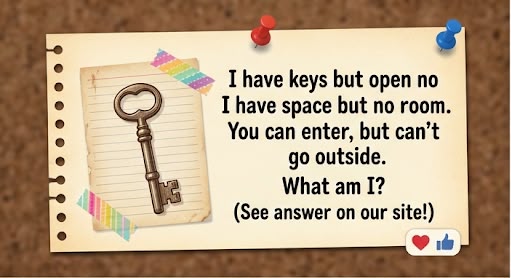
Classic brain teasers excel at taking everyday objects and describing them through clever double meanings. One of the most popular and recognizable riddles asks: “I have keys but open no locks. I have space but no room. You can enter, but can’t go outside. What am I?”
While it sounds like a mysterious puzzle about a building or a secret vault, the answer is a tool that almost everyone uses every single day.
In this guide, we will reveal the answer, break down the clever wordplay behind each line, explore alternative answers, and examine why riddles are great for cognitive agility.
What Is the Answer to the Riddle?
The answer to this classic brain teaser is a keyboard (or a computer keyboard / piano keyboard).
Decoding the Riddle Line by Line
- “I have keys but open no locks…”
- A computer keyboard features letter, number, and function keys (and a piano has musical keys), but none of them are designed to turn physical door locks.
- “…I have space but no room…”
- Keyboards feature a “Spacebar” (or space key), but the device offers no physical physical living space or architectural room.
- “You can enter, but can’t go outside.”
- Solvers use the “Enter” key to submit commands, input data, or create new lines, but clicking or pressing it doesn’t allow anyone to step outside.
Why Wordplay Riddles Work So Well
The genius of this riddle lies in linguistic homonyms—words that sound the same or have identical spellings but carry vastly different meanings based on context:
- Keys: Physical lock openers vs. typing/musical buttons.
- Space: Physical volume/area vs. blank distance between words.
- Enter: Physical motion into an enclosure vs. input command execution.
By playing on architectural expectations (“locks,” “room,” “outside”), the riddle distracts your mind from thinking about technology or musical instruments.
Why Brain Teasers Benefit Cognitive Agility
Engaging with word games and logical puzzles offers several mental health and performance benefits:
- Sharpens Problem-Solving: Riddles challenge linear thinking, training your brain to analyze scenarios from multiple angles.
- Promotes Lateral Thinking: Puzzles encourage creative associations between unrelated concepts.
- Provides a Quick Mental Reset: Solving short riddles offers a satisfying dose of dopamine and a quick break during work or study sessions.
Conclusion
The “keyboard” riddle remains a timeless favorite because it bridges old-school wordplay with modern daily life. Next time you type an email or press the spacebar, you’ll appreciate the clever logic behind this iconic puzzle!
Frequently Asked Questions (FAQ)
What is the origin of the keyboard riddle?
This puzzle emerged in modern riddle collections during the late 20th century, growing in popularity alongside the widespread adoption of personal computers and typing keyboards.
Can a piano be an answer to this riddle?
A piano partially fits the first line (“I have keys but open no locks”), but the complete riddle with “space” and “enter” specifically points to a computer or typewriter keyboard.
What are other examples of homonym riddles?
Similar riddles include “What has a head and a tail but no body?” (a coin) or “What has hands but cannot clap?” (a clock).
