
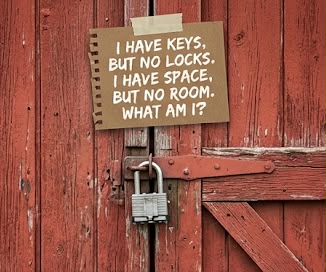
Riddles and word puzzles remain a fantastic way to stretch our lateral thinking by taking daily objects and reinterpreting them through clever wordplay. One of the most recognizable classic brain teasers asks: “I have keys, but no locks. I have space, but no room. What am I?”
While the phrasing sounds like a puzzle about a house or a physical building, the answer is an item that millions of people use every single day.
In this guide, we will reveal the answer, break down the clever double meanings behind each line, explore alternative variations, and examine why solving riddles benefits mental agility.
What Is the Answer to the Riddle?
The answer to this classic brain teaser is a keyboard (or a computer keyboard / piano keyboard).
Decoding the Riddle Line by Line
- “I have keys, but no locks…”
- A computer or typewriter keyboard is covered with individual typing buttons called “keys” (and a piano features musical keys), but none of these keys fit into a physical padlocked door or lock cylinder.
- “…I have space, but no room.”
- Keyboards feature a prominent “Spacebar” (or space key) used to create blank gaps between characters, but the device provides no physical room or living space inside it.
- Expanded Lines (“You can enter, but can’t go outside”)
- In longer versions of this puzzle, lines like “You can enter, but can’t go outside” are added, referring to the “Enter” or “Return” key used to input commands or create new text lines.
The Power of Wordplay: How Homonyms Misdirect the Mind
The reason this riddle continues to stump people lies in homonyms—words with identical spellings or pronunciations that carry vastly different meanings depending on context:
- Keys: Physical door openers vs. input buttons on a device or musical instrument.
- Space: Physical volumetric area vs. the blank gap between typed words.
- Enter: Physical movement into a room vs. a computer command key.
By framing the riddle with structural words like “locks” and “room,” your brain naturally visualizes buildings, doors, or treasure chests, steering you away from technology and office tools.
Why Brain Teasers and Riddles Benefit Cognitive Skills
Engaging with word puzzles and logic teasers offers several cognitive benefits:
- Promotes Lateral Thinking: Puzzles train your mind to look beyond literal definitions and consider alternative symbolic meanings.
- Sharpens Problem-Solving: Working through riddles builds mental agility and improves creative problem-solving skills.
- Quick Mental Refresh: Solving a short riddle provides a quick dopamine boost and a fun mental break during work or study routines.
Conclusion
The “keyboard” riddle remains a timeless favorite because it bridges classic wordplay with modern daily life. Next time you type a message or hit the spacebar, you’ll appreciate the clever logic behind this iconic brain teaser!
Frequently Asked Questions (FAQ)
What is the origin of the keyboard riddle?
This puzzle emerged in modern riddle collections during the late 20th century, becoming widely popular alongside the global adoption of personal computers, typewriters, and digital keyboards.
Can a piano be an answer to this riddle?
A piano fits the first line (“I have keys, but no locks”), but the full variation featuring “space” and “enter” specifically targets a computer or typewriter keyboard.
What are other examples of homonym-based riddles?
Common examples include “What has hands, but cannot clap?” (a clock) and “What has a head and a tail, but no body?” (a coin).
