
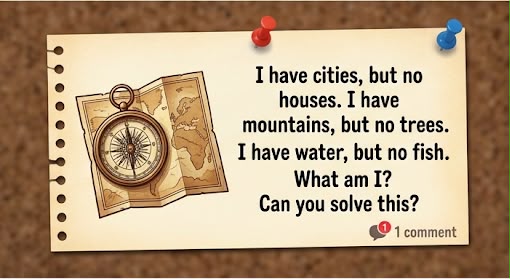
Classic brain teasers excel at challenging our lateral thinking by describing physical tools and objects through abstract, symbolic representations. One of the most famous and widely shared geographic riddles asks: “I have cities, but no houses. I have mountains, but no trees. I have water, but no fish. What am I?”
While simple on the surface, this riddle uses spatial metaphors to describe an essential tool for navigation and global exploration.
In this guide, we will reveal the answer, break down the logic behind each line, explore similar geographic brain teasers, and examine why solving riddles benefits mental sharpness.
What Is the Answer to the Riddle?
The answer to this classic brain teaser is a map (or a globe).
Decoding the Riddle Line by Line
- “I have cities, but no houses…”
- Maps depict major cities, state capitals, and urban centers using labels or dot markers, but they do not contain actual physical houses or buildings.
- “…I have mountains, but no trees…”
- Topographic and physical maps illustrate mountain ranges, elevation lines, and terrain shading without including actual living trees or forests.
- “…I have water, but no fish.”
- Oceans, seas, lakes, and rivers are drawn and shaded in blue, representing bodies of water without housing living marine life.
The Power of Cartography: How Maps Represent the World
The reason a map fits this riddle so cleanly lies in the fundamental nature of cartography:
- Symbolic Representation: Maps translate massive physical landscapes, natural boundaries, and human infrastructure into clear, readable symbols, lines, and colors.
- Abstract Scale: Cartographers scale down vast physical distances onto paper or digital screens, capturing entire mountain chains and metropolises in two-dimensional space.
Why Geographic Riddles Remain Popular
Puzzles like the map riddle continue to generate high engagement across social platforms and puzzle forums for several key reasons:
- Visualizing Concepts: The puzzle forces the brain to move beyond physical reality and consider symbolic representations.
- Accessible Fun: It is easy to understand for readers of all ages, making it great for family games, classroom trivia, or quick online sharing.
- Cognitive Boost: Engaging with conceptual riddles stimulates problem-solving neural pathways, boosting mental agility and focus.
Conclusion
The “map” riddle is an enduring classic that demonstrates how simple wordplay can turn geography into a clever puzzle. Next time you consult a GPS or unfold a paper map, you’ll appreciate the logic behind this iconic brain teaser!
Frequently Asked Questions (FAQ)
What is the origin of the map riddle?
This puzzle is a traditional riddle that dates back over a century, appearing in historical riddle collections, children’s puzzle books, and folklore across the English-speaking world.
Are there alternative answers to this riddle?
While “a map” (or a globe) is the standard intended answer, some creative solvers suggest digital navigation applications or virtual atlas software.
What are the main types of maps?
The primary types of maps include political maps (showing borders and cities), physical maps (showing landforms like mountains and rivers), topographic maps (showing elevation), and thematic maps (focusing on specific topics like climate or population density).
