
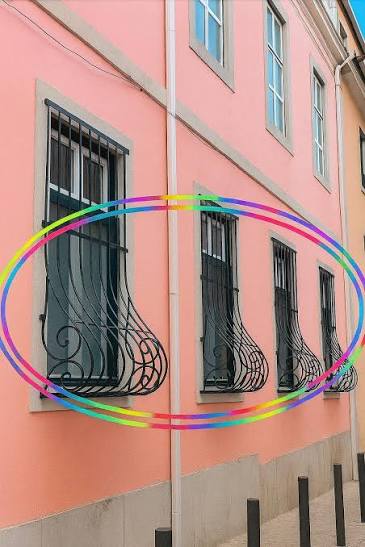
Walking through historic neighborhoods in Portugal, Spain, and parts of Latin America, observant travelers often notice a distinct architectural quirk: ground-floor window grilles that bulge outward near the base.
While standard security bars lie flat against a window frame, these wrought-iron structures—historically referred to as rejas de panza (belly grilles) or rejas abombadas—curve outward in a dramatic “S” shape.
In this guide, we explore the fascinating history, cultural significance, and practical functions behind these iconic architectural details.
The Practical Purpose of Curved Window Grilles
While security was the primary reason for installing iron grilles on ground-floor windows, the outward curve solved several practical and social challenges of past centuries:
1. Accommodating Hoop Skirts and Bustles
- In the 18th and 19th centuries, women’s fashion featured wide hoop skirts (crinolines) and bustles. The outward curve allowed women to stand right at the window ledge to look out, talk to neighbors, or get fresh air without their bulky dresses crumpling against flat metal bars.
2. Social Courting and Interaction
- In traditional Spanish and Portuguese culture, young women often socialized with suitors through ground-floor window grilles (pelar la pava). The curved design provided enough space to lean forward, converse comfortably, and pass small items or letters back and forth while maintaining social decorum and physical security.
3. Potted Plants and Ventilation
- The protruding bottom ledge created a safe, secure shelf to place small potted flowers (such as geraniums) or herbs to catch sunlight without taking up indoor space or falling onto the street below.
Craftsmanship and Architectural Evolution
Fabricating these curved grilles required skilled blacksmithing:
- Wrought Iron Artistry: Blacksmiths heated iron rods to high temperatures to hand-bend the outward “belly” curve, frequently embellishing the base with ornate scrolls, spirals, and decorative rosettes.
- Security vs. Aesthetics: By combining structural strength with curved geometry, home owners achieved effective security against intruders while adding elegance and depth to the building’s facade.
Conclusion
What looks like a simple decorative choice today is actually a clever blending of security, social etiquette, and fashion history. The next time you spot a “belly grille” on a historic pastel building, you are looking at a centuries-old design built specifically for comfort and connection!
Frequently Asked Questions (FAQ)
What are curved window grilles called in Spanish?
They are commonly called rejas de panza (belly grilles) or rejas abombadas (bulging/convex grilles).
Where are these window grilles most commonly found?
They are widely found in historic towns across Portugal, Spain, and former Spanish colonial cities in Latin America (such as in Mexico, Colombia, and Cuba).
Were these grilles used solely for security?
No. While keeping intruders out was their primary function, the outward bulge specifically catered to dress fashions, window gardening, and social interaction at street level.
