
Introduction
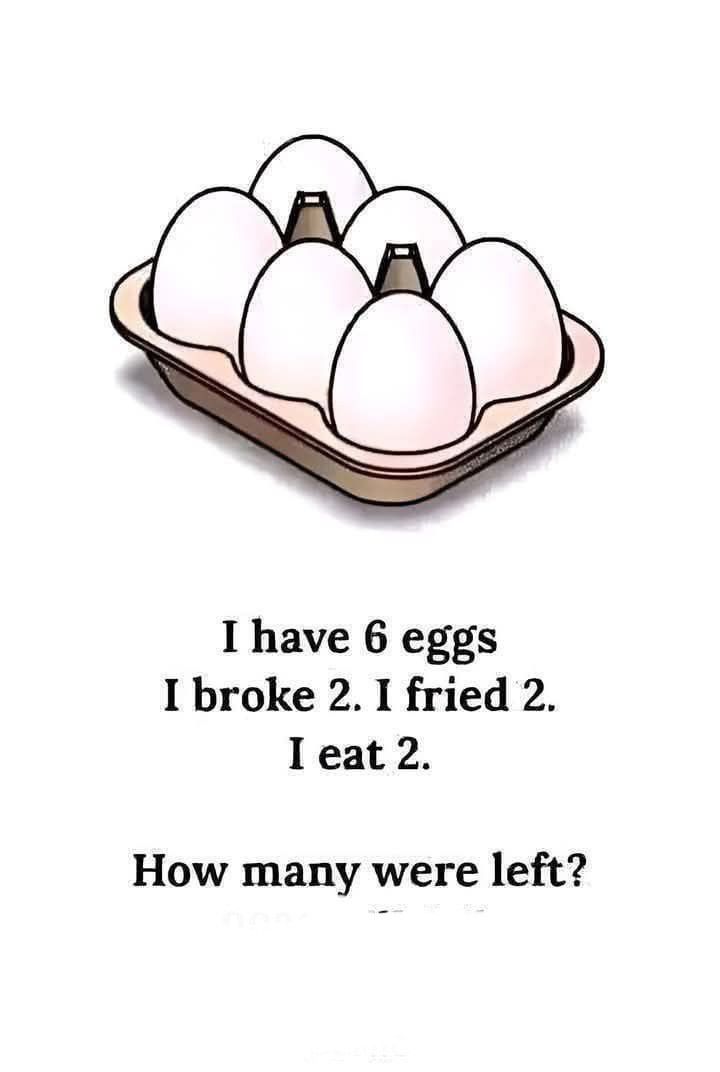
Viral trick questions, word riddles, and logic puzzles frequently circulate across social media, inviting users to test their reading comprehension and critical thinking skills. Designed specifically to spark playful debate and drive high comment engagement, these puzzles challenge solvers to look past standard arithmetic. When encountering an image stating “I have 6 eggs. I broke 2. I fried 2. I eat 2. How many were left?”, readers immediately start subtracting numbers in their heads.
Evaluating brain teasers closely mirrors examining tricky phrasing, linguistic nuances, and step-by-step problem-solving. In this comprehensive guide, we explore the simple logic behind this riddle, examine common calculation pitfalls, and share practical tips for solving word trick challenges.
Decoding the Egg Riddle
The secret to solving this puzzle lies in understanding that the actions described can apply to the exact same set of eggs.
1. Breaking Down the Clues
- Starting Amount: You start with 6 eggs.
- The Actions: “I broke 2. I fried 2. I eat 2.”
- The Trick: In many classic riddles, the same group of items undergoes multiple steps. If you break 2 eggs, fry those exact same 2 broken eggs, and then eat them, you are dealing with that same group of 2 eggs throughout the process. Therefore, out of the original 6 eggs, subtracting the 2 eggs that were used leaves you with 4 eggs.
2. Calculating the Final Count
- Total Started: 6 eggs
- Eggs Used/Eaten: 2 eggs (which were broken, fried, and eaten)
- Total Remaining: $6 – 2 = \mathbf{4}$ eggs left untouched in the carton!
Practical Tips for Solving Word Riddles
- Read Every Word Carefully: Word puzzles often use sequential descriptions that trick you into performing redundant subtractions.
- Visualize the Scenario: Picture yourself in the kitchen—breaking, frying, and eating the same couple of eggs doesn’t mean separate groups of eggs are being destroyed at each step.
- Engage Online: Sharing classic riddles is a fantastic way to test your logic and see how your reasoning compares with friends in the comment section.
Interesting Facts About Word Riddles
- Linguistic trick questions train the brain to pay close attention to semantics rather than relying purely on automatic math reflexes.
- Classic riddle graphics consistently rank among the most viral types of content on social media because they encourage friendly arguments in the comments.
- Wordplay puzzles stimulate the brain’s linguistic and logical processing centers simultaneously.
Conclusion
While viral social media riddles designed to test your math skills often trick people into subtracting every number mentioned, realizing that the same 2 eggs were broken, fried, and eaten leaves you with 4 eggs!
Frequently Asked Questions
How many eggs are left?
There are 4 eggs left in total (the 4 untouched eggs remaining from the original 6).
Why isn’t the answer 0?
Because the puzzle describes the same 2 eggs being broken, fried, and eaten sequentially, rather than six separate eggs being destroyed.
What is the trick behind this riddle?
It relies on phrasing that makes solvers think they need to subtract every single action ($6 – 2 – 2 – 2$) instead of recognizing that the actions overlap on the same items.
