
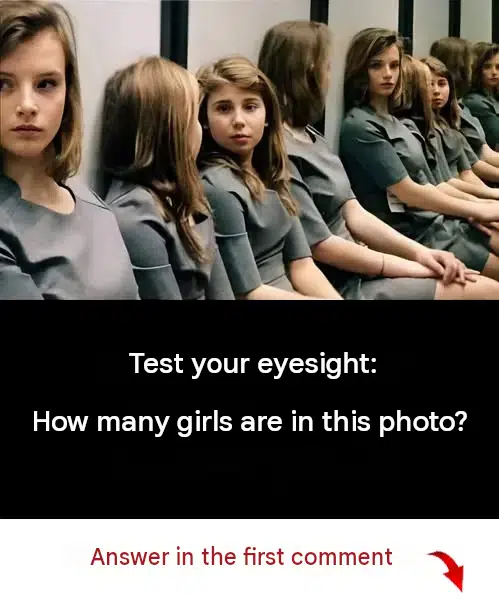
Internet optical illusions and viral photo puzzles have a unique way of capturing our attention, sparking fierce debates, and flooding social media comment sections. One of the most famous visual riddles circulating online features a seemingly endless row of girls sitting between two mirrors, creating a hypnotic infinity-mirror effect.
At first glance, viewers often count a dozen or more faces, leading to wildly different guesses. Is it an AI-generated image, digital manipulation, or a clever optical reflection?
In this comprehensive article, we will reveal the exact solution to this viral puzzle, explore the physics of mirrors and reflections, analyze why human visual perception easily gets tricked, and examine how critical observation benefits cognitive health.
Solving the Puzzle: How Many Girls Are There?
When looking at the image, mirrors placed on opposing sides create multiple reflections that make a small group look like a crowded room. However, if you look closely at the physical bodies rather than the reflected faces, the true count becomes clear.
The Correct Answer Revealed
There are only 2 girls sitting between the mirrors!
Why Does It Look Like So Many?
The setup utilizes a classic infinity mirror illusion (or two parallel mirrors facing each other):
- The Real People: There are only two actual human beings sitting on the bench.
- The Reflections: Each girl’s face and body is reflected backward and forward multiple times by the parallel mirrors flanking the scene, creating a repeating sequence of virtual images.
- The Visual Trick: Because the mirrors bounce the light reflections repeatedly, our brains struggle to distinguish between the physical person and their mirror reflections, multiplying the apparent count significantly.
The Science of Optics: How Parallel Mirrors Create Infinity
To understand why this illusion is so effective, we have to look at the fundamental laws of physics and geometrical optics.
Reflection and Light Bouncing
When light hits a smooth reflective surface like a mirror, it bounces off at the exact same angle it hit (the law of reflection). When two flat mirrors are placed parallel to each other with an object in between:
- Light from the object strikes Mirror A and creates a reflection.
- That same light then travels backward to strike Mirror B, creating a secondary reflection of the reflection.
- This process repeats continuously, creating a receding tunnel of identical images that visually appears to stretch into infinity.
Human Perception and Cognitive Biases
Our eyes capture raw visual data, but our brains do the heavy lifting of interpreting that data. When presented with a row of repeating faces, the brain relies on shortcuts. Instead of tracing each body to verify if it’s a reflection or a physical person, the brain assumes every distinct face represents a unique individual, resulting in an inflated count.
The Benefits of Optical Illusions and Brain Puzzles
Engaging with visual riddles, mirror illusions, and logic puzzles offers fantastic mental benefits.
1. Training Visual Discrimination
Puzzles like this train your eyes and brain to look past superficial confusion and focus on structural details (such as tracing arms, clothing alignment, and body posture rather than just counting faces).
2. Boosting Cognitive Agility
Challenging your perception helps prevent mental stagnation, encouraging flexible thinking and improving problem-solving speeds in everyday tasks.
3. Stress Relief and Entertainment
Taking a few minutes to solve a fun visual puzzle provides a healthy, engaging mental break from work or daily stressors.
Real-World Applications of Optics and Reflection Science
The principles demonstrated in this mirror illusion go far beyond viral internet posts. They play vital roles in modern technology, engineering, and daily life.
Medical and Scientific Instruments
- Endoscopes and Laparoscopes: Doctors use complex optical systems involving lenses and mirrors to look inside the human body through tiny incisions, minimizing surgical risks.
- Microscopes and Telescopes: Precision mirrors and glass lenses allow scientists to observe distant galaxies or microscopic cellular structures with incredible clarity.
Financial and Business Planning: Seeing the Full Picture
Just as optical illusions trick our perception by showing multiple reflections instead of reality, business leaders must look past surface-level data. When analyzing financial reports, investment portfolios, or market trends, thorough due diligence ensures you see the actual foundation rather than misleading reflections of growth.
Legal and Insurance Considerations
In legal services and insurance claims involving vehicle accidents or property damage, optical illusions, blind spots, and mirror reflections frequently complicate eyewitness testimony. Forensic investigators rely on strict optical calculations to determine what drivers or witnesses could actually see versus what was merely a reflection.
Tips for Solving Complex Visual Puzzles
If you want to sharpen your ability to beat optical illusions on the first try, keep these strategies in mind:
- Count Physical Bodies, Not Faces: In mirror puzzles, faces multiply infinitely, but physical torsos, hands, and feet are harder to duplicate seamlessly.
- Trace the Environment: Look for the edges of the mirrors or frame boundaries to understand where the real scene ends and the reflections begin.
- Take a Step Back: Sometimes changing your viewing angle or squinting helps filter out distracting background reflections.
Interesting Facts About Mirrors and Illusions
- Ancient Mirrors: The earliest mirrors were made from polished obsidian (volcanic glass) or hammered copper and bronze dating back thousands of years.
- The Pepper’s Ghost Effect: Nineteenth-century theater illusionists used angled glass plates and hidden lighting to make ghosts appear and disappear on stage—a technique still used in modern theme park rides and holographic concerts!
- The Speed of Light: When you look into a mirror, you aren’t seeing yourself in absolute real-time; you are seeing the reflection of light that traveled from your face to the mirror and back to your eyes, taking a tiny fraction of a microsecond!
Conclusion
The “How many girls are in this photo?” illusion is a brilliant reminder of how easily our brains can be tricked by clever lighting and parallel mirrors. While casual observers might count six, eight, or ten people, a closer look reveals that there are only two real girls creating a mesmerizing chain of reflections.
Sharing puzzles like this is a fantastic way to spark curiosity, challenge your friends, and appreciate the fascinating laws of physics operating all around us!
Frequently Asked Questions (FAQ)
Is this photo digitally manipulated or AI-generated?
No! This is a real photograph taken using physical mirrors placed in a specific configuration (often called an infinity mirror setup) to create the optical illusion naturally.
Why do mirrors create multiple images?
Mirrors bounce light back and forth between each other. Each time the light bounces, it captures another layer of reflection, creating a receding tunnel of identical images.
How can I tell the difference between a real person and a reflection in photos like this?
Look closely at the physical posture, clothing alignment, and the presence of mirror frames or seams that divide the physical space from the reflected space.
