
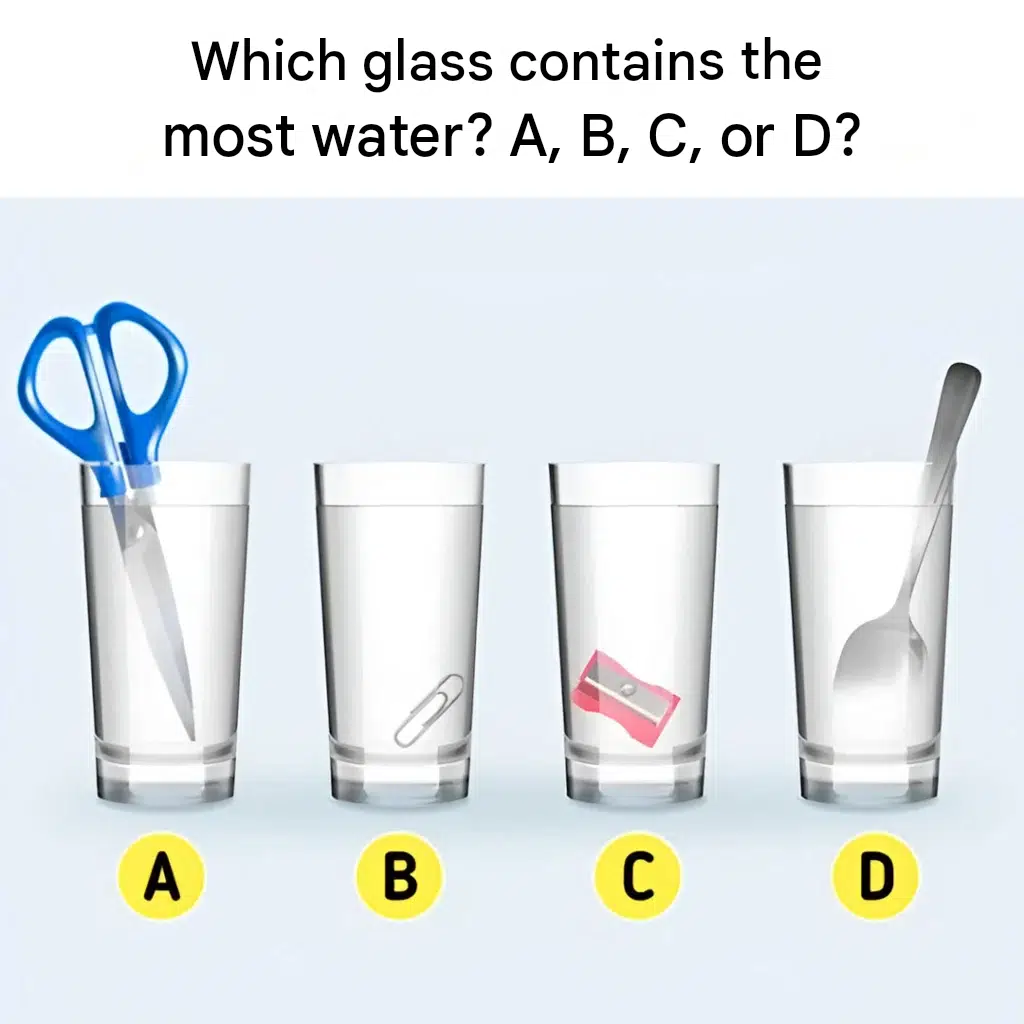
Brain teasers, optical illusions, and viral logic puzzles have taken the internet by storm in recent years. Among the most popular of these visual riddles is the classic “Which glass contains the most water?” puzzle. At first glance, all four glasses appear to have water filled to the exact same visual line. However, each glass holds a different everyday object submerged inside it: a pair of scissors, a paper clip, a pencil sharpener, and a metal spoon.
While it seems like a simple visual question, solving this riddle correctly requires a basic understanding of fundamental physics—specifically physics principles related to volume, mass, density, and liquid displacement.
In this comprehensive article, we will break down the exact solution to this viral puzzle, explain the science of Archimedes’ principle, explore how brain teasers benefit cognitive health, and examine how critical thinking skills apply to everyday real-world decision-making.
Solving the Puzzle: Step-by-Step Breakdown
To determine which glass contains the actual highest volume of water, we must analyze the total space inside each identical glass.
Understanding the Starting Point
- Identical Glasses: All four glasses (A, B, C, and D) are identical in size, shape, and capacity.
- Identical Water Levels: The apparent surface level of the water is at the exact same height across all four glasses.
- Different Submerged Objects: Each glass contains an object of varying physical volume submerged in the liquid:
- Glass A: Scissors (large visual size and volume).
- Glass B: Paper Clip (extremely tiny physical volume).
- Glass C: Pencil Sharpener (medium physical volume).
- Glass D: Metal Spoon (moderate physical volume).
The Correct Answer Revealed
The correct answer is Glass B!
Why Glass B Has the Most Water
When an object is placed into a glass of water, it displaces (pushes aside) a volume of water equal to the volume of the submerged portion of the object.
Because the water level appears even across all four glasses:
- The glass with the largest object (Glass A – Scissors) has the least amount of actual water, because the bulky object takes up a major portion of the space inside the glass.
- The glass with the smallest object (Glass B – Paper Clip) takes up the least amount of space, meaning it requires the greatest volume of real water to reach that same visual fill line.
Therefore, Glass B holds the maximum volume of liquid.
The Physics Behind the Puzzle: Archimedes’ Principle
This viral brain teaser is a direct practical illustration of Archimedes’ Principle, one of the fundamental laws of fluid mechanics.
What is Archimedes’ Principle?
Formulated by the ancient Greek mathematician and inventor Archimedes of Syracuse, the principle states that:
Any object, wholly or partially immersed in a fluid, is buoyed up by a force equal to the weight of the fluid displaced by the object.
When you drop an object into a filled container of liquid, the liquid level rises because the object needs room for its own physical volume.
Volume vs. Mass: A Common Confusion
Many people incorrectly answer this puzzle because they confuse mass (weight) with volume (3D space occupied):
- Mass: How heavy an object is.
- Volume: How much physical space an object occupies.
In this puzzle, weight does not determine the water level—volume does. Even if an object is made of heavy steel or light plastic, the amount of water it displaces depends purely on the physical space (volume) it takes up under the water line.
How Brain Puzzles Boost Cognitive Health and Brain Function
Engaging with daily visual puzzles, math riddles, and logic questions isn’t just entertaining—it offers tangible psychological and cognitive benefits.
1. Enhances Lateral Thinking
Standard problem-solving relies on linear logic. Visual riddles force your brain to look past initial impressions (the identical water lines) and evaluate underlying factors (the volume of submerged objects).
2. Promotes Neuroplasticity
Regular mental stimulation helps form new neural connections in the brain. Challenging your mind with diverse puzzles encourages neuroplasticity, keeping your brain sharp as you age.
3. Improves Focus and Visual Processing
Analyzing fine details in images trains your visual perception and improves short-term attention to detail, which is beneficial in both academic and professional environments.
Practical Applications: Science and Real-World Economics
Understanding liquid displacement and volume measurement extends far beyond online riddles. These core scientific concepts play crucial roles in major global industries.
Maritime Engineering and Shipping
Shipbuilders must calculate displacement precisely to design cargo ships, submarines, and cruise liners. Knowing how much water a ship displaces determines its buoyancy, payload capacity, and maritime safety ratings.
Healthcare and Medical Technology
In medical diagnostics and technology, fluid dynamics and volume measurement are critical. For example, hydro-density testing measures human body composition by measuring displaced water, helping fitness professionals and medical specialists determine precise body fat ratios.
Financial Planning and Resource Allocation
In business, finance, and investment management, the “displacement principle” is often used metaphorically. When investing resources, capital, or time into one asset class, it “displaces” availability for another. Smart business leaders analyze true net capacity before allocating major growth investments.
Tips for Solving Visual Riddles Faster
If you love testing your skills on viral logic games, follow these simple strategies to improve your solving speed:
- Identify the Constant Variables: Look for what stays the same (e.g., identical glass sizes, equal water height).
- Isolate the Distracting Variable: Pinpoint what changes between options (e.g., the size of the objects).
- Apply Basic Physical Rules: Ask yourself how natural laws (gravity, volume, density) interact with the scene.
- Avoid Emotional Rushing: Take ten seconds to double-check your initial instinct before finalizing your choice.
Interesting Historical Facts About Fluid Science
- The Original “Eureka!” Moment: Legend says Archimedes discovered his famous principle while stepping into a bath, noticing how the water level rose as his body sank into the tub. Excited by his discovery, he ran through the streets shouting “Eureka!” (“I have found it!”).
- Submarine Ballast Tanks: Submarines control their depth using Archimedes’ principle. By filling ballast tanks with water, they increase overall density to submerge. To rise back to the surface, compressed air blows the water out.
- Iceberg Displacement: Because ice is about 90% as dense as liquid water, roughly 90% of an iceberg’s volume remains hidden beneath the surface of the ocean!
Conclusion
The “Which Glass Has More Water?” riddle is a classic example of how simple visual illusions can challenge our perception. While all four glasses look evenly filled, applying basic principles of physical volume reveals that Glass B contains the highest amount of actual water.
Sharing riddles like this is a fun, interactive way to test your critical thinking, challenge friends, and appreciate the elegant science hidden in everyday life!
Frequently Asked Questions (FAQ)
Why doesn’t the weight of the object change the water level?
The height of the water level is determined by the physical volume (3D space) the object occupies under water, not its weight. A light plastic object and a heavy metal object of identical dimensions will displace the exact same amount of liquid.
What if an object floats on top of the water?
If an object floats, it displaces a volume of water equal to the weight of the floating object rather than its entire physical volume. However, in this specific puzzle, all objects are submerged within the water.
What is the difference between volume and capacity?
Volume refers to the amount of space an object occupies or encloses, measured in cubic units. Capacity refers to the maximum amount of liquid or material a container can hold.
