
Introduction
Deception is an intricate part of human interaction, woven deeply into the fabric of social psychology, history, and daily communication. From small “white lies” told to spare someone’s feelings to massive fraudulent schemes that destroy financial lives, the ability to discern truth from falsehood is a skill that humans have coveted for millennia. When presented with quotes attributed to brilliant minds regarding lie detection, people are naturally fascinated. Whether analyzing interpersonal relationships, conducting business meetings, or consulting with a legal services expert, knowing when someone is holding back the truth can change the entire dynamic of an interaction.
While detecting a lie with 100% accuracy remains impossible without definitive physical proof, behavioral scientists, interrogation experts, and cognitive psychologists have spent decades studying the mechanics of deception. It turns out that lying is mentally exhausting. Lying requires a person to fabricate a narrative, remember the fake details, suppress the real story, monitor the listener’s reactions, and consciously control their own behavioral cues—all simultaneously. This phenomenon, known in cognitive psychology as “cognitive load,” creates specific vulnerabilities in a liar’s story. By asking strategic questions that exploit this mental burden, you can quickly expose inconsistencies, hesitation, and underlying deception.
In this deep dive into the science of lie detection, we will explore the underlying principles of psychological deception, break down powerful behavioral triggers, examine two fundamental questioning methods that expose deceit, and provide practical strategies for spotting dishonest behavior in everyday situations.
1. The Psychology of Deception and Cognitive Load
To effectively spot dishonesty, one must first understand what occurs inside the human brain during a lie. Telling the truth is cognitively effortless: the brain simply retrieves a recorded memory from neural storage and describes it as it occurred. Deception, however, is a complex multi-tasking process.
The Mental Effort Behind a Deception
When an individual decides to lie, their brain enters a high-workload state. The cognitive strain consists of several distinct stages:
- Constructing the Falsehood: The liar must manufacture a plausible narrative that fits the situation while avoiding obvious contradictions.
- Suppressing the Truth: The brain must actively suppress real memories and impulses to speak the truth, requiring substantial executive function and focus.
- Monitoring Performance: The deceiver constantly assesses their tone, eye contact, body language, and facial expressions to ensure they appear relaxed and convincing.
- Evaluating the Listener: The liar closely watches the listener’s face and micro-expressions to gauge whether the lie is being believed or if suspicion is arising.
- Managing the Script: The deceiver must remember every detail of the fake story so they don’t accidentally contradict themselves later in the conversation.
Because the brain’s processing bandwidth is limited, this high cognitive load creates subtle leaks. An individual focused on remembering a complex lie will often struggle to maintain natural body language, smooth speech patterns, or immediate response times.
Baseline Behavior: The Foundation of Detection
A fundamental rule in scientific lie detection is establishing a subject’s “baseline.” A baseline refers to how a person normally behaves, speaks, and moves when they are entirely comfortable and telling the truth.
Without establishing a baseline, it is easy to misinterpret nervous habits—such as fidgeting, clearing the throat, or avoiding eye contact—as signs of guilt. Some naturally anxious people exhibit “deceptive” body language even when completely innocent. Conversely, seasoned deceivers or narcissists can remain calm under direct pressure. Effective detection involves looking for sudden deviations from an individual’s normal, relaxed baseline state rather than relying on stereotypical “poker tells.”
2. The 2 Core Questions That Unmask Deception
In high-stakes environments—such as law enforcement interrogations, corporate insurance fraud investigations, or legal proceedings—investigators rely on structured questioning techniques designed to increase cognitive load on suspect individuals. Two core strategic question formats are universally recognized by deception experts as the most effective tools for exposing a liar.
Question Type 1: The Unanticipated Reverse Question
“Can you tell me everything that happened, but starting from the end and moving backward?”
Most liars prepare their stories in chronological order: First A happened, then B happened, which led to C. They rehearse this sequence mentally, building a linear timeline that sounds smooth and polished. However, very few liars prepare their fabricated stories in reverse order.
When you ask someone to recount an event backward—starting with the outcome and working back to the beginning—the cognitive strain increases exponentially for a deceiver. An innocent person retrieving genuine sensory memories can easily jump around the timeline because the real experience is mapped in their brain. A liar, on the other hand, must constantly cross-reference their fake narrative to ensure they don’t contradict themselves.
What to look for during a reverse timeline question:
- Unusual delays and pauses: Long silences as the brain desperately processes the fake timeline in reverse.
- Drop in detail: The story suddenly becomes vague, lacking sensory details like sounds, colors, or subtle interactions.
- Increased anxiety cues: Unconscious physical fidgeting or heavy breathing due to sudden mental exhaustion.
Question Type 2: The Spatial / Unexpected Detail Question
“What were you looking at or thinking right before [Event X] happened, and can you draw the layout of the room?”
Liars almost always focus on preparing the “core story”—the main events, excuses, or alibis. They rarely prepare answers for obscure, peripheral, or sensory details. Asking an unexpected spatial or situational question forces the speaker to construct new details on the spot.
For instance, if a person claims they were at a restaurant during a specific time, asking them what the host looked like, where the restrooms were located, or to draw a quick sketch of their seating position will catch a liar completely off guard.
What to look for during a spatial detail question:
- Glancing upward or searching: An innocent person re-examines a real memory in their mind’s eye. A liar often looks away to invent details or displays frustration at being asked “irrelevant” questions.
- Verbal stalling: Phrases like “Why does that matter?” or “I don’t see why you need to know that” are classic stalling tactics used to buy time while inventing a plausible answer.
- Inconsistent spatial logic: A fabricated sketch or description often contains logical impossibilities that contradict previous statements.
3. Verbal and Behavioral Indicators of Deception
Beyond asking strategic questions, paying close attention to specific verbal patterns and physical behaviors can help you evaluate a person’s honesty.
Language and Linguistic Indicators
When people lie, their linguistic patterns often shift subconsciously as they try to distance themselves from the lie or convince you of their integrity.
- Over-emphasizing Honesty: Frequent use of qualifying phrases like “To be completely honest with you,” “Swear to God,” or “Frankly speaking.” Honest people rarely feel the need to repeatedly vouch for their own truthfulness.
- Linguistic Distance: Avoiding personal pronouns like “I,” “me,” or “my.” A liar might say “The car was driven away” instead of “I drove the car away,” psychologically distancing themselves from the action.
- Repeating the Question: Repeating the exact question asked (e.g., “Did I take the money? No, I did not take the money.”) gives the deceiver extra seconds to fabricate a response.
- Selective Memory Gaps: Overusing phrases such as “As far as I can recall” or “Not that I know of” to leave an escape route in case evidence later contradicts them.
Micro-Expressions and Body Language
While popular media exaggerates certain body language tells, specific physical reactions—driven by the autonomic nervous system—remain difficult for a liar to control.
+--------------------------+------------------------------------------------------+
| Indicator                | Deceptive Significance                               |
+--------------------------+------------------------------------------------------+
| Micro-Expressions        | Brief, involuntary facial twitches revealing true    |
|                          | emotions (fear, contempt, anger) for milliseconds.   |
+--------------------------+------------------------------------------------------+
| Artificial Eye Contact   | Unnatural, unblinking eye contact used consciously   |
|                          | by liars trying to appear extra convincing.          |
+--------------------------+------------------------------------------------------+
| Barrier Behaviors        | Crossing arms, placing objects (like cups or bags)   |
|                          | between themselves and the interviewer.              |
+--------------------------+------------------------------------------------------+
| Dry Mouth / Throat Gulp  | Stress triggers adrenaline, stopping saliva flow     |
|                          | and causing frequent swallowing or throat-clearing.  |
+--------------------------+------------------------------------------------------+
4. Famous Quotes and Historical Misattributions
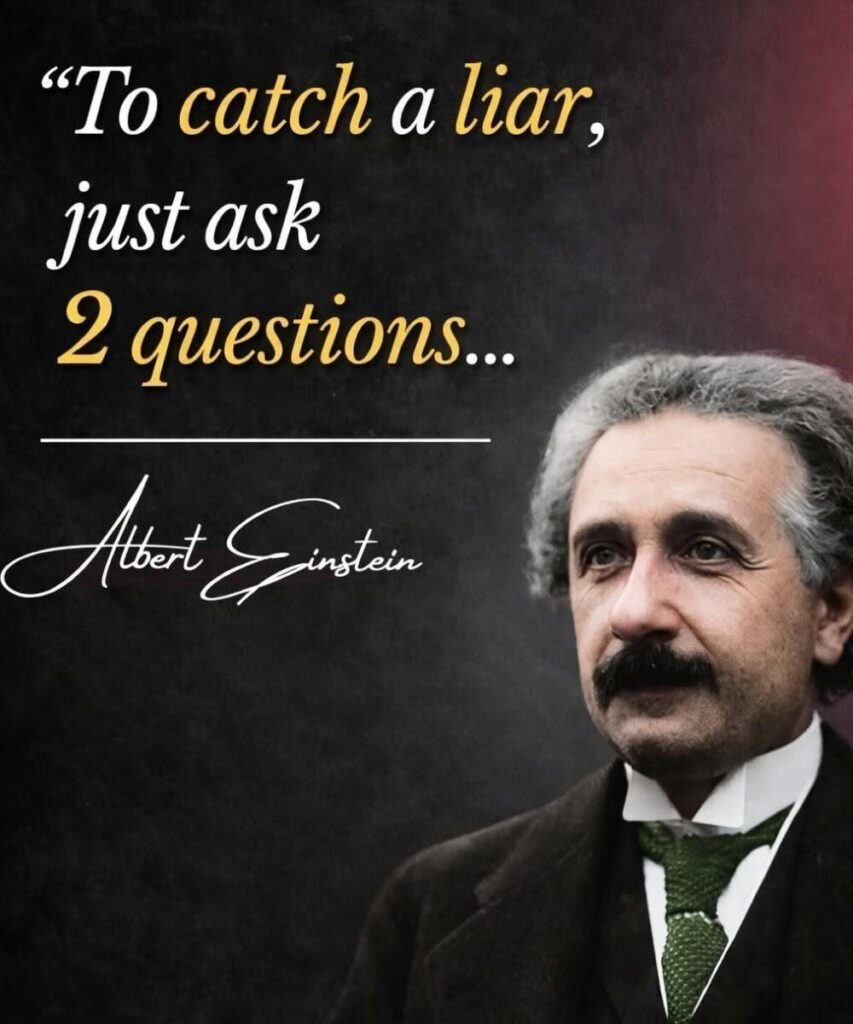
Internet culture is filled with inspiring and provocative quotes credited to famous figures like Albert Einstein, Mark Twain, or Abraham Lincoln. However, historical accuracy is often sacrificed for viral engagement.
The Attribution Trend on Social Media
Memes featuring iconic figures alongside compelling quotes about human nature, philosophy, or psychology are engineered to maximize viral reach. Attaching a quote to a historical genius like Albert Einstein lends immediate authority and credibility to the message, making viewers far more likely to share, like, and comment.
Albert Einstein on Truth and Human Nature
While Albert Einstein wrote extensively on physics, philosophy, ethics, and human society, many viral quotes attributed to him regarding lie detection, modern relationship advice, or specific psychological tricks are apocryphal. Einstein’s actual writings on truth focused heavily on scientific inquiry, objective reality, and ethical integrity. One of his genuine and famous reflections on honesty states:
“Whoever is careless with the truth in small matters cannot be trusted with important matters.” — Albert Einstein
This real insight highlights that honesty is a deeply ingrained character trait. A person who routinely exaggerates or shades the truth in trivial daily situations is statistically far more likely to engage in significant deception when high stakes—such as personal finances, legal disputes, or business partnerships—are on the line.
5. Practical Applications in Business, Finance, and Daily Life
Understanding deception principles isn’t just an academic exercise; it offers valuable real-world utility across professional and personal domains.
In Corporate and Financial Environments
In business, trade, and investment, verifying information accuracy is critical. Whether evaluating a potential business partner, conducting due diligence for a loan, or discussing terms with a mortgage broker, asking open-ended, detail-oriented questions can prevent costly mistakes.
- Verification over Assumption: Always verify factual claims through independent data, documentation, or background checks rather than relying purely on verbal assurance.
- Analyzing Inconsistencies: Pay close attention when financial projections, revenue figures, or operational details shift during follow-up conversations.
In Legal and Insurance Domains
Attorneys, legal services teams, and insurance claims adjusters undergo rigorous training in statement analysis. They examine written and spoken statements for structural anomalies:
- Statement Balance: Genuine statements typically spend equal time describing what happened before, during, and after an event. Deceptive statements often spend 80% of the narrative building up the backstory and rush through the crucial event itself.
- Unsolicited Excuses: Providing elaborate explanations for questions that were never asked often points to a guilty conscience attempting to pre-empt suspicion.
In Personal Relationships
Detecting dishonesty in personal relationships requires immense tact and empathy. Jumping to conclusions based on a single fidget or pause can damage trust.
- Focus on Communication: Instead of playing detective, use open, non-confrontational dialogue to explore discrepancies.
- Look for Patterns: A single suspicious behavior is rarely proof of a lie; a cluster of behavioral changes across time is far more telling.
Conclusion: Developing Your Critical Thinking Skills
Detecting deception is less about reading minds and more about understanding human cognitive limits. By shifting focus from unreliable body language “tells” to cognitive questioning strategies, you can evaluate statements with much greater precision.
The two fundamental questioning techniques—asking for a narrative in reverse order and probing for unexpected spatial details—leverage the natural limits of human memory and cognitive load. Combined with establishing a solid behavioral baseline and listening for linguistic shifts, these techniques provide a practical toolkit for discerning truth in everyday life.
Ultimately, while viral quotes and clever online advice spark curiosity, real lie detection relies on critical thinking, careful observation, and patience. In a world full of noise and misinformation, cultivating a sharp, analytical mind is one of the best investments you can make for your personal and professional future.
Practical Tips for Evaluating Honesty
- Always Establish a Baseline First: Spend the first few minutes of conversation engaging in relaxed, low-stakes small talk to learn how the person behaves when telling the truth.
- Ask Open-Ended Questions: Avoid questions that can be answered with a simple “yes” or “no.” Force the speaker to construct full sentences and detailed narratives.
- Utilize Strategic Silence: After a person answers a question, pause and remain silent for two or three seconds. A liar will often feel uncomfortable with the silence and fill it with unnecessary, revealing details.
- Focus on Cognitive Load: If you suspect a fabricated story, ask questions that require mental effort to answer, such as drawing a sketch or clarifying precise timelines.
- Look for Clusters, Not Single Signs: Never label someone a liar based on a single physical gesture. Search for a cluster of three or more behavioral and verbal changes occurring simultaneously.
- Verify Physical Facts: Whenever possible, cross-check verbal claims against written records, digital logs, or third-party confirmation.
FAQ Section
Q: Is there a guaranteed physical sign that proves someone is lying?
A: No. There is no single universal behavior—such as looking to the left, touching one’s nose, or clearing one’s throat—that definitively proves deception. All behavioral signs must be evaluated against the person’s baseline behavior and the overall context.
Q: Does eye contact reveal whether a person is telling the truth?
A: Not reliably. A common myth is that liars avoid eye contact. In reality, many practiced liars maintain deliberate, intense eye contact specifically because they know people look for eye avoidance as a sign of lying.
Q: Did Albert Einstein actually publish a guide on catching liars?
A: No. Albert Einstein was a theoretical physicist known for his groundbreaking work on relativity and quantum mechanics. Quotes attributing formal lie detection techniques or specific “2-question methods” to Einstein are modern internet fabrications designed to make viral content more appealing.
Q: How do professional interrogators catch experienced liars?
A: Professionals use advanced techniques such as the Strategic Use of Evidence (SUE) framework. They withhold key evidence they already possess and ask the suspect questions about those specific details. When the suspect’s statement contradicts the physical evidence, the deception is revealed.
Q: Can anxiety make an innocent person look guilty?
A: Yes, absolutely. High levels of stress, fear, or anxiety can produce physical reactions—such as sweating, stammering, elevated heart rate, and fidgeting—that mimic deceptive behavior. This is why establishing a calm baseline is critical before drawing conclusions.
