
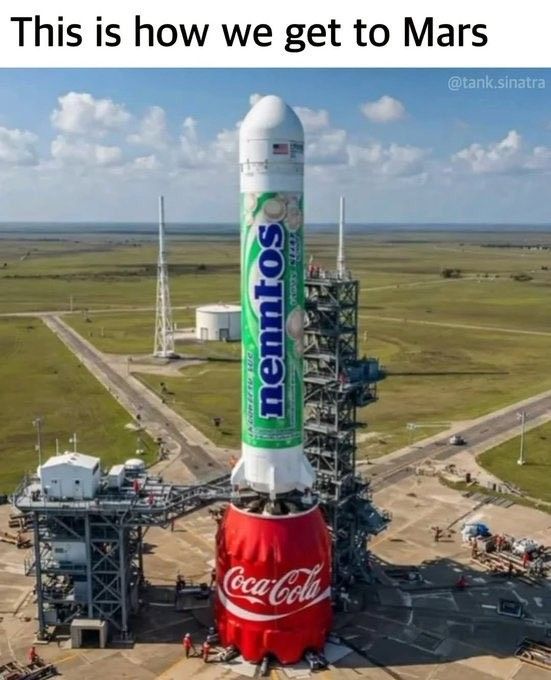
Internet humor and science memes often merge popular culture with real physical principles to spark viral discussions. A widely circulated viral graphic titled “This is how we get to Mars” features an edited space launchpad photo where the rocket fuselage is replaced by a massive roll of Mentos mints sitting atop a giant Coca-Cola bottle. This funny visual joke taps into the famous science experiment involving carbonated soda and mint candy eruptions, posing a humorous alternative to conventional space travel.
Understanding the chemistry behind the Mentos and soda reaction, comparing rapid gas expansion to real rocket propulsion, and exploring modern space exploration insurance offers an engaging look into this science meme.
The Science Behind the Mentos and Soda Eruption
The dramatic geyser created when Mentos mints drop into carbonated soda is a famous physical reaction called nucleation.
1. Rapid Carbon Dioxide Release
Carbonated soda is packed with dissolved carbon dioxide gas under pressure. When Mentos mints are dropped into the liquid, the micro-pitted, rough surface of the candy acts as thousands of microscopic nucleation sites, forcing dissolved carbon dioxide gas to rapidly form bubbles and expand out of solution.
2. Surface Tension Breakdown
Ingredients in the mints—such as gum arabic and gelatin—break down the surface tension of the liquid soda. This allows carbon dioxide bubbles to expand almost instantly, forcing liquid up and out of the bottle neck in a high-velocity jet stream.
Comparing Soda Geysers to Real Rocket Propulsion
While a Mentos eruption creates impressive thrust on a small scale, real spaceflight relies on chemical combustion and immense force.
1. Thrust and Specific Impulse
Rocket propulsion systems (such as liquid oxygen and kerosene engines) generate thrust through extreme high-temperature chemical reactions, producing exponentially more energy per unit of mass than carbon dioxide gas expansion ever could.
2. Payload Requirements for Interplanetary Travel
Reaching Earth orbit or traveling to Mars requires reaching escape velocity (over 25,000 miles per hour). While compressed gas thrusters are used for minor spacecraft maneuvers in microgravity, launching heavy payloads into deep space requires liquid or solid rocket propellants.
Space Exploration, Aerospace Innovation, and Insurance Coverage
Modern space missions to Mars and low-Earth orbit involve complex logistics, high technology, and specialized risk management.
Commercial Spaceflight and Satellite Risks
As commercial space agencies expand launch schedules, protecting high-value aerospace hardware, satellites, and crewed vessels requires dedicated commercial space insurance policies. Space launch coverage helps aerospace organizations mitigate risks associated with launch failures, orbital deployments, and experimental technology tests.
Practical Tips for Performing the Soda and Mentos Science Experiment
- Use Diet Soda: Diet carbonated drinks contain artificial sweeteners that create higher, less sticky geysers compared to sugary sodas.
- Use Mint Mentos: Original mint-flavored Mentos have a rougher surface texture with more nucleation sites than fruit-flavored candy coatings.
- Conduct the Experiment Outdoors: The rapid foam release creates a large mess, making open outdoor grassy areas the best setting for safety and cleanup.
Frequently Asked Questions (FAQ)
What causes the Mentos and Diet Coke eruption?
The reaction is a physical process called nucleation, where the rough surface of the candy rapidly releases dissolved carbon dioxide gas from the liquid.
Could a soda and Mentos reaction launch a real rocket?
No. While the gas expansion produces short-term kinetic energy, it lacks the energy density and velocity required to lift heavy structures or achieve orbital velocity.
Is commercial space travel covered by insurance?
Yes. Modern aerospace ventures utilize specialized launch insurance, satellite coverage, and space liability protection for orbital missions.
