
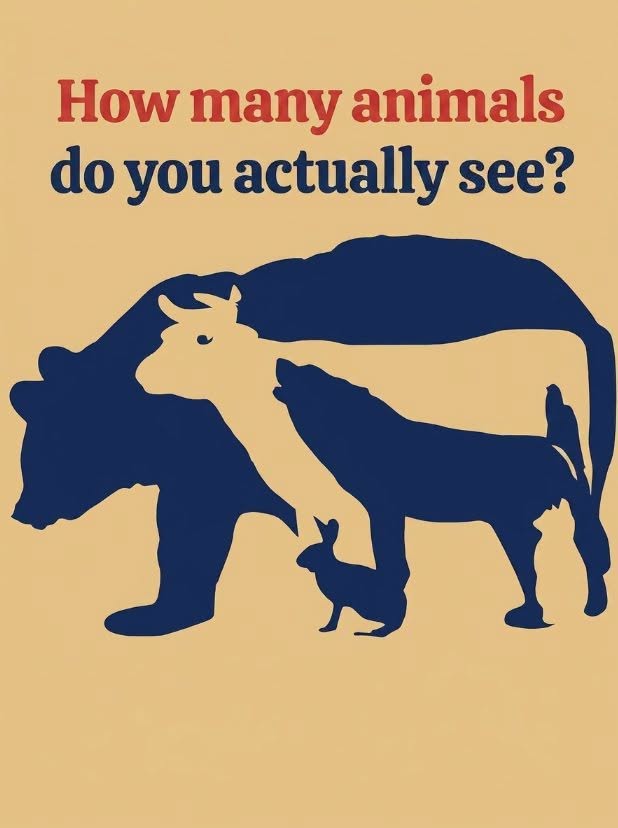
Visual brain teasers utilizing negative space are popular social media puzzles that challenge observation skills and cognitive flexibility. A viral image asking “How many animals do you actually see?” features layered silhouettes nested within one another. By manipulating positive and negative space, artists create clever visual illusions where one animal’s outline forms the shape of another. Finding every hidden creature requires systematic scanning and attention to visual contrast.
Understanding how visual perception works, identifying nested silhouettes, and practicing observation techniques makes solving visual puzzles a fun mental exercise.
Breakdown of Hidden Animals in the Image
Looking closely at the contrast between the dark blue figures and light background reveals four distinct animals nested together.
1. The Large Bear (Background Silhouette)
The outer dark blue silhouette forming the largest outline is a bear, walking toward the left with large paws and a broad back.
2. The Cow (Negative Space Figure)
Inside the body of the bear, the light beige negative space forms the complete silhouette of a cow, facing left with horns and a tail.
3. The Wolf (Inner Dark Silhouette)
Layered within the chest and body area of the cow is a dark blue silhouette of a wolf, facing left with its head tilted upward as if howling.
4. The Rabbit (Smallest Foreground Silhouette)
Tucked near the front legs of the cow and underneath the wolf is the smallest dark blue figure: a rabbit sitting with upright ears.
How Negative Space Illusions Work
Visual puzzles like this rely on the brain’s ability to distinguish figure from ground in art and design.
Figure-Ground Perception
The human visual cortex automatically attempts to organize images into a main subject (the figure) and a backdrop (the ground). When artists design overlapping shapes where background spaces form complete subjects, the brain toggles between interpreting light and dark areas as distinct objects.
Cognitive Benefits of Brain Teasers
Regularly practicing visual brain teasers enhances spatial reasoning, improves visual acuity, and strengthens mental focus across all age groups.
Practical Tips for Solving Silhouette Puzzles
- Alternate Between Light and Dark Areas: Shift your focus deliberate between dark shapes and light background areas to spot hidden outlines.
- Scan from Outer Outlines Inward: Start by identifying the largest surrounding shape before looking for smaller shapes nested inside.
- Look for Distinct Feature Cues: Search for recognizable features like ears, tails, snouts, or paws that signal a specific animal profile.
Frequently Asked Questions (FAQ)
How many total animals are in this image?
There are 4 distinct animals hidden in the puzzle: a bear, a cow, a wolf, and a rabbit.
What is negative space in art?
Negative space refers to the empty or background area surrounding and between the main subjects of an image, often used to create hidden secondary shapes.
Why do some people miss the smaller animals?
The brain naturally focuses on the largest, most dominant shapes first, often filtering out smaller nested figures until forced to scan details closely.
