
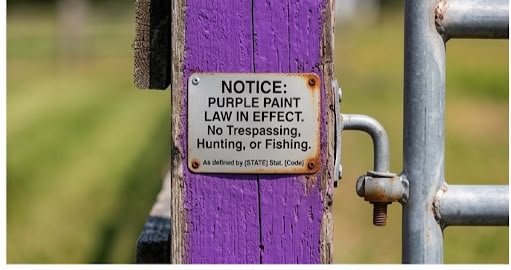
If you drive past rural properties, farm gates, or forest perimeters, you may see metal signs explicitly stating “NOTICE: PURPLE PAINT LAW IN EFFECT. No Trespassing, Hunting, or Fishing.” Paired with vibrant purple markings on fence posts or gate structures, these warnings carry serious legal authority.
Across more than 20 U.S. states, Purple Paint Laws recognize purple markings as legally binding “No Trespassing” indicators.
In this legal guide, we will break down what the Purple Paint Law means, how property owners use it, and key guidelines to follow around private land boundaries.
What Is the Purple Paint Law?
The Purple Paint Law allows property owners to mark trees, boundary posts, or gate entrances with bright purple paint to legally prohibit unauthorized access.
1. Legal Equivalent to Posted Signs
- Full Enforcement: Under state statutes, a purple paint stripe serves as an official legal notice equal to traditional metal or plastic “No Trespassing” signs.
- Explicit Restrictions: Entering property marked with purple paint without permission constitutes illegal trespassing, including unapproved hunting, fishing, trapping, or hiking.
2. Standardized High-Visibility Warning
Legislatures selected purple because it does not match natural landscape colors, making it easily distinguishable for outdoor recreationists and travelers.
Why Landowners Use Purple Paint Markings
Property owners favor purple paint for several key reasons:
- Weather and Time Durability: Physical signs deteriorate in rain, snow, or direct sun. Outdoor-grade paint remains visible on wood or metal surfaces for years.
- Cost-Effective Land Coverage: Spraying paint lines along lengthy perimeter fences or remote acres costs significantly less than buying dozens of signs.
- Prevention of Theft and Vandalism: Metal or plastic signs are frequently stolen, destroyed, or knocked down. Paint cannot be easily removed by trespassers.
Standard Statutory Requirements for Purple Markings
State laws outline specific rules for applying legal purple property marks:
- Stripe Dimensions: Paint marks must generally be vertical lines measuring at least 8 inches long and 1 inch wide.
- Eye-Level Height: Marks must be positioned between 3 feet and 5 feet above the ground level for clear visibility.
- Spacing Standards: Paint stripes along fences, posts, or boundary trees are typically spaced no more than 100 feet apart.
Conclusion
A “Purple Paint Law in Effect” sign or purple boundary marking serves as a clear legal notice indicating private property. Understanding these markings helps outdoor enthusiasts avoid accidental trespass violations and respect property rights.
Frequently Asked Questions (FAQ)
What states recognize the Purple Paint Law?
Over 22 U.S. states enforce Purple Paint Laws, including Texas, Arkansas, Missouri, Florida, Illinois, Indiana, Kansas, Maine, North Carolina, Pennsylvania, and Tennessee, among others.
Does the Purple Paint Law apply to hunting and fishing?
Yes. Purple paint marks signify no trespassing for any unauthorized activities, explicitly including hunting, fishing, foraging, camping, and off-road driving.
Do landowners have to post a metal sign along with purple paint?
No. In states with active Purple Paint Laws, paint markings alone are sufficient under the law, though some property owners add explanatory metal signs for added clarity near gates and main entrances.
