
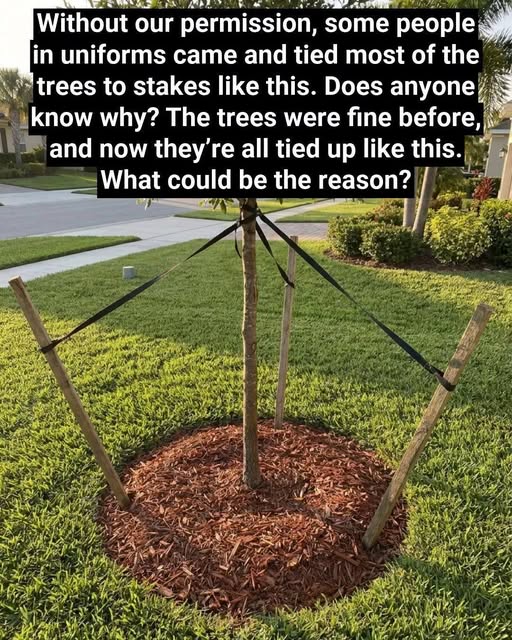
When unexpected changes occur on or around residential property, concern is a natural reaction. Property owners take pride in their landscaping, and any unannounced intervention by individuals in uniforms can instantly spark curiosity, confusion, and even anxiety. Recently, a common scenario has been making rounds in community discussions: homeowners waking up to find that newly planted or established trees on or near their property lines have been securely tied to wooden stakes using heavy-duty straps, entirely without prior warning.
For those unfamiliar with municipal codes, landscaping maintenance protocols, and real estate management, this sight looks alarming. The immediate questions that arise involve legality, property rights, and the physiological impact on the trees themselves. Why would municipal workers, utility crews, or landscape management teams suddenly stake trees that appeared to be standing perfectly fine on their own? To answer this fully, we need to explore arboriculture, property law, local governance, and the broader financial and legal implications of urban forestry management.
Decoding the Stakes: What Tree Staking Actually Means
In professional arboriculture, staking is a standard technique used to support trees, particularly young ones or those recently transplanted. When a tree is moved from a nursery to a residential landscape, its root system is significantly reduced. This leaves the tree temporarily vulnerable to environmental stressors, most notably strong winds, heavy storms, and shifting soil.
Staking provides external stability, ensuring that the root ball remains firm in the ground. If a tree rocks back and forth excessively in high winds, the delicate new root tips that are trying to establish themselves can snap. Without these roots absorbing water and nutrients, the tree’s overall health declines rapidly. Therefore, staking acts as a mechanical safeguard, holding the trunk steady until the root system grows deep and wide enough to anchor the tree naturally.
However, improper staking can cause damage. When crews or homeowners leave straps on too long, or tie them too tightly, it can girdle the trunk, cutting off the flow of nutrients and water beneath the bark. This explains why professional guidelines emphasize that staking is usually a temporary measure—rarely meant to last beyond one full growing season.
Why Are Workers in Uniforms Suddenly Staking Trees?
Seeing workers in uniforms appear out of nowhere can feel like an intrusion, but there are several standard operational reasons why this happens on public easements, community property, or newly developed residential areas.
1. Municipal and City Ordinances
In many planned communities and suburban neighborhoods, local governments or city forestry departments maintain strict landscaping requirements. If a subdivision is relatively new, the developers or city planners often hold a warranty period during which the contractor or municipality is legally responsible for the survival of street trees planted in the public right-of-way or utility easements. If local inspectors notice that recent windstorms have caused young trees to lean, municipal maintenance crews will step in automatically to protect the public investment without knocking on every door.
2. Homeowners Association (HOA) Regulations
Master-planned communities managed by an HOA often hire third-party landscape architecture firms. These firms operate under strict aesthetic and horticultural guidelines. If community inspectors notice that a row of trees is leaning or failing to establish a straight vertical axis, they will dispatch a crew to stake them. Because these areas often include shared common elements or specific easements defined in property deeds, individual homeowners may not have direct control over what happens within these zones.
3. Real Estate Developer Warranties and Municipal Compliance
When purchasing property in a new development, the title work, mortgage agreements, and local zoning laws often dictate shared responsibilities regarding landscaping. Developers are frequently required by city planning commissions to ensure a high survival rate for newly planted canopy trees. Staking is a proactive measure to prevent liability issues or failure during municipal inspections, protecting property values across the entire neighborhood.
Legal and Property Considerations: Easements Explained
One of the most frequent points of friction between property owners and municipal or utility workers involves the concept of property boundaries versus easements. Many homeowners assume that the grass and trees extending from their front door to the street belong entirely to them. Legally, however, a significant portion of this front yard often sits on a utility or public right-of-way easement.
An easement grants specific entities—such as the city, county, or utility providers—the legal right to access and maintain the land for public benefit. This can include maintaining drainage systems, running power lines, repairing water mains, and managing street trees. Understanding the legal boundaries outlined in your property survey can prevent unnecessary disputes when crews arrive to perform maintenance.
When legal or municipal interventions occur, having a clear grasp of local real estate laws, property titles, and community bylaws helps homeowners navigate changes smoothly. In complex situations involving property disputes, boundary overlaps, or damage claims, consulting a qualified attorney or legal services professional specializing in real estate law can provide necessary clarity.
Financial Impacts on Property Value and Landscaping Investments
Landscaping is not merely an aesthetic choice; it is a substantial financial investment that directly influences property valuation. Mature, healthy trees can increase a residential property’s market value by a measurable percentage, offering shade that reduces energy costs and enhances curb appeal.
When municipalities or developers invest in urban forestry, they are protecting long-term community assets. Conversely, neglected trees that lean, uproot, or pose safety hazards can lead to property damage, lower appraisal values, and potential legal liabilities if a falling branch damages a vehicle or structure. Proper maintenance, including timely staking and pruning, mitigates these financial risks.
For homeowners navigating broader financial planning, factoring in property maintenance, local tax assessments tied to community developments, and insurance coverages for structural landscaping is essential. Just as homeowners carefully review their mortgage terms, insurance policies, and investment portfolios, staying informed about neighborhood infrastructure management ensures that property assets remain secure and well-maintained over time.
Practical Tips for Homeowners Navigating Neighborhood Landscaping
Discovering unexpected modifications to your property can be jarring, but handling the situation constructively ensures peace of mind and protects your landscape. Consider the following practical steps when dealing with unexpected maintenance or landscaping interventions:
- Check your property survey and deed to identify whether the affected trees sit within a designated public easement or right-of-way zone.
- Contact your local municipal public works department or city forester to ask if a neighborhood-wide tree stabilization project is currently underway.
- Reach out to your Homeowners Association (HOA) management office to verify if the landscaping crew was dispatched for routine community maintenance or warranty compliance.
- Inspect the staked trees carefully to ensure that the support straps are not digging tightly into the bark or girdling the trunk, which can cause long-term injury.
- Document the changes with clear photographs in case you need to report improper installation or potential damage to young tree trunks.
- Allow the stakes to remain through the high-wind seasons, but monitor the tree’s growth so that supports can be removed after one year once roots are firmly established.
Interesting Facts About Urban Forestry and Tree Staking
- Research shows that trees allowed to move slightly in the wind develop thicker trunks and stronger root systems compared to trees that are rigidly staked for too long.
- Many cities have aggressive urban canopy initiatives, planting thousands of trees annually to combat the urban heat island effect and improve local air quality.
- The practice of staking dates back centuries, evolving from rigid wooden braces to modern, flexible nylon straps designed to minimize bark damage.
- Public right-of-way easements often extend several feet inward from the sidewalk or curb, meaning the homeowner owns the aesthetic upkeep while the city retains management rights.
- Proper urban forestry management can reduce residential cooling costs by providing strategic shade during peak summer months.
Conclusion
Finding trees suddenly tied to stakes by uniformed crews can feel alarming at first glance, but it is almost always a routine measure aimed at protecting young plants from environmental stress, high winds, and root displacement. Whether driven by municipal ordinances, developer warranties, or HOA landscape protocols, these actions are designed to secure long-term urban canopy health and community property values. By understanding property easements, communicating with local authorities, and monitoring tree health, homeowners can turn a moment of confusion into an opportunity to appreciate the intricate planning that keeps our neighborhoods green and resilient.
Frequently Asked Questions
Can the city or HOA legally tie my trees without asking?
Yes, if the trees are planted within a public right-of-way, utility easement, or common community property governed by association bylaws, municipal crews or HOA-contracted landscapers typically have the legal right to maintain them without individual homeowner notification.
How long should tree stakes remain in place?
Professional arborists generally recommend removing stakes and support straps after one full growing season. Leaving them on longer can inhibit natural trunk thickening and damage the bark.
What should I do if the staking straps are damaging the tree?
You can contact the entity responsible for the landscaping—such as your HOA or city public works department—to request an adjustment, or carefully loosen the straps yourself if they are cutting into the bark, provided the tree is on your private property.
Are homeowners financially liable if a street tree falls?
Liability depends on where the tree is planted and who owns the land. Trees located within public easements or city-maintained right-of-ways are generally the responsibility of the municipality or HOA rather than the individual homeowner.
