
We spend roughly one-third of our lives sleeping, making sleep posture a critical factor in overall spinal health, joint integrity, and muscle recovery. Waking up with lower back stiffness, neck pain, or tight hip flexors often stems from improper spinal alignment while resting.
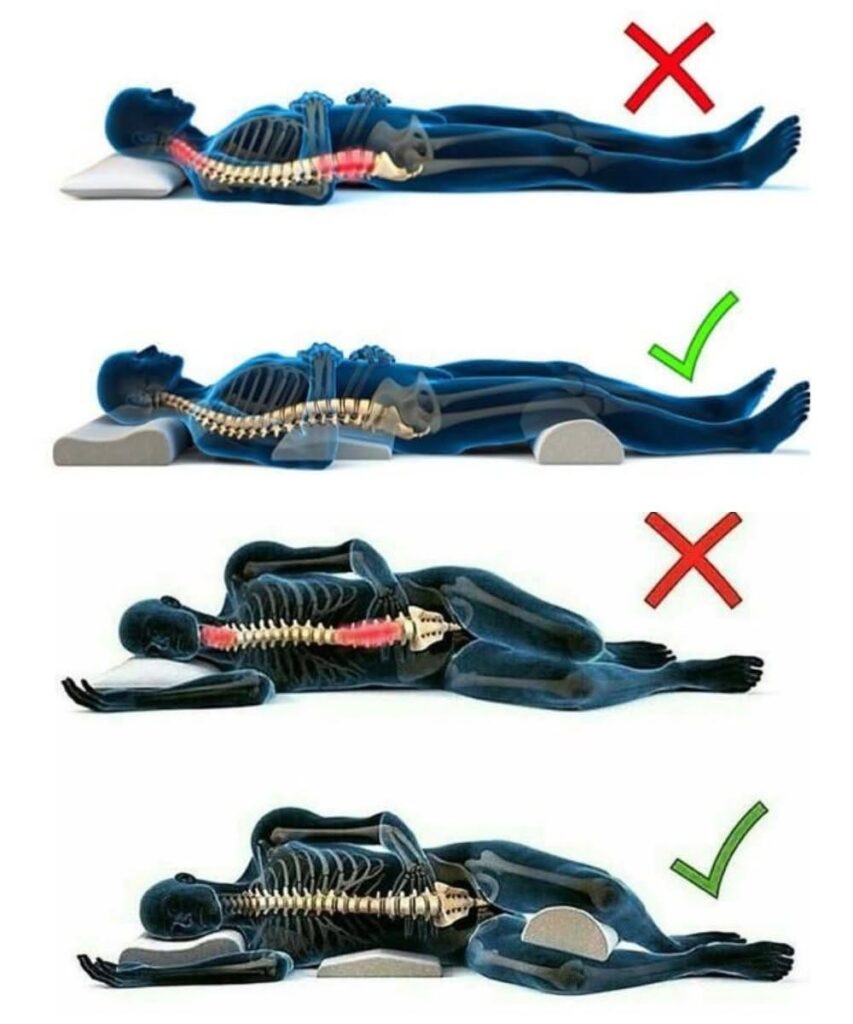
A viral medical diagram illustrates four distinct sleeping posture positions. The graphic compares unassisted back and side sleeping (marked with red “X” icons showing spinal stress areas in red) against ergonomically supported back and side sleeping (marked with green checkmarks demonstrating neutral spinal alignment with targeted pillow support).
Proper ergonomic support fills structural gaps beneath the neck, lumbar curve, knees, and hips, keeping the vertebral column in a neutral position throughout the night.
Here is a full breakdown of the biomechanics behind sleep posture, pillow placement hacks, and daily ergonomic recommendations.
Biomechanical Comparison of Sleep Postures
+-----------------------------------------------------------------------------------+
|                        SLEEP POSTURE & PILLOW SUPPORT OVERVIEW                    |
+-------------------+----------------------------+----------------------------------+
| Sleeping Position | Unsupported Risk Factors   | Recommended Pillow Solution      |
+-------------------+----------------------------+----------------------------------+
| Back Sleeping     | Flat legs strain lumbar    | Place a semi-roll pillow under   |
| (Supine Position) | curve; flat head pillow    | the knees and a cervical contour |
|                   | strains neck vertebrae     | pillow supporting the neck curve |
| Side Sleeping     | Top leg drops, twisting    | Place a firm pillow between knees|
| (Lateral Position)| lumbar spine & straining   | and small lumbar support wedge   |
|                   | the sacroiliac (SI) joint  | to prevent lateral pelvic tilt   |
+-------------------+----------------------------+----------------------------------+
1. Back Sleeping (Supine Position): Neutral Spine Alignment
Back sleeping is widely regarded by orthopedic specialists as ideal for weight distribution across the spine. However, sleeping completely flat without support forces the lumbar curve into hyperextension and can strain the neck:
- The Problem: Extending legs completely flat pulls on the psoas muscles, increasing tension on the lower back ($L1-L5$ vertebrae).
- The Ergonomic Fix: Placing a contoured roll pillow under your knees relaxes hip flexors and flattens the lower back into a comfortable neutral position. A cervical contour pillow supports the neck’s natural curve without pushing the chin forward.
2. Side Sleeping (Lateral Position): Preventing Pelvic Twist
Side sleeping is the most common position, but without proper support, it can cause significant lateral spinal deviation:
- The Problem: Lying on your side causes the top leg to slide forward and drop downward, rotating the pelvis and twisting the lumbar spine out of alignment overnight.
- The Ergonomic Fix: Placing a firm pillow between your knees keeps hips, pelvis, and spine parallel. Adding a thin lumbar wedge or torso support prevents the mid-spine from sagging into the mattress.
Step-by-Step Guide to Setting Up an Ergonomic Bed
Optimizing your sleeping environment takes only a few simple adjustments:
- Select the Right Pillow Height: Choose a head pillow that matches your shoulder width if you sleep on your side, or a medium-thin pillow if you sleep on your back, keeping your head level with your torso.
- Incorporate Knee Support: Always keep a dedicated knee pillow nearby. Position it under your knee joints when on your back, or between your knees and ankles when turning onto your side.
- Assess Mattress Firmness: A medium-firm mattress provides optimal support for most body types, preventing heavy hip and shoulder regions from sinking too deeply.
Financial and Health Benefits of Ergonomic Sleep
Investing in proper sleep support pays long-term health dividends:
- Reducing Physical Therapy Costs: Preventing chronic lower back strain and sciatica flare-ups reduces the need for frequent chiropractic visits or physical therapy treatments.
- Improving Sleep Quality and Productivity: Eliminating nighttime toss-and-turning due to joint pressure leads to deeper REM sleep cycles, improving daily focus, mood, and energy.
Fascinating Facts About Sleep Biomechanics
- Intervertebral Disc Hydration: During sleep, pressure on spinal discs decreases, allowing them to absorb fluid and rehydrate. Proper alignment maximizes disc hydration, making you up to half an inch taller in the morning!
- Spinal Neutrality Threshold: Keeping the head elevated higher than 15 degrees above horizontal while back-sleeping can constrict upper respiratory airways and increase snoring.
Conclusion: Transform Your Sleep Health Tonight
Achieving pain-free sleep doesn’t require expensive specialized beds—it simply requires supporting your body’s natural curves. By placing strategic pillows under your knees or between your legs, you can protect your spine, reduce joint strain, and wake up refreshed every morning.
Frequently Asked Questions
Q1: Is it better to sleep on your back or your side?
A1: Both positions are healthy when supported correctly. Back sleeping with a pillow under the knees offers the most balanced weight distribution, while side sleeping with a pillow between the knees prevents pelvic twisting.
Q2: Why does sleeping on your back cause lower back pain?
A2: Lying completely flat on your back stretches hip flexors tight, which pulls on the lumbar spine and creates unnecessary lower back arch strain.
Q3: What is the best pillow placement for side sleepers?
A3: Place a firm pillow between your knees and calves to keep your legs, hips, and spine in parallel alignment.
Q4: Should stomach sleeping be avoided?
A4: Yes. Stomach sleeping forces your neck to rotate at severe angles for hours and flattens the natural arch of your spine, leading to neck and lower back strain.
Q5: How often should you replace your bed pillows?
A5: Bed pillows should generally be replaced every 1 to 2 years to maintain proper structural support and hygiene.
