
Understanding your natural body frame is essential for tailoring effective fitness routines, nutrition plans, and strength goals.
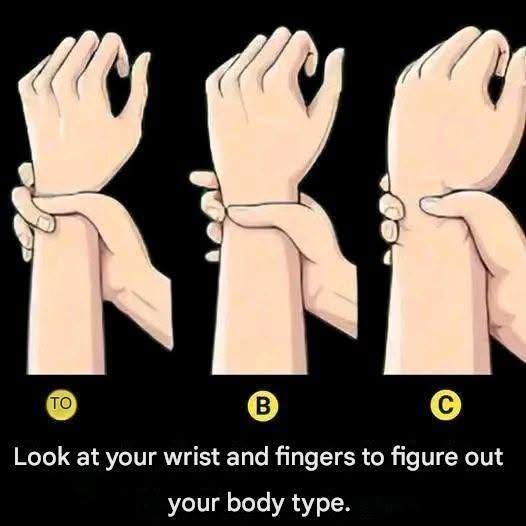
A popular fitness graphic—labeled “Look at your wrist and fingers to figure out your body type”—illustrates three hand positions around the wrist labeled A (mislabeled as “TO”), B, and C.
This simple self-assessment, known as the Wrist Measurement Test, measures bone structure and frame size to help categorize your body into one of three classic somatotypes: Ectomorph, Mesomorph, or Endomorph.
Here is a complete breakdown of what each wrist test result reveals about your somatotype, fitness predisposition, and dietary needs.
The 3 Somatotype Categories & Wrist Test Results
The test works by wrapping the thumb and middle finger of one hand around the wrist of the opposite arm (just above the wrist bone):
+-----------------------------------------------------------------------------------+
|                        SOMATOTYPE WRIST TEST COMPARISON TABLE                     |
+---------------+----------------------------+--------------------------------------+
| Result Label  | Finger Overlap / Gap       | Somatotype & Frame Characteristics   |
+---------------+----------------------------+--------------------------------------+
| Option A (TO) | Thumb & finger overlap     | Ectomorph: Small frame, lean & tall  |
| Option B      | Thumb & finger touch       | Mesomorph: Medium frame, athletic    |
| Option C      | Gap between fingers        | Endomorph: Large frame, broad & stocky|
+---------------+----------------------------+--------------------------------------+
Option A: The Ectomorph (Fingers Overlap)
- Wrist Test: The thumb and middle finger easily overlap each other.
- Physical Traits: Small bone structure, thin wrists, fast metabolism, lean muscle mass, and narrow shoulders.
- Fitness & Diet Strategy: Ectomorphs often struggle to gain weight or muscle mass (“hardgainers”). They benefit most from heavy resistance training with longer rest periods and a higher-calorie diet rich in carbohydrates and healthy fats.
Option B: The Mesomorph (Fingers Touch)
- Wrist Test: The thumb and middle finger touch perfectly end-to-end without overlapping or leaving a gap.
- Physical Traits: Medium frame, naturally athletic build, broad shoulders, narrow waist, and efficient muscle development.
- Fitness & Diet Strategy: Mesomorphs gain muscle and burn fat relatively easily. A balanced split of strength training, cardiovascular exercises, and moderate macronutrient ratios yields optimal results.
Option C: The Endomorph (Fingers Do Not Touch)
- Wrist Test: A noticeable gap remains between the thumb and middle finger due to a thicker wrist bone structure.
- Physical Traits: Larger bone structure, wider hips, stockier build, and a slower metabolic rate that stores fat more readily.
- Fitness & Diet Strategy: Endomorphs excel at power movements and strength building. To manage body composition, high-intensity interval training (HIIT), consistent cardio, and a controlled-carbohydrate, high-protein diet work best.
The Science: Bone Structure vs. Body Composition
While William Sheldon introduced the concept of somatotypes in the 1940s, modern exercise physiology recognizes that wrist circumference is a reliable indicator of skeletal frame size:
- Fixed Skeletal Frame: Wrist size is determined by bone density and circumference, which remain constant regardless of weight loss or fat gain.
- Hybrid Somatotypes: Most individuals are not purely one somatotype but rather a combination (e.g., Ecto-Mesomorph or Meso-Endomorph).
Financial Impact: Optimizing Health & Training Investments
Knowing your somatotype helps optimize your health and wellness spend:
- Targeted Nutrition: Eliminates wasted money on ineffective “one-size-fits-all” weight loss supplements or generic mass gainers unsuited for your metabolic rate.
- Efficient Personal Training: Focuses gym memberships and equipment purchases on workouts tailored specifically to your natural recovery times and skeletal leverages.
Fascinating Facts About Human Bone Structure & Fitness
- Wrist Circumference Standard: In medical anthropometry, a wrist circumference under 6.5 inches for men typically indicates a small frame, while over 7.5 inches indicates a large frame.
- Genetic Preprogramming: While bone structure is genetically fixed, muscle mass and fat percentage are fully adaptable through consistent exercise and proper nutrition.
Conclusion: Use Your Frame Size to Reach Your Goals
Whether your fingers overlap or leave a gap, identifying your underlying skeletal frame gives you valuable insight into how your body responds to training, allowing you to design a workout and nutrition program that works with your genetics.
Frequently Asked Questions
Q1: What does it mean if my thumb and middle finger overlap?
A1: Overlapping fingers indicate a smaller bone structure, typical of an Ectomorph body type characterized by a lean build and fast metabolism.
Q2: Is the wrist test completely accurate for determining body type?
A2: The wrist test accurately measures skeletal frame size, which is a key component of somatotyping. However, body composition (fat vs. muscle) can be altered through training.
Q3: Can your somatotype change over time?
A3: Your bone structure remains permanent, but you can change your body composition (muscularity and body fat percentage) through diet and exercise.
Q4: Why is the middle finger used instead of the index finger?
A4: The middle finger provides an accurate baseline length relative to the hand size when wrapping around the narrowest part of the wrist joint.
Q5: What is the best workout for an Endomorph?
A5: Endomorphs thrive on a combination of heavy compound resistance training (squats, deadlifts) paired with regular high-intensity interval training (HIIT) to promote calorie expenditure.
