
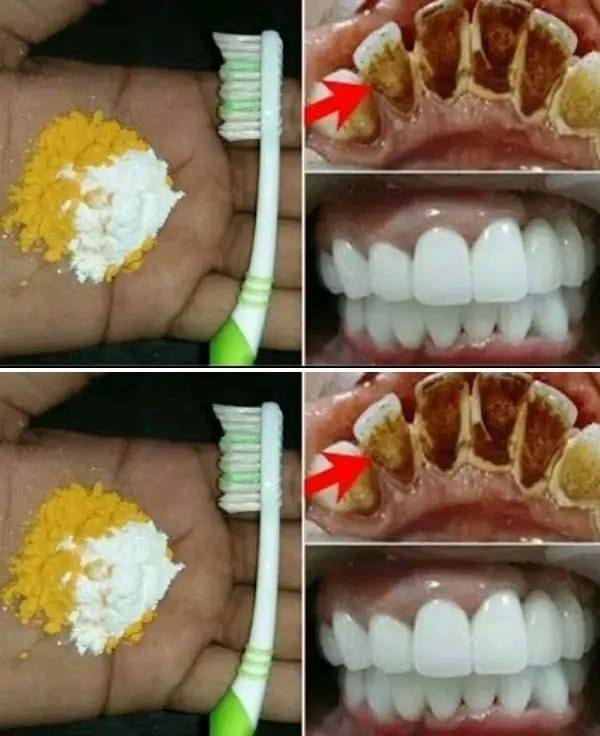
Social media graphics frequently promise instant home remedies for extreme dental issues, showcasing dramatic side-by-side photos. One popular viral graphic implies that brushing with a mixture of turmeric and white powder (such as baking soda or salt) can transform severely tartar-encrusted, discolored teeth into a perfect set of pearly white veneers overnight.
In reality, hardened dental calculus (tartar) cannot be brushed away at home using DIY abrasive powders, and relying on unproven remedies can pose risks to enamel and gum health.
Visual Breakdown: The Viral Remedy Graphic
The image features a side-by-side collage comparing household ingredients to extreme before-and-after dental photos.
+-----------------------------------------------------------------------+
|                    DENTAL REMEDY GRAPHIC ANALYSIS                     |
|                                                                       |
|   [ Left Panels ]      ---> Hand holding yellow turmeric powder,      |
|                             white powder, and a toothbrush            |
|                                         |                             |
|                                         v                             |
|   [ Top Right Panels ] ---> Close-up of heavy brown dental calculus       |
|                             and tartar buildup on lower teeth         |
|                                         |                             |
|                                         v                             |
|   [ Bottom Right ]     ---> Perfectly straight, stark white veneers/  |
|                             restorations                              |
+-----------------------------------------------------------------------+
Key Visual Components
- Ingredient Panel (Left): Displays a palm holding yellow turmeric powder alongside a white powder and a toothbrush.
- Before Image (Top Right): Shows severe subgingival and supragingival tartar (calculus) buildup along the inner surface of the teeth with red arrows pointing to the deposits.
- After Image (Bottom Right): Displays an unrealistic jump to bright white, perfectly aligned dental veneers or crowns rather than natural teeth after cleaning.
Why DIY Powders Cannot Remove Hardened Tartar
- Calculus Is Mineralized Deposit: Once plaque mineralizes into hard tartar, it bonds firmly to tooth enamel and root surfaces. Standard toothbrush bristles cannot scrub it off regardless of the substance used.
- Abrasive Enamel Wear: Brushing with harsh coarse powders (like salt or unrefined baking soda) can wear down tooth enamel and cause gum recession over time.
- Turmeric Staining: Turmeric is a strong natural dye. While occasionally touted in DIY trends for anti-inflammatory properties, it can temporarily stain porous dental surfaces, composite fillings, and toothbrush bristles.
Home Care vs. Professional Dental Care
| Treatment | Plaque (Soft Film) | Tartar / Calculus (Hardened Deposit) | Safe for Daily Use |
| Flossing & Brushing | Removes effective soft plaque | Cannot remove calcified deposits | Yes (Twice daily with fluoride toothpaste) |
| DIY Powders / Turmeric | Partially abrasive scrub | Cannot remove calcified deposits | No (Risk of enamel wear & irritation) |
| Professional Scaling | Cleans thoroughly | Safely removes all calculus above and below gumline | Recommended every 6 months |
Frequently Asked Questions (FAQ)
1. How is hardened tartar safely removed from teeth?
Tartar can only be safely removed by a dentist or dental hygienist using specialized ultrasonic instruments and hand scalers during a professional dental cleaning.
2. What is the best way to prevent tartar buildup at home?
Brush twice daily with an ADA-accepted fluoride toothpaste, floss daily to remove plaque between teeth, and use an antiseptic mouthwash to reduce plaque-causing bacteria.
Conclusion
Exaggerated social media transformations often misuse unrelated before-and-after photos. Routine professional dental cleanings remain the only safe and effective method for removing hardened calculus and protecting long-term oral health.
