
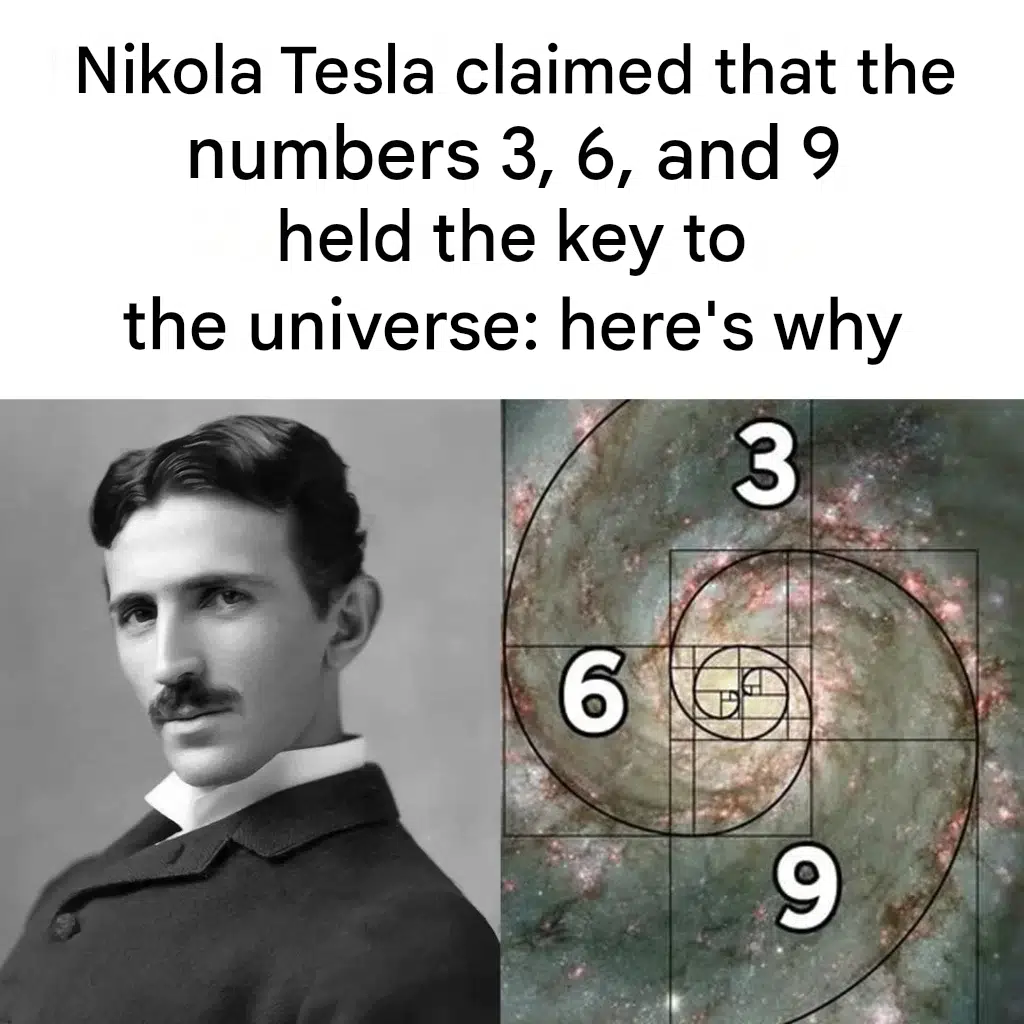
Nikola Tesla remains one of the most brilliant, eccentric, and visionary minds in human history. As a pioneer of alternating current (AC) electrical systems, wireless transmission, and advanced electrical engineering, his inventions laid the foundational groundwork for the modern technological world. Yet, beyond his scientific patents and laboratory breakthroughs, Tesla was equally famous for his unusual personal habits, philosophical musings, and a deep fascination with numerical patterns.
Among his many esoteric theories, one quote has captivated historians, mathematicians, and pop culture enthusiasts alike: his assertion that if you only knew the magnificence of the numbers 3, 6, and 9, you would have the key to the universe.
In this comprehensive guide, we will explore the origins of Tesla’s numerical obsession, examine the mathematics behind doubling patterns, discuss the intersection of science and mysticism, and provide practical ways to cultivate creative thinking.
The Origin of Tesla’s Numerical Fascination
Tesla’s fixation on numbers was not arbitrary; it stemmed from a blend of rigorous scientific observation and peculiar personal rituals. He was known to perform daily actions in sets divisible by three—such as walking around a block three times before entering a building or requesting a specific number of cloth napkins stacked neatly at dinner tables.
While mainstream historians attribute these behaviors to severe obsessive-compulsive tendencies, Tesla himself viewed the universe through the lens of pure energy, frequency, and vibration. He believed that fundamental mathematical patterns governed physical reality, energy distribution, and cosmic geometry.
The Mathematics of Vortex Math and the 3, 6, 9 Pattern
In modern esoteric mathematics and vortex-based systems, researchers often analyze a doubling sequence (1, 2, 4, 8, 16, 32, etc.) and reduce each number to a single digit by adding them together.
                      +---------------------------------------+
                      |         THE DOUBLING SEQUENCE         |
                      +---------------------------------------+
                                          |
         +--------------------------------+--------------------------------+
         |                                |                                |
         v                                v                                v
   [ POWERS OF TWO ]              [ SINGLE DIGIT REDUCTION ]       [ THE OMITTED CORE ]
+---------------------+        +---------------------+        +---------------------+
| • 1, 2, 4, 8        |        | • 1 > 2 > 4 > 8     |        | • Numbers 3, 6, and |
| • 16 (1+6 = 7)      |        | • 7 > 5 > 1         |        |   9 never appear    |
| • 32 (3+2 = 5)      |        | • Forms 1-2-4-8-7-5 |        |   in this loop      |
+---------------------+        +---------------------+        +---------------------+
The Power of Three, Six, and Nine
When examining this doubling pattern, an intriguing mathematical anomaly emerges:
- The Doubling Loop: Starting with 1 and doubling continuously yields 1, 2, 4, 8, 7, 5, and back to 1. Notice that the numbers 3, 6, and 9 never appear in this sequence.
- The Governing Force: Conversely, if you double numbers starting from 3 (3, 6, 12, 24, 48…), the digital roots cycle exclusively between 3 and 6, while 9 acts as a grand overarching controller or singularity point that supersedes the loop.
Proponents of vortex mathematics argue that this pattern represents energy flowing through physical dimensions, with 3 and 6 representing the dual polarity of the field and 9 representing the higher dimensional source or vortex field itself.
Financial, Scientific, and Philosophical Implications
While Tesla’s ideas about 3, 6, and 9 lean heavily into philosophy and mysticism rather than peer-reviewed physics, they raise interesting questions about how humans perceive patterns in nature.
The Business of Innovation and Genius
Great historical breakthroughs often arise when visionaries look beyond conventional boundaries. Just as Tesla envisioned wireless power transmission decades before infrastructure existed, modern technology relies on thinking outside established frameworks.
Investing in Intellectual Curiosity
Exploring abstract theories, history, and science expands cognitive flexibility. Investing time in reading, scientific education, and creative problem-solving provides immense personal and intellectual returns, sharpening critical thinking skills in an increasingly complex world.
Practical Ways to Foster Creative and Analytical Thinking
Channeling the inquisitive spirit of inventors like Tesla involves cultivating daily habits that stimulate both logical reasoning and creative imagination.
+-----------------------------------------------------------------------+
|                    CREATIVE THINKING ACTION PLAN                      |
+-----------------------------------------------------------------------+
| STEP 1 : Dedicate time daily for uninterrupted deep focus and reading |
| STEP 2 : Explore cross-disciplinary subjects (art, math, and physics) |
| STEP 3 : Maintain a journal to sketch unconventional ideas and puzzles|
| STEP 4 : Challenge standard assumptions by questioning root causes    |
+-----------------------------------------------------------------------+
1. Embrace Uninterrupted Deep Focus
Tesla was famous for working in total solitude, allowing his mind to visualize complex electromagnetic machinery entirely in his head before building physical prototypes. Setting aside distraction-free time enhances deep cognitive output.
2. Connect Disparate Fields of Knowledge
True innovation happens at the intersections. Combine analytical subjects like mathematics with creative pursuits like design, writing, or structural engineering to unlock novel perspectives.
Fascinating Facts About Nikola Tesla
- Photographic Memory: Tesla could memorize entire books, memorize complex engineering blueprints in his head, and recall detailed structural designs years later without referring to notes.
- Polyglot Skills: He spoke eight languages fluently, allowing him to read international scientific research papers in their original text.
- Inventions Beyond AC Power: Alongside alternating current, Tesla contributed pioneering concepts toward X-ray imaging, remote control robotics, neon lighting, and early radio wave communication.
- The Pigeon Connection: In his later years living in New York City hotels, Tesla became famously devoted to feeding wild pigeons, developing a deep, eccentric bond with a specific white injured pigeon.
Conclusion
Whether Nikola Tesla’s fascination with the numbers 3, 6, and 9 was rooted in profound metaphysical truth, sacred geometry, or personal idiosyncrasies, it continues to inspire wonder across generations. Tesla viewed the universe not as a collection of dead matter, but as a living symphony of frequency, energy, and vibration. By exploring these numerical mysteries, we honor the boundless curiosity of a man who spent his life trying to decode the hidden mechanics of the cosmos.
Frequently Asked Questions (FAQ)
Did Nikola Tesla actually say that 3, 6, and 9 hold the key to the universe?
While frequently attributed to Tesla in popular culture and internet lore due to his known eccentricities and obsession with the number three, direct historical documentation of this exact quote in his formal scientific writings remains sparse.
What is vortex math?
Vortex mathematics is an alternative branch of numbers study that maps energy flow and repeating digital root patterns (such as doubling sequences) in a toroidal grid system, often connecting these concepts to Tesla’s theories.
Why was Tesla obsessed with the number 3?
Tesla performed many of his daily routines—such as walking around buildings three times or washing his hands in sets of three—which biographers attribute to severe obsessive-compulsive habits or personal lucky rituals.
How do digital roots work in mathematics?
Digital root reduction involves repeatedly adding the digits of a number together until a single-digit number remains (for example, 16 becomes 1 + 6 = 7).
What were Tesla’s most important scientific contributions?
Tesla’s most revolutionary contributions include developing the alternating current (AC) electrical power system, inventing the Tesla coil, and laying foundational principles for wireless radio communication.
