
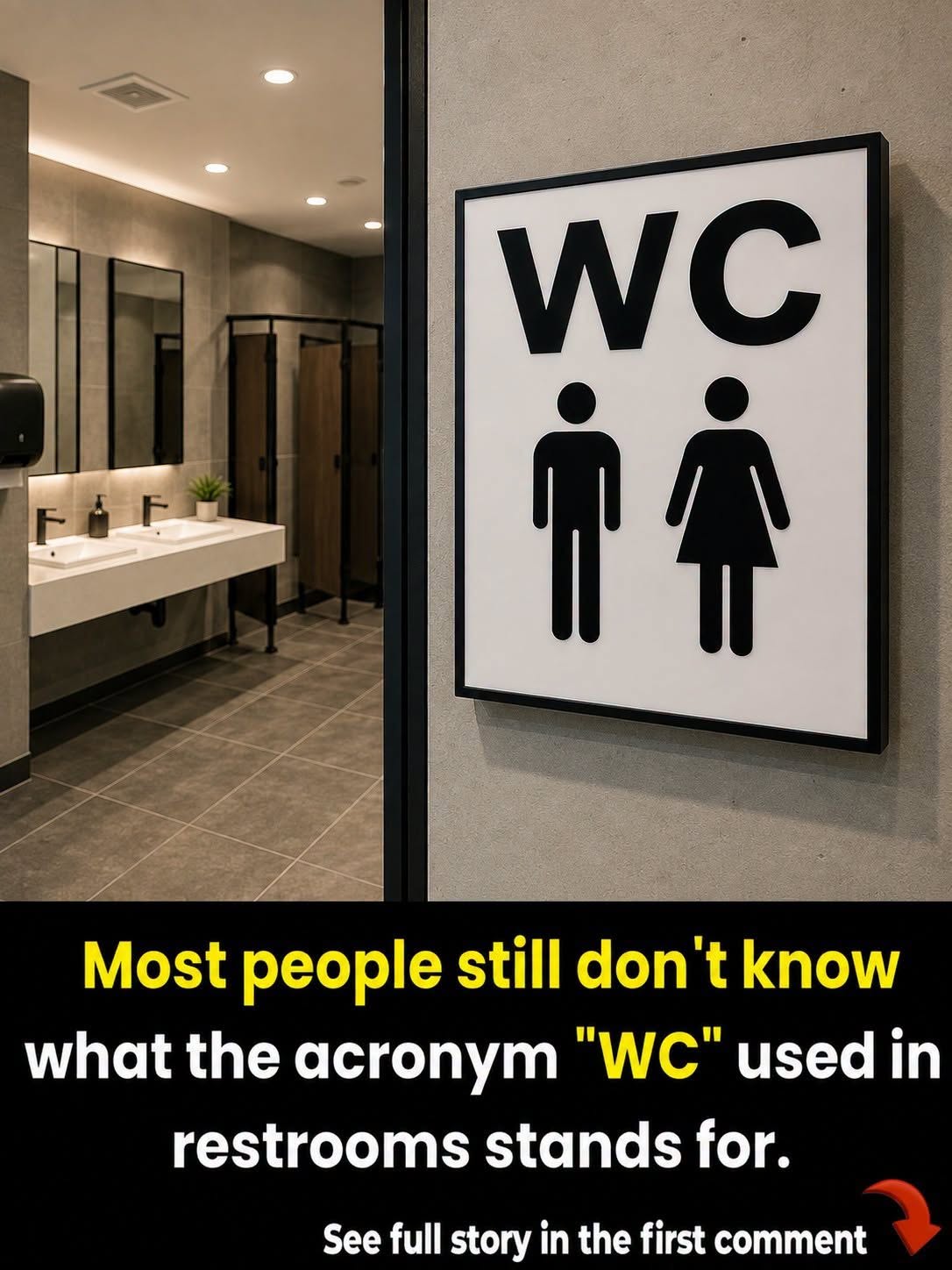
Whether traveling through Europe, Asia, or navigating international airports, you have almost certainly seen the letters “WC” displayed prominently on restroom doors alongside male and female pictograms.
An intriguing viral graphic featuring a modern restroom sign highlights this common mystery with the caption: “Most people still don’t know what the acronym ‘WC’ used in restrooms stands for.”
Despite being recognized globally, the true origin and historical meaning of “WC” remain a mystery to many travelers.
Here is a complete breakdown of what “WC” stands for, how it revolutionized indoor sanitation, and why it became an international symbol for public restrooms.
What Does WC Stand For?
WC stands for Water Closet.
The term originated in 19th-century Britain during the Victorian era. It was created to describe a revolutionary technological advance in home plumbing: a small, private room containing an indoor flush toilet that used running water to wash away waste.
The History of the Water Closet: Revolutionizing Sanitation
To understand why “WC” became such a landmark phrase, it helps to look at how people used the restroom before indoor plumbing became widespread.
+-----------------------------------------------------------------------------------+
|                        EVOLUTION OF SANITATION TERMS                              |
+-------------------+----------------------------+----------------------------------+
| Era / System      | Common Terminology         | Key Characteristics              |
+-------------------+----------------------------+----------------------------------+
| Pre-19th Century  | Outhouse, Privy, Chamberpot| Outdoor pits or indoor portable  |
| 19th Century      | Water Closet (WC)          | Indoor room with piped water     |
| 20th Century-Now  | Restroom, Bathroom, Washroom| Full room with toilet & sink     |
+-------------------+----------------------------+----------------------------------+
1. From Outhouses to Indoor Plumbing
Before the 19th century, most households relied on outdoor pit latrines (outhouses), privies, or indoor chamber pots. As cities grew denser during the Industrial Revolution, urban waste management became a severe public health crisis.
2. Polite Victorian Etiquette
When flush toilets were first introduced inside affluent homes, polite Victorian society found direct words for bodily functions inappropriate. Referring to the installation as a “water closet”—a literal small closet or room equipped with water—served as a discreet, polite euphemism.
3. The Spread of International Standards
As British engineering and plumbing standards expanded across Europe and the British Empire during the late 1800s and early 1900s, the term “Water Closet” and its abbreviation “WC” were adopted internationally as a universal sign for indoor sanitation facilities.
Why “WC” Remains Popular Globally
While native English speakers in North America typically say “restroom” or “bathroom,” the acronym “WC” remains widely used across the globe for several distinct reasons:
- Language Neutrality: In many non-English speaking European countries (such as France, Germany, Italy, and Spain), “WC” was adopted as a standard sign code, making it an easy international symbol for tourists.
- Compact Signage: The two-letter abbreviation fits neatly on small door plaques, hotel directories, and street directional signs.
- Public Hygiene Standards: In commercial and architectural design, “WC” specifically denotes a toilet facility open to the public or building occupants.
Financial Impact: Architectural and Plumbing Value
The transition to standard “WC” indoor plumbing transformed global real estate and urban design:
- Property Value Expansion: Integrating indoor water closets into 19th and 20th-century housing designs significantly boosted urban property values and improved tenant health outcomes.
- Global Plumbing Standardization: Standardizing pipe dimensions and flushing mechanisms based on early WC designs laid the groundwork for modern multi-billion-dollar global plumbing and sanitation industries.
Fascinating Facts About “WC” and Restroom History
- Alexander Cumming’s Patent: Scottish inventor Alexander Cumming patented the S-trap (the predecessor to the S-bend toilet pipe) in 1775. This genius design used trapped water to prevent foul sewer gases from entering the home, making indoor water closets feasible.
- Thomas Crapper’s Legacy: Contrary to popular belief, Thomas Crapper did not invent the flush toilet, but his plumbing company held multiple patents for improving flush mechanisms in Victorian-era water closets.
Conclusion: A Simple Euphemism That Changed the World
What began as a polite 19th-century euphemism for indoor flush toilets has evolved into one of the most recognized international symbols in human history.
The next time you spot “WC” on a doorway while traveling, you are looking at a small piece of engineering history that forever transformed public health and modern living.
Frequently Asked Questions
Q1: Is “WC” still used in modern English-speaking countries?
A1: “WC” is still used in architectural blueprints and public signage in the United Kingdom and Europe, though everyday spoken language in North America prefers terms like “restroom” or “bathroom.”
Q2: What is the difference between a bathroom and a water closet?
A2: A “bathroom” traditionally refers to a room containing a bathtub or shower, whereas a “water closet” specifically refers to a room containing a toilet and washbasin.
Q3: Why do airplanes use the word “Lavatory” instead of “WC”?
A3: Aviation terminology adopted “lavatory” (derived from the Latin word lavatorium, meaning “place to wash”) as the standard international term for onboard washing facilities.
Q4: Who invented the modern flush toilet?
A4: Sir John Harington invented an early flush toilet system for Queen Elizabeth I in 1596, but practical commercial adoption occurred in the late 18th and 19th centuries thanks to inventors like Alexander Cumming and Joseph Bramah.
Q5: What does “half-bath” mean in real estate?
A5: A “half-bath” (similar to a classic water closet) is a powder room that includes only a toilet and a sink, without a bathtub or shower.
