
Safety pins are among the most versatile household items in existence, used everywhere from quick clothing fixes and sewing projects to athletics and craft making.
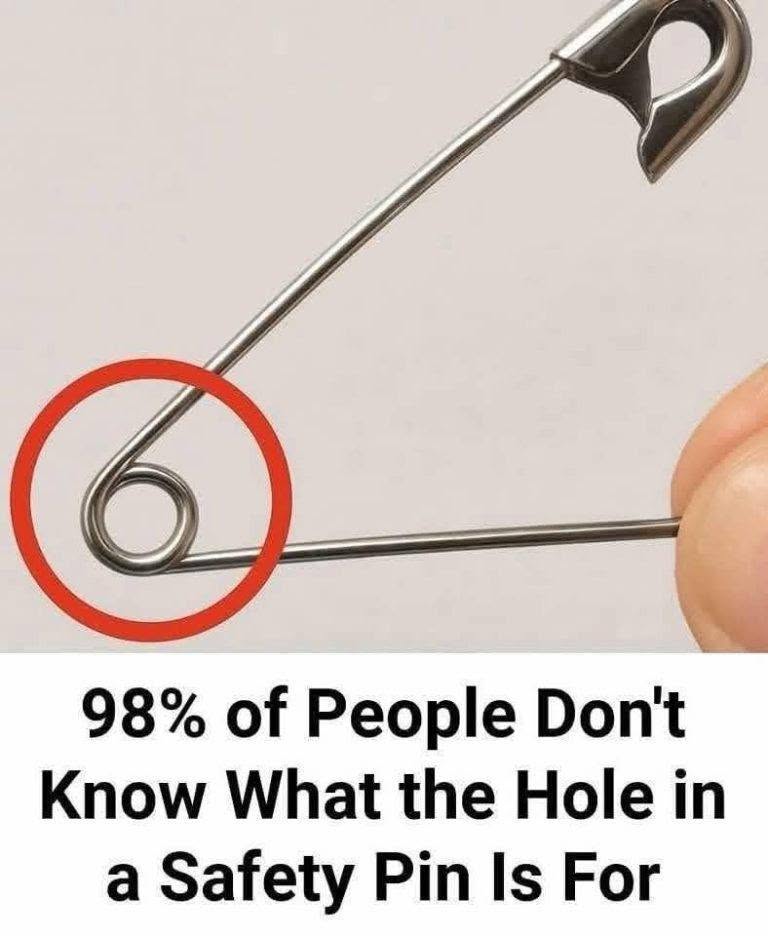
A viral social graphic—captioned “98% of People Don’t Know What the Hole in a Safety Pin Is For”—shows a close-up image of an open metal safety pin with a red circle highlighting the coiled circular loop at the bottom base.
While many people assume this circular opening is designed for threading string, ribbon, or keyrings, its primary purpose is structural engineering: it serves as the torsion spring that powers the entire safety pin mechanism.
Here is a full breakdown of how the coiled loop functions, why it was designed that way, and practical household hacks for safety pins.
The Engineering Purpose of the Coiled Loop
Safety pin design has remained largely unchanged for over 175 years because of its simple, effective mechanics:
+-----------------------------------------------------------------------------------+
|                        SAFETY PIN ANATOMY & FUNCTION CHART                        |
+-------------------+----------------------------+----------------------------------+
| Feature           | Structural Design          | Primary Mechanical Purpose       |
+-------------------+----------------------------+----------------------------------+
| Coiled Loop (Base)| Coiled wire torsion spring | Provides spring tension to spring|
|                   |                            | open and press securely into cap |
| Protective Cap    | Curved metal sheath        | Shield sharp point & lock pin    |
| Pin Shaft & Point | Tapered wire arm           | Pierces fabric cleanly           |
+-------------------+----------------------------+----------------------------------+
1. The Torsion Spring Mechanism
The circular loop at the end of a safety pin is created by bending a single strand of rigid spring wire into a full turn or coil. This coil acts as a torsion spring.
- When you press the pin arm inward to unlatch it from the protective cap, energy is stored in this central coil.
- When released, the spring tension causes the pin arm to snap outward, holding it firmly inside the protective clasp when closed.
2. Preventing Metal Fatigue
If the wire were simply bent sharply back on itself without a circular loop, repeated opening and closing would concentrate mechanical stress at a single sharp point, causing the metal to snap quickly. The circular loop distributes flex stress evenly along the curved circumference of the wire, allowing the pin to be opened and closed thousands of times without breaking.
History of the Invention: Walter Hunt’s $40 Patent
The modern safety pin was invented in 1849 by American mechanic Walter Hunt:
- Debt-Driven Invention: Hunt owed a $15 debt to a friend and spent three hours twisting a length of brass wire until he perfected the coiled spring and protective clasp mechanism.
- Sells the Rights: On April 10, 1849, Hunt received U.S. Patent No. 6,281 for his “Dress Pin.” He sold the patent rights outright for $400 to pay off his debt, missing out on millions as the safety pin became a global staple.
Financial Impact: Clever Household Money-Saving Hacks
The humble safety pin can solve common wardrobe and home challenges without expensive repairs:
- Fixing Lost Drawstrings: Attach a safety pin to the loose end of a hoodie or sweatpants drawstring to easily snake it back through the fabric casing in minutes.
- Preventing Static Cling: Pinning a small metal safety pin to the interior hem of a skirt or trousers dissipates static electricity build-up without buying costly chemical sprays.
- Securing Duvet Covers: Pinning interior corners of comforters inside duvet covers prevents bunching and extends the life of bedding sets.
Fascinating Facts About Safety Pins
- The “Coilless” Safety Pin Variant: In knitting and garment manufacturing, specialized “coilless” safety pins (gourd or pear pins) are used without the bottom loop so delicate yarn strands don’t get snagged inside the coil.
- Symbol of Solidarity: In social movements, wearing a visible safety pin has served as a simple symbol of support, safety, and solidarity for marginalized communities.
Conclusion: Brilliant Mechanical Simplicity
Far from being a random manufacturing detail or a simple hanging hole, the circular coil at the base of a safety pin is the essential spring mechanism that makes the tool safe, flexible, and functional.
Frequently Asked Questions
Q1: What is the official term for the bottom loop on a safety pin?
A1: It is called the coiled loop or torsion spring.
Q2: Who invented the modern safety pin?
A2: American inventor Walter Hunt patented the modern coiled safety pin in 1849.
Q3: Why do yarn knitters prefer pins without the bottom coil?
A3: Fine threads and delicate yarn loops can get trapped inside the coiled wire loop, causing snagging and fabric tearing. Coilless pins prevent this.
Q4: How does a safety pin prevent static electricity in clothing?
A4: The metal wire acts as a conductor that channels static charges away from synthetic fabrics into the air, preventing clothes from clinging to skin.
Q5: What metal is used to make standard safety pins?
A5: Most safety pins are manufactured using nickel-plated steel, brass, or stainless steel to prevent rust and maintain spring stiffness.
