
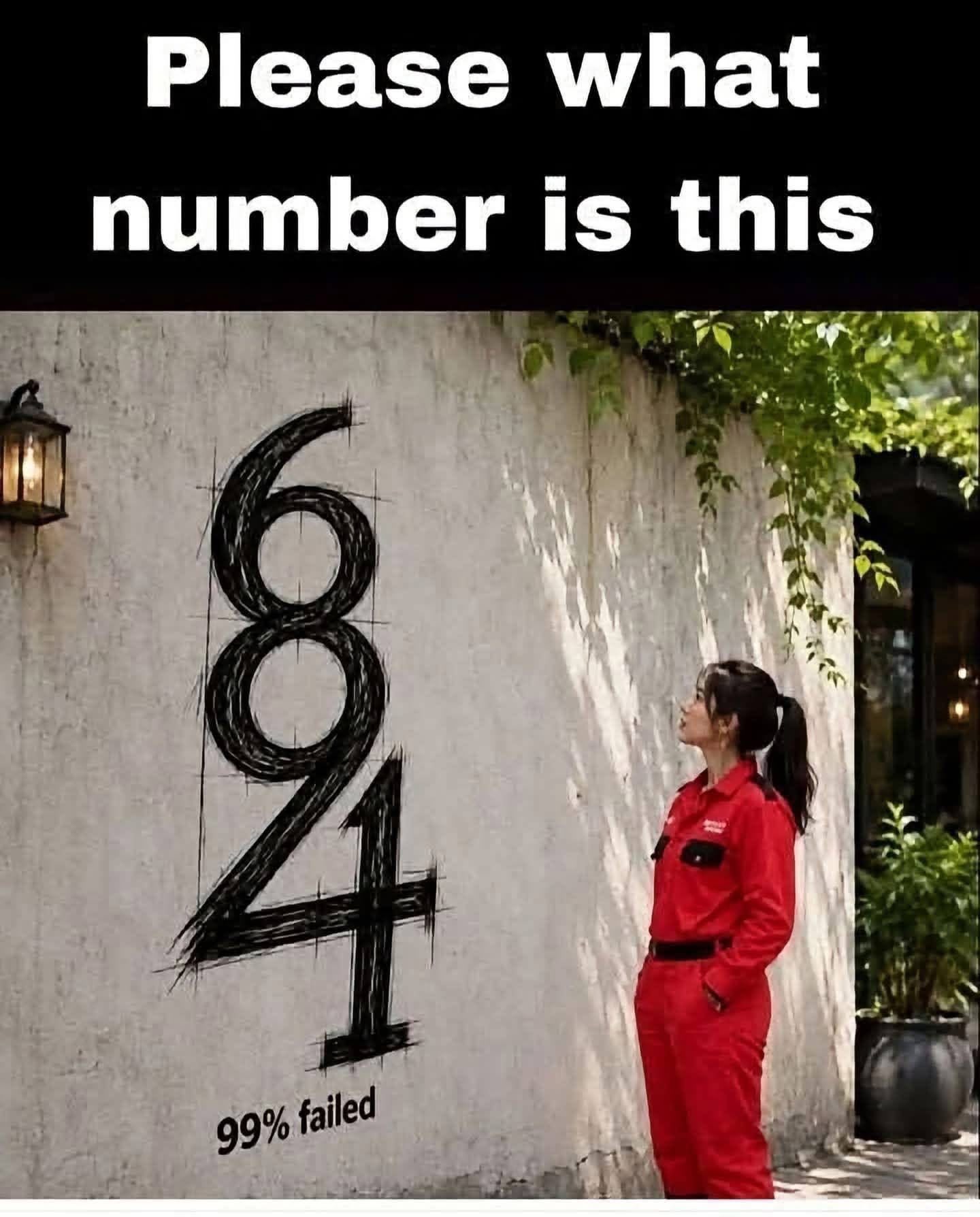
Visual puzzles and overlapping number illusions regularly spark passionate debates across social media platforms. A popular viral image features a woman in a red jumpsuit standing outside a building, staring up at a large piece of black brushstroke wall art that combines multiple overlapping numbers. Accompanied by the caption “Please what number is this? 99% failed,” viewers are challenged to decipher every digit fused into the single vertical graphic.
Understanding the complete sequence hidden in the artwork, analyzing the visual illusion tricks behind overlapping typography, and exploring the cognitive benefits of brain teasers can help you test your perception skills.
The Solution: Deciphering the Hidden Digits
When looking closely at the vertical brushstroke graphic from top to bottom, four distinct numerical digits overlap to form the full number 6824:
1. The Top Digit: 6
The top section of the artwork clearly loops around to form a classic numeral 6 with a distinct top curve and a closed bottom loop.
2. The Middle-Upper Digit: 8
In the center upper section, two stacked circular loops join together to form the digit 8, sharing its upper loop with the bottom of the number 6.
3. The Middle-Lower Digit: 2
Directly beneath the figure 8, the curved line transitions smoothly into a diagonal stroke and flat base, clearly outlining a numeral 2.
4. The Bottom Digit: 4
The bottom section of the artwork terminates in a sharp angular cross and vertical stem, forming a prominent numeral 4.
The Complete Combined Number: 6824
By reading the overlapping digits from top to bottom, the hidden sequence forms 6824 (though some viewers also spot individual digits like 6, 8, 2, and 4 in various order combinations).
The Cognitive Psychology Behind Overlapping Optical Illusions
Why do visual puzzles like this split internet opinions and cause confusion?
1. Gestalt Principles of Perception
The human visual system naturally attempts to group lines and curves into whole, recognizable objects. When multiple digits share common strokes (such as the bottom loop of 6 becoming the top loop of 8), the brain experiences visual ambiguity and struggles to isolate one number from another.
2. Selective Attention and Figure-Ground Segregation
Viewers who focus only on the prominent bottom stem immediately see the number 4, while those scanning from the top down spot the 6 and 8. Disentangling overlapping lines requires active cognitive flexibility and focused perceptual scanning.
Brain Training, Eye Health, and Insurance Benefits
Regularly engaging with complex visual riddles and optical illusions provides valuable cognitive and visual exercise.
Boosting Mental Agility and Focus
Solving spatial logic puzzles stimulates visual processing areas in the brain, enhancing attention to detail, pattern recognition, and problem-solving skills across all age groups.
Routine Eye Care and Health Insurance Coverage
If you frequently experience eye strain, double vision, or difficulty distinguishing fine visual details during online puzzles, scheduling an eye examination with an optometrist or ophthalmologist is essential. Standard vision insurance plans and health policies cover annual comprehensive eye exams to ensure optimal visual health.
Practical Tips for Solving Overlapping Number Puzzles
- Break the Graphic into Sections: Isolate the top, middle, and bottom of the image separately rather than trying to view the whole figure at once.
- Trace the Key Outlines: Use your finger or a stylus to trace each continuous line loop to identify complete individual digits.
- Invert or Change Contrast: Sometimes tilting your screen or viewing the image from a slight distance makes obscured overlapping numbers stand out clearly.
Frequently Asked Questions (FAQ)
What is the correct number hidden in the wall art illusion?
The hidden sequence combining all overlapping digits from top to bottom is 6824.
What individual digits are visible in the graphic?
The graphic clearly contains four digits: 6, 8, 2, and 4.
Does health or vision insurance cover routine eye tests?
Yes. Annual vision checks and diagnostic eye examinations are covered under most standard vision insurance plans and health insurance policies.
