
Introduction
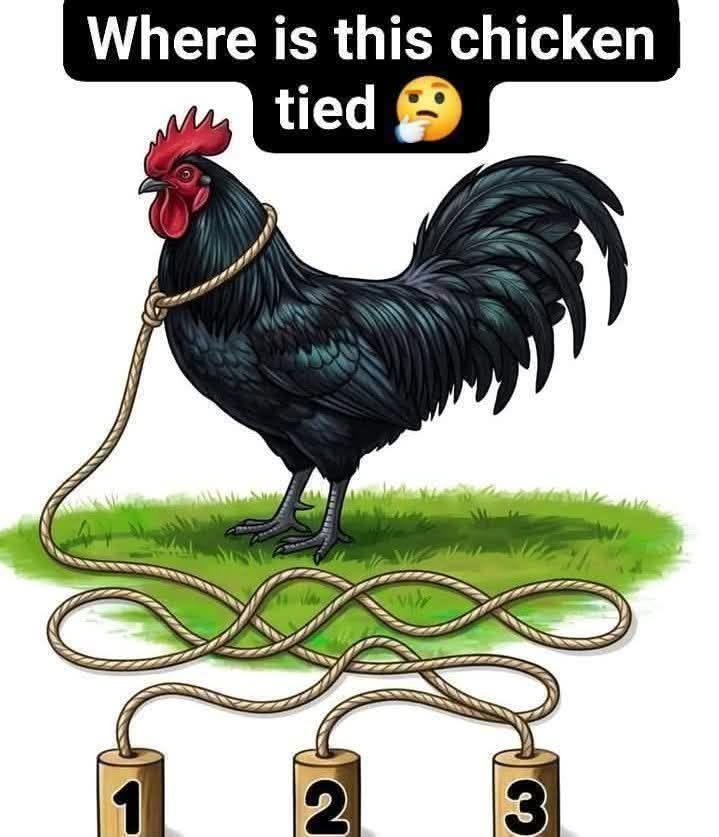
Viral visual maze puzzles and tracing challenges frequently capture the attention of millions across social media platforms, sparking intense debate and friendly competition in comment sections worldwide. When presented with a deceptive rope-tracing puzzle—such as a chicken tied to one of three wooden posts—most people rush to guess based on superficial intuition or glance over the complex loops. However, these trick questions are specifically designed to test whether observers apply methodical visual tracing or fall for optical distractions.
Just as puzzle enthusiasts carefully examine every line to find the correct path, professionals across diverse industries rely on precise observation, rigorous analysis, and attention to detail every day. Whether you are reviewing contract figures with an attorney, managing professional legal services, evaluating terms on a loan or mortgage, securing insurance coverage, or planning a strategic investment, the ability to isolate correct pathways is essential for success. This comprehensive guide explores the mechanics of visual tracking, the psychology of maze puzzles, and how cognitive puzzles sharpen mental agility.
Tracing the Rope: Finding the Correct Post
To solve maze-based search puzzles accurately, it helps to trace the rope backward from the source or forward from the posts.
- Following the Path from the Chicken: Start at the loop around the rooster’s neck and carefully follow the rope down through the tangled loops on the grass.
- Tracing Through the Loops: As you navigate the twists, you will notice that the rope leads past dead ends and loops, directing your eye across the ground.
- The Correct Post: Tracing the continuous line all the way down reveals that the rope connects directly to Post 2 (the middle post), while posts 1 and 3 are merely looping dead ends designed to trick the eye.
Real-World Applications of Visual and Analytical Precision
While viral maze puzzles are designed for lighthearted entertainment, the underlying cognitive discipline is directly applicable to high-stakes professional decision-making.
Financial and Business Strategy
In the corporate and financial sectors, overlooking a complex operational pathway or tangled dependency can lead to costly errors.
- Investment and Retirement: Financial analysts audit intricate cash-flow webs and asset trails to detect hidden discrepancies before finalizing a retirement or investment portfolio.
- Credit and Lending: Underwriters carefully review multi-tiered financial records to ensure that every liability in a commercial loan or residential mortgage application is accurately mapped.
- Corporate Risk and Insurance: Protecting a business requires scrutinizing complex supply chains and policy dependencies to maintain comprehensive insurance coverage.
Legal and Technological Precision
In regulated fields, missing a subtle structural connection can have serious legal or technical repercussions. Legal services provided by a qualified attorney ensure that all cross-references in a binding contract are error-free. Similarly, in technology and software engineering, debugging complex logic paths requires tracing variables through tangled loops of code.
Practical Tips to Improve Visual Attention and Problem-Solving
If you want to sharpen your observation skills and excel at maze challenges, keep these simple strategies in mind:
- Trace Backward: Often, starting from the target (the chicken’s neck) and tracing backward to the options is easier than guessing from the bottom up.
- Use a Finger or Cursor: Physically follow the line step-by-step to prevent your eyes from jumping across crossing ropes.
- Practice Regularly: Engaging in visual maze puzzles keeps your neural pathways active and enhances spatial reasoning speed.
- Consult Experts When Needed: Just as puzzle keys provide clarity, complex life choices regarding health, medicine, or finance are best navigated with professional guidance.
Interesting Facts About Visual Mazes
- Why Tracing is Hard: The human brain naturally tries to group nearby parallel lines together, which causes our eyes to slip onto adjacent fake paths when looking at tangled ropes.
- Engagement Drivers: Visual maze puzzles consistently outperform standard text posts because they invite direct participation and friendly community challenges.
- Cognitive Load: Scanning dense visual fields stimulates the parietal lobe and visual cortex, encouraging heightened mental focus and perceptual acuity.
Conclusion
Visual maze puzzles offer a delightful blend of amusement and cognitive challenge. By forcing us to look past our initial assumptions, they train our brains to think more critically and observe our environment closely. Whether you are solving a viral social media puzzle, managing a corporate business, or planning a secure financial investment, sharp logic and analytical precision remain invaluable assets.
FAQ Section
Which post is the chicken tied to?
The chicken is tied to Post 2 (the middle post). If you trace the rope from its neck carefully through the loops, it leads straight to the second cylinder.
Why are visual maze puzzles so tricky?
Crossing lines and parallel ropes trick our depth perception and visual tracking, causing our eyes to jump to incorrect paths.
How does attention to detail apply to everyday financial decisions?
Scrutinizing complex data trails helps individuals catch errors, balance budgets, review interest rates on loans, and make informed, rational choices regarding investments.
