
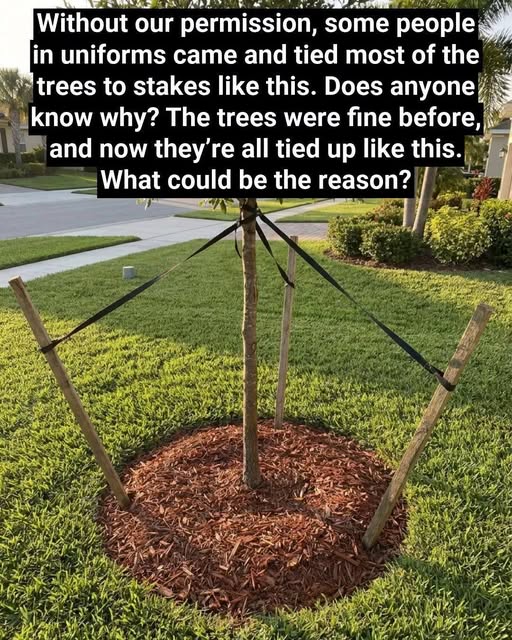
Seeing uniformed workers show up in your neighborhood and secure young palm trees or newly planted saplings to sturdy wooden stakes can feel confusing—especially if it happens on or near your property without prior notice.
As captured in the image where a newly planted tree is braced with wooden stakes and tension straps under the caption: “Without our permission, some people in uniforms came and tied most of the trees to stakes like this. Does anyone know why? The trees were fine before, and now they’re all tied up like this. What could be the reason?”—this sight frequently sparks questions on neighborhood forums.
Why would municipal workers, city contractors, or Homeowners Association (HOA) landscaping crews stake trees across an entire neighborhood?
Here is a look at why uniformed crews carry out tree staking, the municipal responsibilities involved, and the arboricultural benefits of proper tree anchoring.
The Primary Reasons Uniformed Crews Stake Neighborhood Trees
When municipal or HOA crews stake trees across a residential area, it is almost always linked to public safety, storm preparation, or municipal infrastructure maintenance.
1. Hurricane and Severe Storm Preparation
In coastal regions or storm-prone states, municipal arborists and county public works crews actively monitor weather forecasts.
- Preventing Windthrow: Young trees or recently transplanted palms lack deep, established root systems. High winds during tropical storms or severe summer gales can easily uproot them (a phenomenon known as windthrow).
- Guarding Public Infrastructure: Staking trees prevents young trunks from leaning into sidewalks, roadways, or nearby power lines during high-wind events, protecting public safety and city property.
2. Post-Planting Stabilization for Municipal Trees
Cities and HOAs regularly plant street trees along public easements, sidewalk strips, and road right-of-ways to expand urban canopy cover.
- Easement Rights: The strip of lawn between the sidewalk and street (or within a set distance from the curb) is typically a public right-of-way or easement managed by the local municipality or HOA, allowing authorized workers to maintain municipal trees without individual homeowner consent.
- Root Anchor Support: Newly planted trees need 6 to 12 months for their root systems to anchor firmly into surrounding soil. Staking stabilizes the root ball against strong gusts so delicate feeder roots are not torn as the tree sways.
3. Correcting Leaning Trunks or Loose Soil
During heavy rain events, soil around street trees can become saturated and soft. Passing vehicles, lawn care equipment, or gusty winds can cause young trees to lean severely.
- Straightening Growth: Crews use tripod staking configurations (using three angled wooden stakes and flexible webbing straps) to pull leaning trunks back into vertical alignment before the trunk hardens and grows crookedly.
Staking Methods: How Proper Tree Support Works
Proper tree staking requires specific techniques to protect the tree bark and allow natural trunk movement:
+-----------------------------------------------------------------------------------+
|                           TREE SUPPORT METHOD COMPARISON                          |
+-------------------+----------------------------+----------------------------------+
| Staking Setup     | Primary Purpose            | Typical Duration                 |
+-------------------+----------------------------+----------------------------------+
| Tripod Staking    | Severe Wind & Storm Proofing| 6 to 12 Months                   |
| Guy Wire System   | Large Specimen Tree Support| 1 to 2 Years                     |
| Single/Double Stake| Everyday Trunk Straightening| 3 to 6 Months                    |
+-------------------+----------------------------+----------------------------------+
Why Flexible Straps Are Crucial
Professional arborists use broad, flexible canvas or rubber straps rather than thin metal wire or harsh rope. Broad straps distribute tension across a wider area of bark, preventing the ties from cutting into the cambium layer as the trunk grows.
What Homeowners Should Know About Easements and City Trees
If workers in uniforms stake trees in front of your home, keeping municipal guidelines in mind helps avoid misunderstandings:
- Identify the Property Line: Most residential properties feature a public utility or roadway easement extending several feet from the curb. Trees located within this zone fall under county, municipal, or HOA jurisdiction.
- Avoid Removing the Stakes Yourself: Municipal workers set stake tension carefully. Removing stakes prematurely can cause the tree to fall during the next strong windstorm, potentially creating liability issues for property damage.
- Staking Should Be Temporary: Tree stakes should generally be removed after one growing season (6 to 12 months). Leaving stakes attached for years can restrict trunk movement, preventing the tree from developing natural wind-resistance strength (reaction wood).
Financial and Community Benefits of Urban Canopy Care
Properly anchoring and maintaining neighborhood trees provides direct community benefits:
- Lowering Storm Repair Costs: Proactive tree staking prevents storm damage, saving municipalities and property owners thousands of dollars in emergency tree removal and sidewalk repair fees.
- Boosting Property Values: Healthy, mature, upright street trees enhance neighborhood curb appeal and have been shown to increase residential property values by up to 3% to 15%.
Fascinating Facts About Trees and Wind
- Thigmomorphogenesis: Trees respond to mechanical stress like wind through a process called thigmomorphogenesis. Gentle swaying triggers the release of plant hormones that cause the trunk to grow thicker and stouter, reinforcing its structural strength naturally!
- Palm Tree Flexibility: Unlike hardwood oak or maple trees, palm trees are monocots (closer in structure to grass than wood). Their fibrous trunk structure allows them to bend at extreme angles during hurricane-force winds without snapping.
Conclusion: A Proactive Protection Measure
Seeing uniformed workers tie neighborhood trees to wooden stakes may seem unexpected, but it is a routine, protective measure carried out by municipal public works, county arborists, or HOA landscaping teams.
By stabilizing root systems, preventing storm blow-downs, and maintaining upright growth along public easements, tree staking keeps neighborhood streets safe, green, and beautiful for years to come.
Frequently Asked Questions
Q1: Who is allowed to stake trees in front of my yard?
A1: Authorized personnel from your local city or county public works department, municipal forestry crews, local utility companies, or contracted HOA landscaping teams have the right to maintain trees located within public easements or community property zones.
Q2: How long should stakes stay on a newly planted tree?
A2: Stakes should typically remain in place for 6 to 12 months—just long enough for the root system to establish itself in the surrounding soil. Leaving stakes on longer than one or two years can weaken the trunk.
Q3: Can tight straps damage the tree bark?
A3: Yes, if left on too long or tied with harsh wire. However, professional crews use wide, flexible webbing straps designed to cushion the trunk while allowing slight sway.
Q4: What should I do if a stake breaks or comes loose?
A4: Contact your local city public works department, municipal arborist office, or HOA management team to report the loose stake so crews can re-secure or remove it safely.
Q5: Will staking a tree prevent it from growing strong?
A5: If tied too tightly or left on for years, yes. However, temporary staking using flexible straps allows enough natural sway for the trunk to develop reaction wood while protecting the developing root system from wind damage.
