
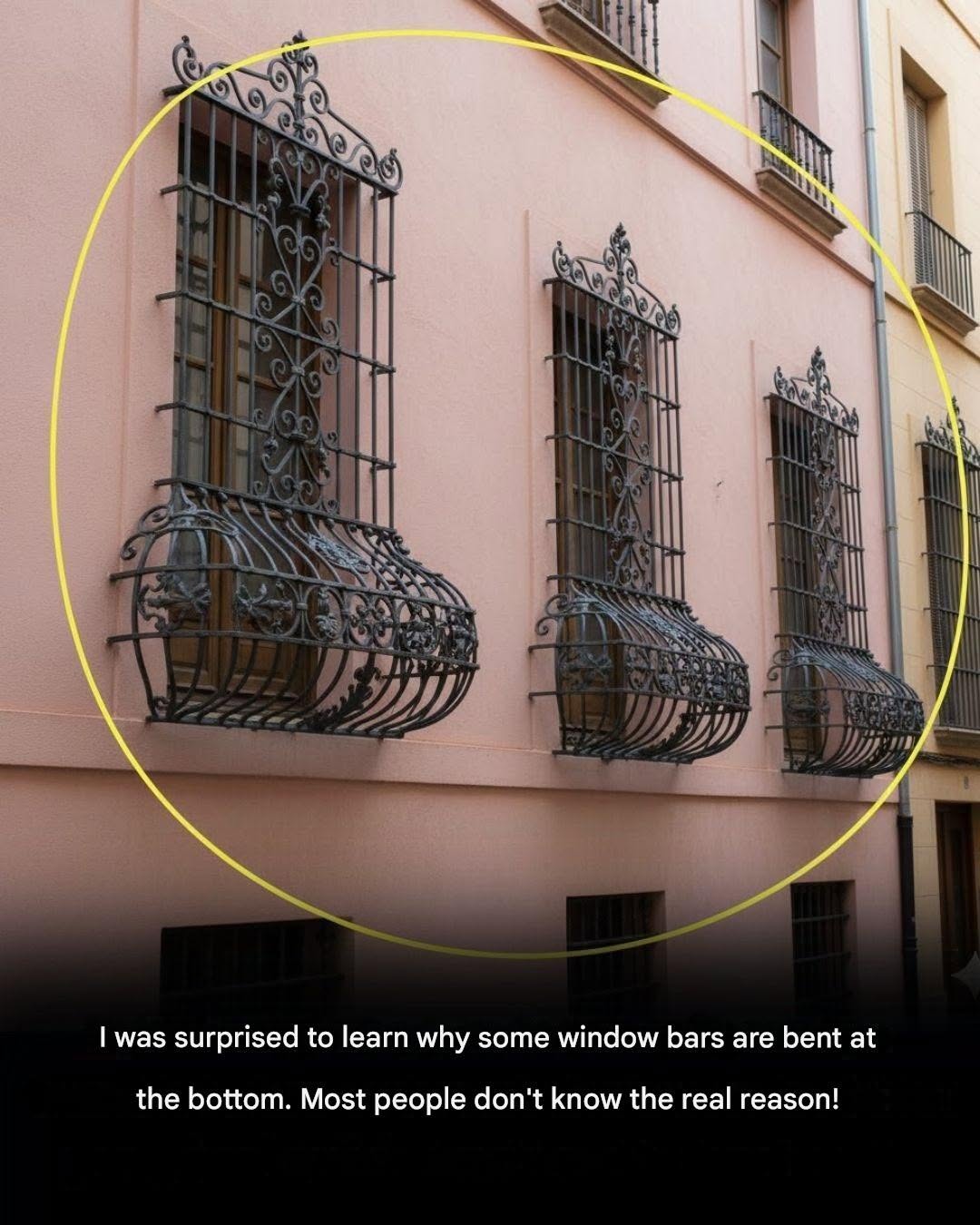
Walking through historical neighborhoods across Spain, Latin America, and the Mediterranean, travelers often notice intricate wrought-iron window grilles (rejas) that curve outward dramatically near the base.
A viral social graphic displays three ornate wrought-iron window cages mounted on a pastel pink facade with the text overlay: “I was surprised to learn why some window bars are bent at the bottom. Most people don’t know the real reason!”
While modern onlookers often assume these curved iron grilles are purely decorative, they serve a range of practical, social, and functional purposes in traditional architecture. Officially known as belly bars (or rejas de buche / rejas de pecho in Spanish), this distinctive shape was intentionally engineered for daily living.
Here is a full breakdown of why window bars are bent at the bottom, their cultural history, and their architectural benefits.
3 Clever Reasons Window Bars Curve Outward
+———————————————————————————–+
| BELLY BAR (REJA DE BUCHE) ADVANTAGES |
+——————-+—————————-+———————————-+
| Feature / Purpose | Design Mechanism | Practical Benefit |
+——————-+—————————-+———————————-+
| Plant & Flower | Outward belly cavity | Holds potted plants & flowers |
| Display | creates a built-in ledge | without stealing interior space |
| Downward Street | Curved bottom opens sight | Enables leaning out to view the |
| Visibility | angles to the ground | street safely from above |
| Courtship & Social| Outward clearance at chest | Allows comfortable conversation |
| Interaction | level for window visits | at street level (“pelar la pava”)|
+——————-+—————————-+———————————-+
- Accommodating Potted Plants and Window Boxes
In dense Mediterranean cities, homes often lacked private front gardens or spacious balconies. The outward curve at the base of the iron bars creates a secure, built-in shelf or cradle. Residents could place potted geraniums, herbs, or flowering plants inside the iron belly, bringing greenery into the home without sacrificing interior room or cluttering narrow sidewalks below. - Leaning Out to View the Street
Flat vertical bars restrict a resident’s movement, making it impossible to look down at the street without pressing face-first against iron. The outward-bulging bottom provides crucial clearance for a person to lean forward, place their arms or chest comfortably against the frame, and look up, down, and along the bustling street below. - Traditional Courtship and Socializing
Historically, particularly in Spanish tradition, ground-floor and first-floor rejas played a vital role in neighborhood courtship rituals (known colloquially as “pelar la pava”). The outward belly allowed a suitor standing outside on the sidewalk to converse comfortably with a young woman inside without requiring her to strain against flat iron bars.
Additional Functional Benefits of Curved Ironwork
Enhanced Airflow and Natural Light: By extending beyond the window frame, the curved cage allows shutters or glass panes to open completely outward into the iron belly, maximizing natural ventilation and breeze inside warm stone homes.
Structural Strength: Curved iron bars absorb physical impacts and structural tension better than rigid flat bars, making the window defense resilient against forced entry while maintaining an elegant aesthetic.
Financial Impact: Historical Craftsmanship & Property Value
Ornate architectural ironwork continues to deliver value to historic properties:
Boosting Historic Charm and Curb Appeal: Restoring original hand-forged rejas significantly enhances historical home value and preserves regional architectural heritage.
Low-Maintenance Security: Unlike modern electronic security systems, hand-crafted wrought-iron bars provide centuries of maintenance-free physical security against intruders.
Fascinating Facts About Spanish Ironwork History
Hand-Forged Artisan Heritage: Traditional Spanish rejas were hand-hammered by master blacksmiths using coal forges, shaping white-hot iron bars into delicate scrolls, acanthus leaves, and geometric cages.
Colonial Architecture Spread: Spanish settlers carried the reja de buche style across the Americas, making curved iron window bars a signature architectural staple in cities like Havana (Cuba), Cartagena (Colombia), and Old San Juan (Puerto Rico).
Conclusion: Function Meets Architectural Beauty
The distinct outward bend at the bottom of historic window bars is a prime example of form following function. By combining security with flower displays, improved street views, and comfortable social interaction, blacksmiths created a timeless architectural feature that remains iconic today.
Frequently Asked Questions
Q1: What are window bars with a curved bottom called?
A1: They are commonly known as belly bars, curved window grilles, or rejas de buche (and rejas de pecho) in Spanish.
Q2: Where are curved window bars most commonly found?
A2: They are prevalent in Spain, the Mediterranean, Latin America, and historic Spanish Colonial districts across North America.
Q3: Why did residents put flowers inside the curved bars?
A3: The outward curve provided a safe, raised platform for potted plants, allowing residents to cultivate small garden spaces without balconies.
Q4: Are belly bars stronger than straight window bars?
A4: Yes. The forged curved geometry distributes physical stress effectively, offering strong anti-burglary security alongside aesthetic beauty.
Q5: Can you open window shutters behind belly bars?
A5: Yes. The extra depth provided by the outward bulge allows window sashes and wooden shutters to swing outward without hitting the metal frame.
