
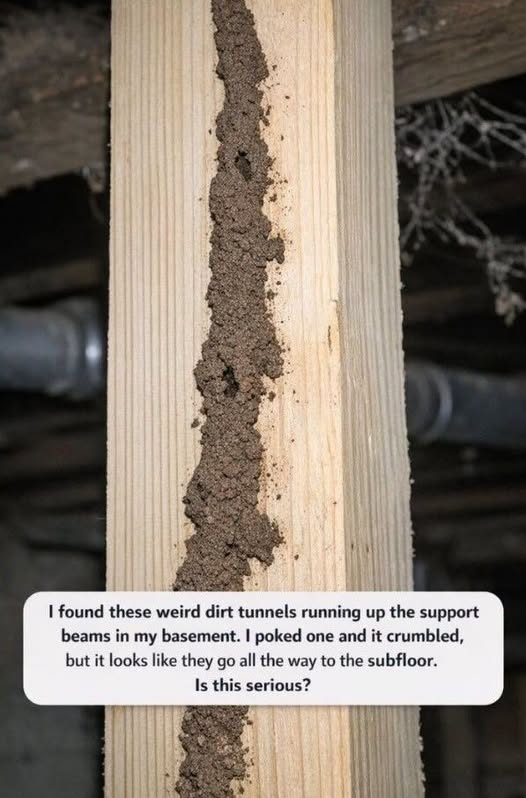
Discovering unusual mud structures running up wooden beams, joists, or concrete foundations in a basement or crawl space is every homeowner’s nightmare.
As captured in the image—where a prominent, earthy tube runs vertically up a wooden support post with the caption “I found these weird dirt tunnels running up the support beams in my basement. I poked one and it crumbled, but it looks like they go all the way to the subfloor. Is this serious?”—these structures are a classic warning sign of active pest activity.
The short answer: Yes, this is very serious.
These dirt tunnels are termite mud tubes (also called shelter tubes), constructed primarily by subterranean termites. They serve as highways connecting underground colonies to the wooden structural elements of your house.
Here is a comprehensive breakdown of what termite mud tubes are, how to identify active infestations, the structural damage risks involved, and the precise steps you need to take immediately.
What Are Termite Mud Tubes and Why Do They Build Them?
Subterranean termites live underground in large social colonies. Because their bodies are soft-bodied and highly susceptible to dehydration, they cannot survive exposure to open, dry air or direct sunlight.
To travel above ground and reach wooden framing, subflooring, and support posts, worker termites construct shelter tubes made from a mixture of soil, wood particles, cellulose debris, and saliva.
+-----------------------------------------------------------------------------------+
|                           TYPES OF TERMITE MUD TUBES                              |
+-------------------+----------------------------+----------------------------------+
| Mud Tube Type     | Purpose                    | Location Found                   |
+-------------------+----------------------------+----------------------------------+
| Exploratory Tubes | Searching for Food Sources | Walls, Beams, Concrete Slabs     |
| Working Tubes     | Active Foraging Highways   | Main Beams to Subfloor Framing   |
| Drop Tubes        | Secondary Suspended Routes | Hanging from Joists to Ground    |
| Swarming Tubes    | Swarmer Exit Vents         | Narrow Cracks & Foundation Joint |
+-------------------+----------------------------+----------------------------------+
Why Mud Tubes Are Critical to Termite Survival
- Moisture Retention: The sealed mud structure traps high humidity inside, preventing worker termites from drying out while foraging.
- Predator Protection: The thick earthy coating protects delicate worker termites from natural predators like ants, spiders, and birds.
How to Test If Termite Mud Tubes Are Active
When a homeowner pokes a mud tube and it crumbles into dry dirt, it is easy to assume the infestation is old or abandoned. However, subterranean termites continuously repair broken tubes unless the colony is eliminated.
The “Break and Wait” Test
- Break a Small Section: Break away a 1- to 2-inch section from the middle of the mud tube.
- Inspect the Interior: Look closely inside the broken ends with a flashlight. You may see small, creamy-white worker termites or soldier termites with brown heads moving inside.
- Check Back in 24 to 48 Hours: Leave the gap undisturbed and check it again in a day or two. If worker termites rebuild the missing section of the tube, you have an active, ongoing infestation.
Note: Even if the tube remains unrepaired, termites may simply have redirected their route through the interior of the wood post. An unrepaired tube does not guarantee your home is termite-free.
The Hidden Structural Risk to Your Home
Subterranean termites eat cellulose-based materials 24 hours a day, 7 days a week. Because they eat wood from the inside out, support beams and subflooring often look intact on the surface while suffering severe structural hollows internally.
Signs of Advanced Termite Damage
- Hollow-Sounding Wood: Tapping wooden beams with a screwdriver handle produces a dull, hollow thud rather than a solid sound.
- Buckling or Sagging Subfloors: As load-bearing joists weaken, hardwood, tile, or carpet floors directly above the basement may sag, squeak excessively, or feel spongy underfoot.
- Blistered Wall Surface: Termite galleries behind drywall or wood paneling can cause paint or wallpaper to blister and bubble, resembling water damage.
Emergency Action Plan for Homeowners
If you discover mud tubes in your basement, crawl space, or foundation walls, take these structured steps immediately:
Step 1: Do Not Spray DIY Bug Sprays
Resist the urge to spray store-bought aerosol insecticides, bleach, or vinegar on the mud tubes. Surface sprays only kill a small percentage of visible worker termites while causing the rest of the underground colony to split into satellite routes, making professional eradication significantly harder.
Step 2: Leave Other Tubes Intact
Avoid breaking down all the mud tubes in your home. Pest control professionals rely on visible shelter tubes to trace the entry points back to the subterranean nest and assess the severity of the infestation.
Step 3: Schedule a Professional Termite Inspection
Contact a licensed pest control company specializing in termite remediation. Professional technicians deploy specialized inspection equipment (such as moisture meters and thermal imaging cameras) to map out hidden nest locations.
Step 4: Choose a Proven Treatment Strategy
- Liquid Termiticide Barriers: Technicians create a treated soil barrier around your home’s foundation (e.g., using Termidor/Fipronil), which worker termites transfer back to the main queen, eliminating the entire subterranean colony.
- In-Ground Baiting Systems: Strategic bait stations placed around the perimeter contain slow-acting insect growth regulators that foraging workers carry back to destroy the subterranean colony.
Financial Impact: Preventing Costly Structural Repairs
Termites cause billions of dollars in structural property damage each year in North America alone—and standard homeowner insurance policies almost never cover termite damage.
- Early Detection Savings: Catching mud tubes early when they first reach basement support beams can limit treatment costs to standard pest control fees ($800–$2,000).
- Delayed Response Costs: Allowing termites to reach subflooring, wall studs, and roof trusses for multiple years can result in structural repair bills exceeding tens of thousands of dollars.
Fascinating Facts About Subterranean Termites
- Colony Size: A single mature subterranean termite colony can contain anywhere from 60,000 to over 2 million worker termites living underground!
- Continuous Feeding: Termite workers never sleep—they forage and consume cellulose continuously throughout their entire lifespan.
- Ancient Engineers: Termites have been building protective shelter tubes for over 100 million years, predating human construction by tens of millions of years.
Conclusion: Act Fast to Protect Your Home
Spotting dirt tunnels on basement support beams is a definitive signal that subterranean termites are targeting your home’s framing. While a crumbling tube might look like simple dried mud, it represents an active lifeline connecting an underground colony to your subfloor.
By avoiding DIY sprays, preserving entry points for inspection, and calling a licensed pest control specialist promptly, you can eliminate the colony, protect your home’s structural integrity, and prevent costly structural repairs.
Frequently Asked Questions
Q1: Are mud tubes always a sign of termites?
A1: Yes. Mud shelter tubes on foundation walls, joists, and support posts are uniquely built by subterranean termites. Mud dauber wasps build mud nests, but their structures resemble tubes or tubes clustered together rather than long continuous tunnels.
Q2: How fast can termites destroy a wooden support beam?
A2: A mature subterranean colony of 60,000 workers can consume approximately one foot of a 2×4 board in about six months. While structural damage takes time, ignoring mud tubes for a year or more can lead to severe structural compromise.
Q3: Will home insurance cover termite damage repairs?
A3: No. Almost all standard homeowners insurance policies consider termite infestations preventable home maintenance issues, meaning structural repairs and pest treatment costs must be paid out-of-pocket.
Q4: Can termites eat through concrete foundations to make tubes?
A4: Termites cannot eat concrete, but they can squeeze through microscopic foundation cracks as small as 1/32 of an inch (0.8 mm). Once through, they build mud tubes over the surface of the concrete to reach wood framing above.
Q5: How can I prevent termites from coming back after treatment?
A5: Maintain proper drainage around your foundation, eliminate wood-to-ground contact around your home exterior, fix plumbing leaks in basements or crawl spaces, and maintain an active professional termite warranty inspection plan.
