
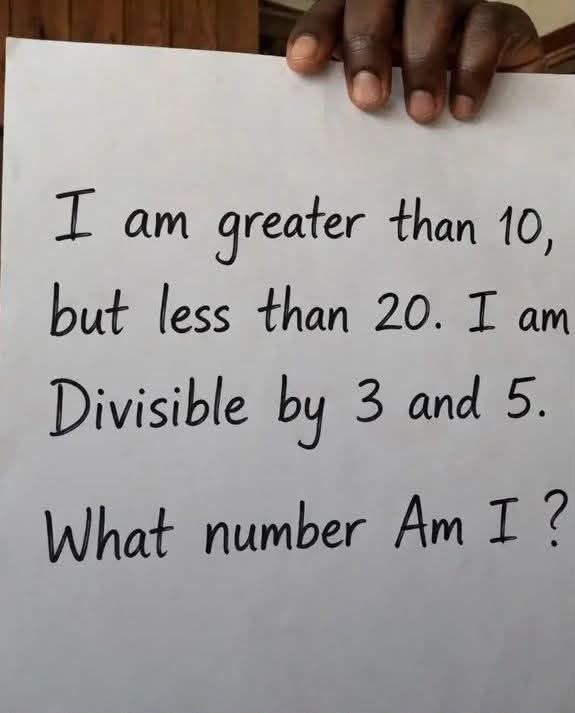
In the digital age, mathematical riddles, logic puzzles, and brain teasers have become an undeniable staple of social media feeds. Every single day, millions of users stop scrolling to solve short numerical challenges, test their arithmetic skills against friends, or debate solutions in the comments section.
What is the science behind our fascination with math puzzles, and how do visual brain teasers intersect with cognitive health, digital education, and everyday problem-solving? This comprehensive guide explores the mechanics of number riddles, cognitive psychology, and the reasons why simple math challenges capture our collective attention.
The Science of Numerical Reasoning and Logic
When people encounter a math riddle—such as finding a number between 10 and 20 that is divisible by both 3 and 5—the human brain immediately engages in systematic logical filtering.
1. Step-by-Step Constraint Satisfaction
Solving a number puzzle requires processing multiple logical constraints simultaneously.
- Setting Boundaries: The brain first establishes numerical ranges (such as numbers strictly greater than 10 and less than 20).
- Applying Divisibility Rules: Next, it applies mathematical principles, such as finding common multiples or testing factors (like checking which numbers in that range are divisible by both 3 and 5).
2. The Satisfaction of Mental Breakthroughs
Math riddles are engineered to test basic logic before rewarding the viewer with a clear, definitive solution.
- Challenging Assumptions: Even simple arithmetic puzzles require a brief moment of focused attention to ensure no constraints are missed.
- The Dopamine Reward: Successfully solving a math riddle triggers a small burst of dopamine, making brain teasers immensely satisfying and encouraging users to share them with others.
H2: The Broader Impact: Cognitive Health, Digital Media, and Education
While math riddles look like simple online games, they connect deeply to broader themes of cognitive wellness and digital learning.
H3: Keeping the Mind Agile Through Math Puzzles
Engaging in regular numerical workouts offers valuable benefits for cognitive fitness.
- Enhancing Problem-Solving Skills: Regularly testing your logic and arithmetic strengthens neural pathways associated with analytical thinking and quantitative reasoning.
- Stress Relief and Focus: Diving into a quick numerical riddle provides a fun, low-stakes mental escape from daily routines, acting as a refreshing cognitive break.
H3: The Dynamics of Viral Content Creation
For digital publishers and content marketers, math riddles are powerful tools for driving online engagement.
- Sparking Debate: Puzzles with clear logical answers encourage comments, friendly discussions, and quick replies, boosting overall post visibility.
- Building Community: Shared interactive content unites users from diverse backgrounds in a collective quest to solve the exact same mental challenge.
H2: Practical Tips for Solving Math and Logic Riddles
If you love tackling numerical puzzles and math riddles online, use this step-by-step approach to find the solution quickly:
- List the Constraints: Write down or mentally note every rule given in the prompt (e.g., number range and divisibility requirements).
- Filter the Range: Identify all whole numbers that fit the initial boundary condition (numbers between 10 and 20: 11, 12, 13, 14, 15, 16, 17, 18, 19).
- Test the Factors: Check each number against the remaining conditions (for example, looking for multiples of both 3 and 5, which points directly to 15).
- Compare Notes: Check the comment section or discuss the puzzle with friends to see how quickly others arrived at the correct answer.
H2: Interesting Facts About Math Puzzles and Brain Teasers
- Ancient Origins: Mathematical riddles are among the oldest recorded forms of human entertainment and education, dating back to ancient Egyptian, Greek, and Chinese texts.
- Universal Language: Because numbers transcend spoken language barriers, math puzzles can go viral instantly across global audiences.
- Mental Agility: Regularly practicing basic arithmetic and logic puzzles helps maintain mental sharpness and numerical fluency across all age groups.
- Educational Value: Teachers often use short number riddles to spark student interest in mathematics before diving into complex lessons.
Conclusion
Math riddles do much more than just entertain us during a quick social media scroll. They test our analytical reasoning, stimulate our cognitive processing, and bring communities together through shared curiosity and friendly debate. Whether you spot the solution instantly or work through the factors step-by-step, brain teasers offer a fantastic workout for the mind.
Take another close look at the puzzle, test your logic, and enjoy the satisfaction of cracking the code!
FAQ Section
Q1: What is the answer to the riddle shown in the image?
A: The answer is 15. It is greater than 10, less than 20, and evenly divisible by both 3 and 5.
Q2: Why do math riddles go viral so easily on social media?
A: They combine intellectual curiosity with a quick, definitive challenge, inviting users to test their skills and compare answers in the comments section.
Q3: Do math puzzles actually improve brain function?
A: Yes, engaging in regular numerical logic puzzles helps stimulate neural activity, enhances concentration, and exercises analytical problem-solving skills.
Q4: How do you find a number divisible by two different factors?
A: You look for common multiples of those factors within the specified range. For 3 and 5, the least common multiple is 15, which falls neatly between 10 and 20.
Q5: Are brain teasers beneficial for older adults?
A: Absolutely. Solving math and logic puzzles is widely recommended as an enjoyable way to keep the mind active, support cognitive agility, and encourage lifelong mental stimulation.
