
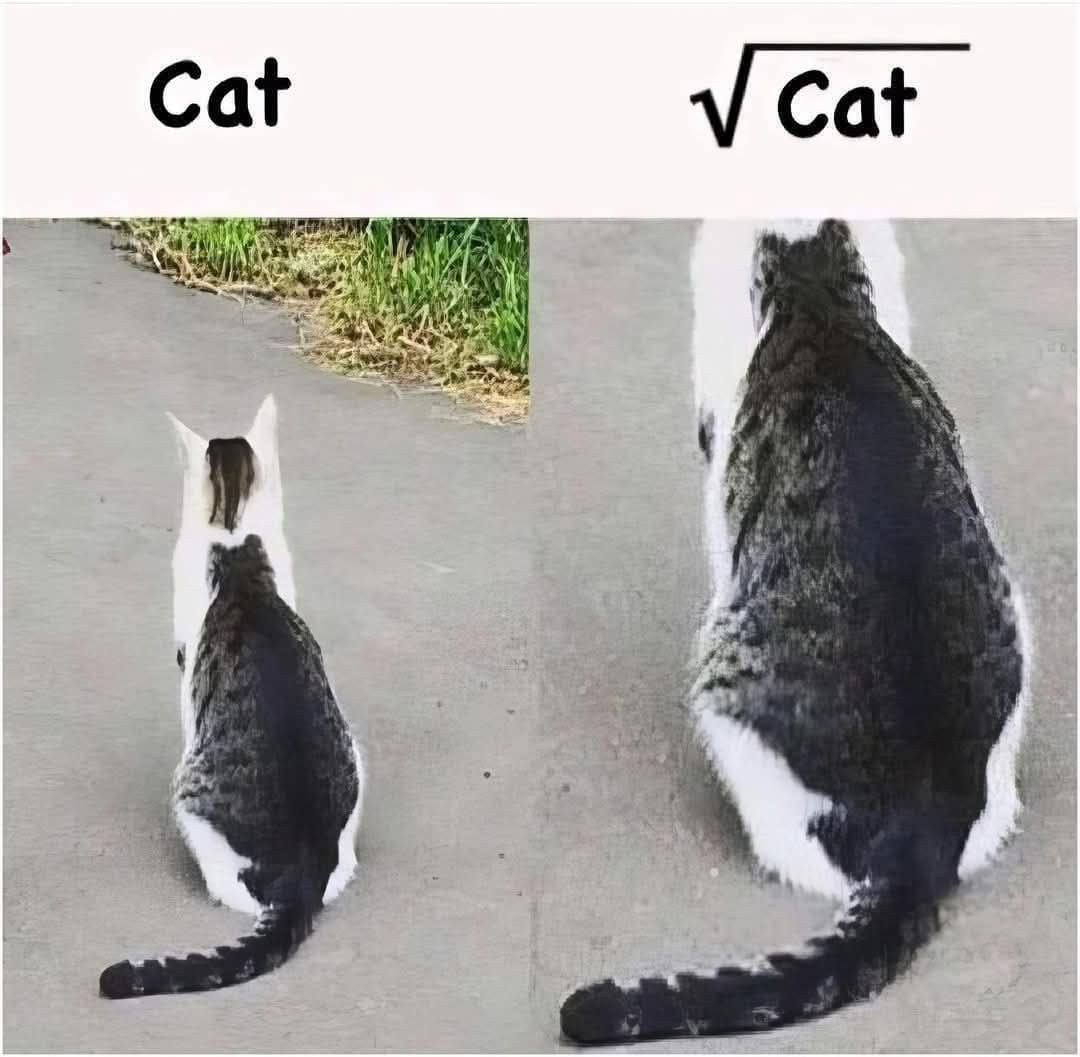
Math humor often relies on clever wordplay, but every so often, a viral image blends mathematical notation with a mind-bending optical illusion to create something truly hilarious.
A popular math meme—headlined “Cat” vs. “$\sqrt{\text{Cat}}$”—presents a side-by-side comparison of a cat sitting on a pavement path. On the left side, labeled “Cat”, a white cat with dark tabby markings on its back sits facing away. On the right side, labeled “$\sqrt{\text{Cat}}$” (the square root of Cat), a zoomed-in cropped version of the dark patch on the cat’s back is shown, revealing that the pattern looks identically like a second, larger dark tabby cat sitting right in front of it.
This clever visual joke combines basic algebra concepts with a classic case of pareidolia—the human tendency to perceive familiar patterns (like a cat) in random visual arrangements.
Here is a full breakdown of the math joke, the optical illusion behind it, and why visual memes like this capture the internet’s imagination.
The Math Behind the Meme: Why $\sqrt{\text{Cat}}$?
To understand the joke, it helps to look at how square roots work in basic mathematics:
+-----------------------------------------------------------------------------------+
|                        THE MATHEMATICAL CONCEPT EXPLAINED                         |
+-------------------+----------------------------+----------------------------------+
| Expression        | Mathematical Meaning       | Meme Interpretation              |
+-------------------+----------------------------+----------------------------------+
| $x^2$             | A quantity multiplied by   | The whole object composed of two |
|                   | itself                     | identical visual layers          |
| $\sqrt{x}$        | The base factor that when  | Extracting the inner "cat" shape |
|                   | squared yields $x$         | hidden inside the main cat       |
+-------------------+----------------------------+----------------------------------+
When you take the square root of a squared term, you isolate the primary underlying component:
$$\sqrt{x^2} = \vert{}x\vert{}$$
In the context of the meme:
- The Full Image (“Cat”): Shows the white cat whose back markings resemble a cat shape. It’s essentially a “cat inside a cat” (or $\text{Cat} \times \text{Cat} = \text{Cat}^2$).
- The Square Root (“$\sqrt{\text{Cat}}$”): “Extracts” the inner cat-shaped pattern from the overall image, leaving you with just the core cat form!
Pareidolia: Why We See a Cat on a Cat
The psychological phenomenon at play here is called pareidolia.
Pareidolia occurs when the human brain interprets random visual stimuli—such as fur patterns, cloud formations, or craters on the moon—as recognizable objects, particularly faces or animal silhouettes.
- Fur Pattern Illusion: The dark tabby patch on the white cat’s spine naturally tapers at the top to look like a cat’s ears and neck, widens in the middle to resemble a torso, and connects seamlessly at the bottom with the cat’s actual tail.
- Brain Processing: Because human vision is optimized for quick pattern recognition, your eyes immediately register two cats sitting in a row rather than one cat with unique coat pigmentation.
Financial Impact: The Commercial Value of Viral Pet Memes
Humorous pet graphics and optical illusions are major drivers of online traffic and media engagement:
- High Engagement Rates: Visual memes containing animals and lighthearted math jokes consistently generate significantly higher share-to-impression ratios than standard text posts.
- Monetization and Reach: Digital publishers and content creators leverage viral visual humor to build organic social media audiences, driving traffic to monetized blogs and niche merchandise storefronts.
Fascinating Facts About Cat Coat Patterns
- Agouti and Tabby Genes: The distinct stripes and patches seen on tabby cats are governed by the Agouti gene, which controls the distribution of pigment across individual hair shafts.
- Piebald Spotting: The combination of white fur and dark tabby patches occurs due to the piebald (white spotting) gene, which prevents pigment cells (melanocytes) from spreading across the entire body during embryonic development.
Conclusion: A Perfect Blend of Logic and Humor
Whether you are a math enthusiast who appreciates a clever radical sign joke or simply an animal lover enjoying a fun optical illusion, the “Root Cat” meme is a prime example of how everyday visual coincidences can brighten up the internet.
Frequently Asked Questions
Q1: Is the image on the right a real second cat?
A1: No. The image on the right (“$\sqrt{\text{Cat}}$”) is simply a close-up crop of the dark fur patch on the back of the single white cat shown on the left.
Q2: What does the square root symbol ($\sqrt{\phantom{x}}$) actually do in math?
A2: The square root of a number $y$ is a value $x$ such that $x \cdot x = y$. For example, $\sqrt{16} = 4$ because $4 \cdot 4 = 16$.
Q3: Why do cat fur patterns sometimes look like shapes or letters?
A3: Pigmentation during fetal development occurs in random wave patterns. As melanocytes migrate, they form unique patches, stripes, and spots that can coincidentally resemble familiar shapes.
Q4: What is pareidolia?
A4: Pareidolia is a psychological phenomenon where the brain perceives a familiar image, shape, or face in an otherwise random visual pattern.
Q5: Who created the concept of square roots?
A5: The concept of square roots dates back to ancient Babylonian and Egyptian mathematicians around 1800 BCE, though the modern radical symbol ($\sqrt{\phantom{x}}$) was introduced by mathematician Christoph Rudolff in 1525.
