
Viral math puzzles and visual brain teasers have become a staple of social media, capturing the attention of millions. From tricky algebraic riddles to deceptive icon-based puzzles, these challenges test our attention to detail, pattern recognition, and mathematical order of operations. While they often look simple at first glance, comment sections frequently divide into intense debates over the correct solution.
Examining how optical math puzzles are structured reveals the hidden traps designed to catch unwary solvers off guard. Let’s break down the mechanics behind these viral brain teasers and solve the puzzle step by step.
Deconstructing the Puzzle: Step-by-Step Mathematical Breakdown
To solve icon-based math puzzles correctly, you must analyze each row carefully, paying attention to hidden multipliers, individual item counts, and standard mathematical order of operations (PEMDAS/BODMAS).
+-----------------------------------------------------------------------------------+
|                        PUZZLE ICON VALUE ANALYSIS                                 |
+------------------------------------+----------------------------------------------+
| Equation Row                       | Mathematical Deduction                       |
+------------------------------------+----------------------------------------------+
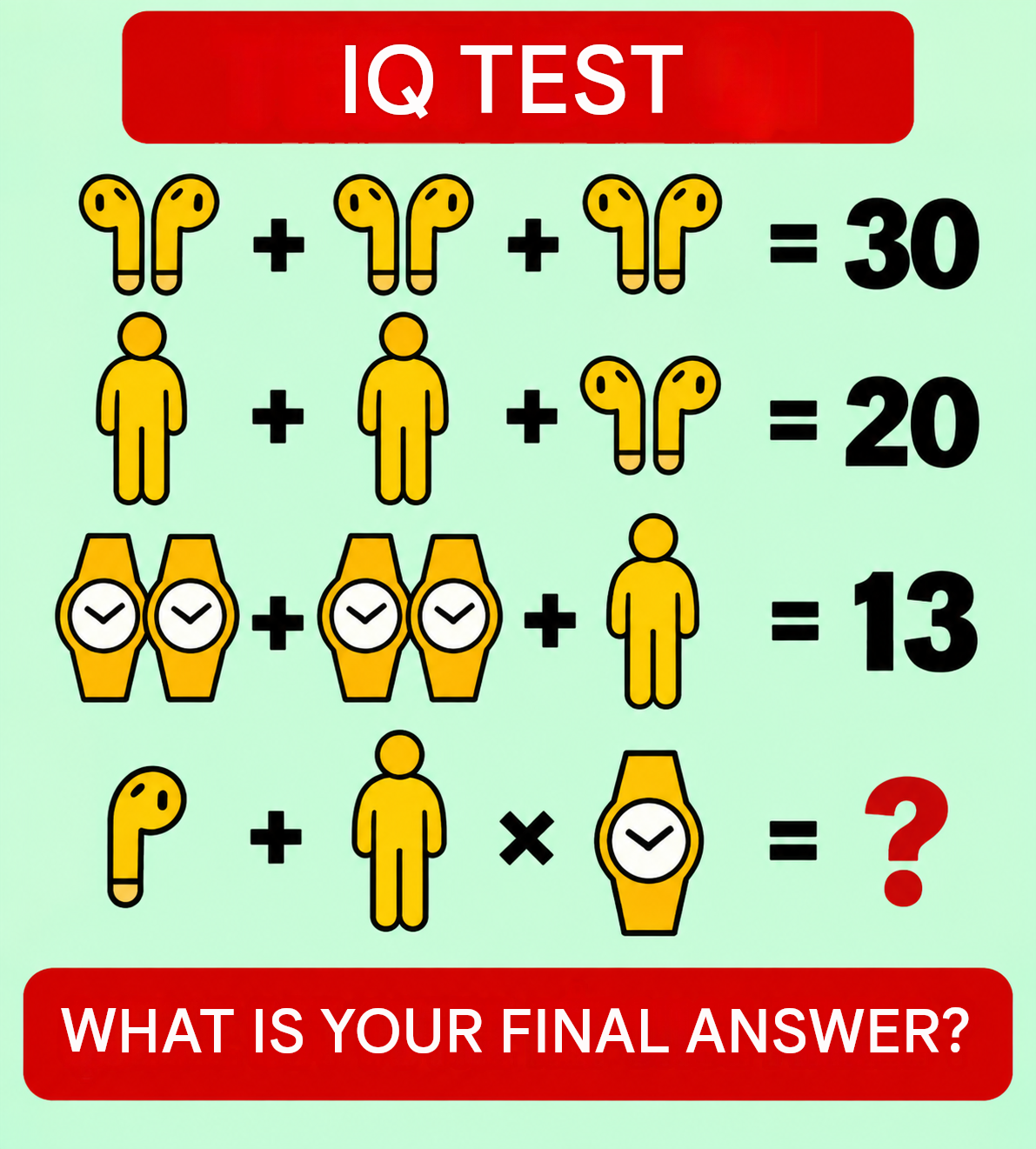
| Row 1 (3 Pairs of Earbuds = 30)    | 3 pairs = 30 $\rightarrow$ 1 pair = 10       |
| Row 2 (2 People + 1 Pair = 20)     | 2x + 10 = 20 $\rightarrow$ Person = 5         |
| Row 3 (2 Pairs of Watches + Person = 13)| 2(2w) + 5 = 13 $\rightarrow$ Watch = 2   |
| Row 4 (1 Single Earbud + Person $\times$ 1 Watch) | Final Evaluation              |
+------------------------------------+----------------------------------------------+
1. Solving for the Earbuds
In the first row, three identical pairs of wireless earbuds add up to 30. Dividing 30 by 3 means each pair equals 10. Looking closer at the icon, each pair consists of two individual earbuds, meaning a single earbud equals 5.
2. Solving for the Person
In the second row, two figures plus one pair of earbuds equal 20. Since a pair equals 10, we subtract 10 from 20, leaving 10 for the two figures. Dividing by two gives a value of 5 for each person figure.
3. Solving for the Watches
In the third row, two double-watch icons plus a person equal 13. Substituting the person’s value of 5 leaves 8 for the two double-watch icons, meaning each double-watch icon equals 4. Looking closely, each double-watch icon contains two watches, so a single watch equals 2.
The Final Equation: Avoiding Common Traps
The final row presents the ultimate test by combining different icons and requiring strict adherence to the order of operations.
+-----------------------------------------------------------------------------------+
|                        FINAL SOLVING EQUATION                                     |
+-----------------------------------------------------------------------------------+
| • Single Earbud Value: 5                                                          |
| • Person Figure Value: 5                                                          |
| • Single Watch Value: 2                                                           |
| • Equation: 5 + (5 $\times$ 2) = ?                                                   |
| • Final Answer: 15                                                                |
+-----------------------------------------------------------------------------------+
Applying the Order of Operations
The final line features 1 single earbud + 1 person figure $\times$ 1 single watch.
- Multiplication comes first: the person (5) multiplied by the single watch (2) equals 10.
- Then, addition: add the single earbud (5) to the product (10), resulting in a final answer of 15.
Practical Tips for Solving Visual Puzzles
Sharpening your problem-solving skills helps you spot hidden tricks in viral brain teasers.
- Examine Details Closely: Always check whether icons appear in pairs or singles (such as counting individual earbuds or watches).
- Follow Mathematical Rules: Never forget the order of operations (multiplication and division before addition and subtraction).
- Do Not Rush: Visual puzzles are intentionally designed to exploit quick assumptions and visual bias.
- Share and Compare: Discussing puzzles with friends is a fun way to test different logical approaches and viewpoints.
- Enjoy the Challenge: Remember that brain teasers are meant to stimulate curiosity and provide a quick mental workout.
Surprising Facts About Brain Teasers and Cognitive Agility
- Cognitive Bias: Human brains naturally look at the overall shape of an icon rather than counting individual components, which is why most people miss modified items in final equations.
- Brain Stimulation: Solving puzzles regularly helps stimulate neural pathways associated with logical reasoning and visual processing.
- Viral Engagement: Puzzles with tricky hidden details naturally drive high social media engagement as users flock to comment sections to defend their answers.
- Historical Puzzles: Mathematical brain teasers have been used for centuries across various cultures to test intelligence and teach arithmetic.
Frequently Asked Questions (FAQ)
What is the correct answer to the final equation?
The correct final answer is 15, calculated by multiplying the person (5) by the single watch (2) to get 10, and then adding the single earbud (5).
Why do most people get this puzzle wrong?
Most people fail because they do not notice that the final row features a single earbud instead of a pair, a single watch instead of a double pair, and they forget to perform multiplication before addition.
How much is a single earbud worth?
Since a pair of earbuds equals 10, a single earbud is worth 5.
How much is a single watch worth?
Since a double-watch icon equals 4, a single watch is worth 2.
Why are visual math puzzles so popular online?
They combine simple arithmetic with visual trickery, creating an engaging challenge that sparks friendly debate across social media comment sections.
Conclusion
Visual brain teasers are a fantastic way to test your attention to detail and keep your mind sharp. Whether you spotted every hidden trick right away or fell into the common traps, solving these puzzles is a rewarding mental exercise.
Stay sharp, keep exploring fun riddles, and share this tricky IQ test with your friends to see if they can get it right!
