
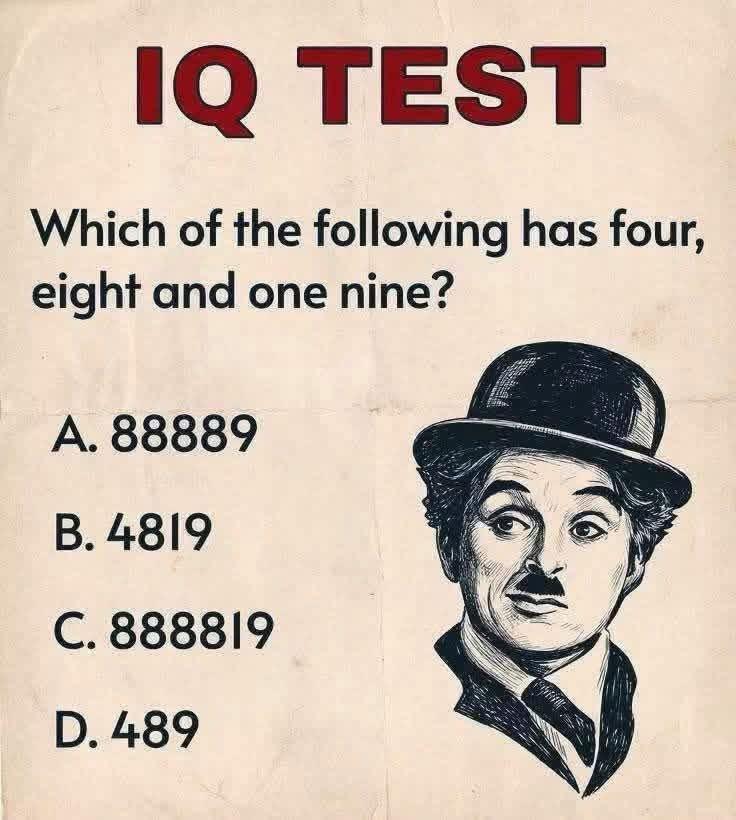
Viral brain teasers and IQ test puzzles have a remarkable way of commanding attention on social media, sparking eager participation and lively comment sections. When an online graphic features Charlie Chaplin alongside a tricky question asking, “Which of the following has four, eight and one nine?” with multiple-choice options, it immediately challenges readers to look beyond standard math and test their wordplay skills. Let’s break down the mechanics of this famous riddle, explore why these puzzles go viral, and look at how lateral thinking helps solve them.
Decoding the Riddle: Wordplay vs. Mathematics
At first glance, people often look at the multiple-choice options (A. 88889, B. 4819, C. 888819, D. 489) and try to count digits or perform mathematical calculations. However, the key to solving this puzzle relies entirely on reading the phrasing literally rather than numerically.
- Analyzing the Phrasing: The question asks which option literally contains the words or digits described: four, eight, and one nine.
- Breaking Down Option C: Looking closely at option C (888819), we can count the individual digits: it contains four 8s (four eights) and one nine at the end!
- Why People Get Trapped: Most brains automatically assume the question refers to standard counting values or number sequencing, leading them to overthink the puzzle and choose incorrectly.
The Psychology of Viral IQ Puzzles
Why do millions of users stop scrolling to engage with visual riddles and IQ test graphics? These puzzles rely on powerful psychological engagement triggers:
- The Challenge Factor: When a post frames a question as an “IQ Test,” it appeals to our innate desire to test our intelligence and prove our problem-solving skills.
- High Comment Rates: Because trick questions easily confuse readers, users flock to the comments to share their answers, debate solutions, and check if they got it right.
- Low Barrier to Participation: Selecting a multiple-choice letter takes only a second, encouraging high-volume engagement across social feeds.
Digital Marketing and Content Strategy
For content creators and web publishers, leveraging viral brain teasers is an effective way to drive traffic. When an engaging social media post sparks curiosity, users willingly click through to an external website to find the full answer key, read related puzzles, or check out fun trivia. This steady stream of social media traffic supports website monetization models like Google AdSense, helping publishers build sustainable online reach and engagement.
Practical Tips for Keeping Your Mind Sharp
While solving lighthearted internet riddles is mostly meant for entertainment, keeping your mind agile and your cognitive processing sharp is a wonderful goal. Here are a few ways to stimulate your brain daily:
- Challenge Yourself Regularly: Engage in crosswords, Sudoku, logic puzzles, and lateral-thinking riddles to keep your neural pathways active.
- Embrace Curiosity: Ask questions, learn new concepts, and explore different perspectives to foster lifelong mental adaptability.
- Prioritize Rest: Adequate sleep and downtime are essential for memory consolidation, focus, and problem-solving abilities.
Conclusion: The Enduring Appeal of Clever Wordplay
The IQ test riddle featuring four 8s and a 9 is a brilliant example of how simple wordplay can entertain and unite internet users. Whether you spotted the trick immediately or fell into the trap of overthinking the numbers, these playful brain teasers offer a fun mental break from the daily routine.
FAQ Section
Q: What is the correct answer to the riddle “Which of the following has four, eight and one nine?” A: The correct answer is C. 888819, because it contains four 8s and one 9.
Q: Why do so many people fail or overthink this puzzle? A: Readers usually look at the numbers mathematically rather than reading the phrase literally as “four 8s and one 9.”
Q: Why are IQ test riddles so popular on social media platforms? A: They spark quick engagement, challenge users to test their smarts, and encourage lively debates in the comment sections.
Q: Do brain teasers help improve cognitive health?
A: Yes, regularly engaging in puzzles and word games helps stimulate problem-solving skills, memory, and cognitive flexibility.
Q: How do websites benefit from sharing viral riddles? A: By sparking curiosity on social media, publishers drive click-through traffic to their websites, boosting page views and ad revenue.
