
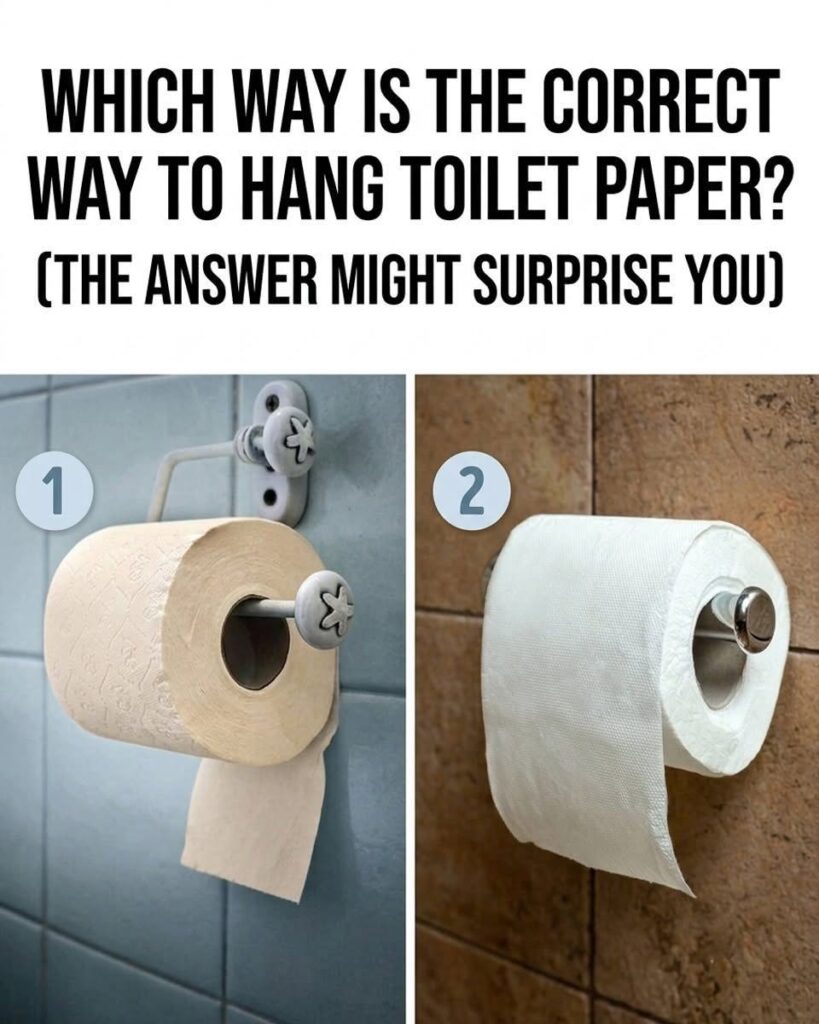
Few household topics ignite as much passionate debate as the orientation of a toilet paper roll. Whether it should hang with the loose end facing front (over) or tucked against the wall (under) has divided households, roommates, and workplaces for decades.
A viral social graphic titled “WHICH WAY IS THE CORRECT WAY TO HANG TOILET PAPER? (THE ANSWER MIGHT SURPRISE YOU)” contrasts Option 1 (under/underhand) against Option 2 (over/overhand).
While personal preference often dictates how people load their dispensers, historical patent evidence, ergonomics, and hygiene science overwhelmingly confirm that Option 2 (Over) is officially the correct method.
Here is a full breakdown of the history, hygiene benefits, and practical reasons why the “over” orientation reigns supreme.
3 Reasons Why Option 2 (Over) Is the Correct Way
+-----------------------------------------------------------------------------------+
|                        TOILET PAPER ORIENTATION COMPARISON                        |
+-------------------+----------------------------+----------------------------------+
| Feature / Metric  | Option 2 (Over / Overhand) | Option 1 (Under / Underhand)     |
+-------------------+----------------------------+----------------------------------+
| 1891 Patent Design| Intended manufacturing design| Contrary to original patent      |
| Hygiene & Germs   | Prevents hands touching wall| Knuckles drag on wall surface    |
| Sheet Visibility  | Easy to find end; pattern  | Loose end hidden underneath;     |
| & Usability       | faces outward cleanly      | harder to grab in low light      |
+-------------------+----------------------------+----------------------------------+
1. The Original 1891 Patent Proof
The ultimate authority on how toilet paper was intended to be used comes from the inventor himself. On September 15, 1891, New York businessman Seth Wheeler—founder of the Albany Perforated Wrapping Paper Company—was granted U.S. Patent No. 459,516 for his invention of perforated toilet paper rolls.
The original patent illustrations explicitly show the paper roll hanging in the over/overhand position (Option 2), with the perforated sheets cascading off the front of the roll away from the wall.
2. Superior Hygiene and Germ Control
The primary functional advantage of the “over” position is sanitary protection:
- Avoiding Wall Contamination: When toilet paper hangs in the “over” orientation, your fingers only touch the clean, exposed sheets you intend to tear off.
- The “Under” Risk: When hanging in the “under” position (Option 1), users frequently drag their fingers and knuckles along the surrounding bathroom wall or tile surface while searching for the hidden end, transferring bacteria onto the wall and subsequent paper sheets.
3. Ease of Use and Visual Aesthetics
The “over” position keeps the loose edge visibly accessible, making it easier to find, grasp, and tear along perforations with a single hand. Additionally, decorative embossing or printed patterns on premium toilet paper are designed to face outward when loaded in the overhand position.
The One Exception: When Option 1 (Under) Makes Sense
While “over” is the intended standard, the “under” orientation (Option 1) offers two practical advantages in specific environments:
- Pet Protection: Cats and dogs often bat at hanging toilet paper rolls. In the “over” position, downward paw strikes cause the roll to unspool completely onto the floor. In the “under” position, batting down spins the roll harmlessly without unraveling sheets.
- Toddler Curiosity: Similar to pets, young children playing with toilet paper will unravel an “over” roll far easier than an “under” roll.
Financial Impact: Smart Purchasing & Waste Reduction
Understanding proper toilet paper mechanics helps reduce bathroom utility expenses:
- Preventing Unnecessary Waste: The “over” position allows users to accurately gauge sheet count and tear cleanly along perforations, reducing excess paper usage.
- Choosing High-Yield Rolls: Purchasing double or mega rolls reduces core cardboard waste and lowers long-term cost per sheet while fitting standard home fixtures.
Fascinating Facts About Toilet Paper History
- Before Perforations: Prior to Seth Wheeler’s 1891 perforation patent, toilet paper was typically sold as loose flat sheets or unperforated paper spools that had to be cut with scissors or torn manually.
- The Hotel Folding Hack: Luxury hotel housekeepers fold the top sheet of the toilet paper into a decorative triangle (“hotel fold”). This visual touch is only possible when the roll is hung in the correct over position.
Conclusion: Settlement of an Age-Old Debate
While pet owners might occasionally rely on the “under” position to stop curious paws, the original 1891 patent, ergonomics, and hygiene standards prove that Option 2 (Over) is the definitive correct way to hang toilet paper.
Frequently Asked Questions
Q1: Who invented perforated toilet paper?
A1: Seth Wheeler patented perforated toilet paper rolls in 1891.
Q2: What does the official patent show for toilet paper orientation?
A2: The official 1891 patent drawings clearly show the paper roll mounted in the over (cascading forward) position.
Q3: Why is hanging toilet paper “over” cleaner than “under”?
A3: Hanging it “over” prevents users from brushing their knuckles against the bathroom wall, keeping paper and surfaces free of bacteria transfer.
Q4: Why do hotel housekeepers fold the tip of the toilet paper?
A4: The triangular fold signals to incoming guests that the bathroom has been thoroughly cleaned and sanitized.
Q5: Is there any practical benefit to hanging toilet paper “under”?
A5: Yes. The “under” position prevents cats, dogs, and toddlers from easily unspooling the entire roll onto the floor.
