
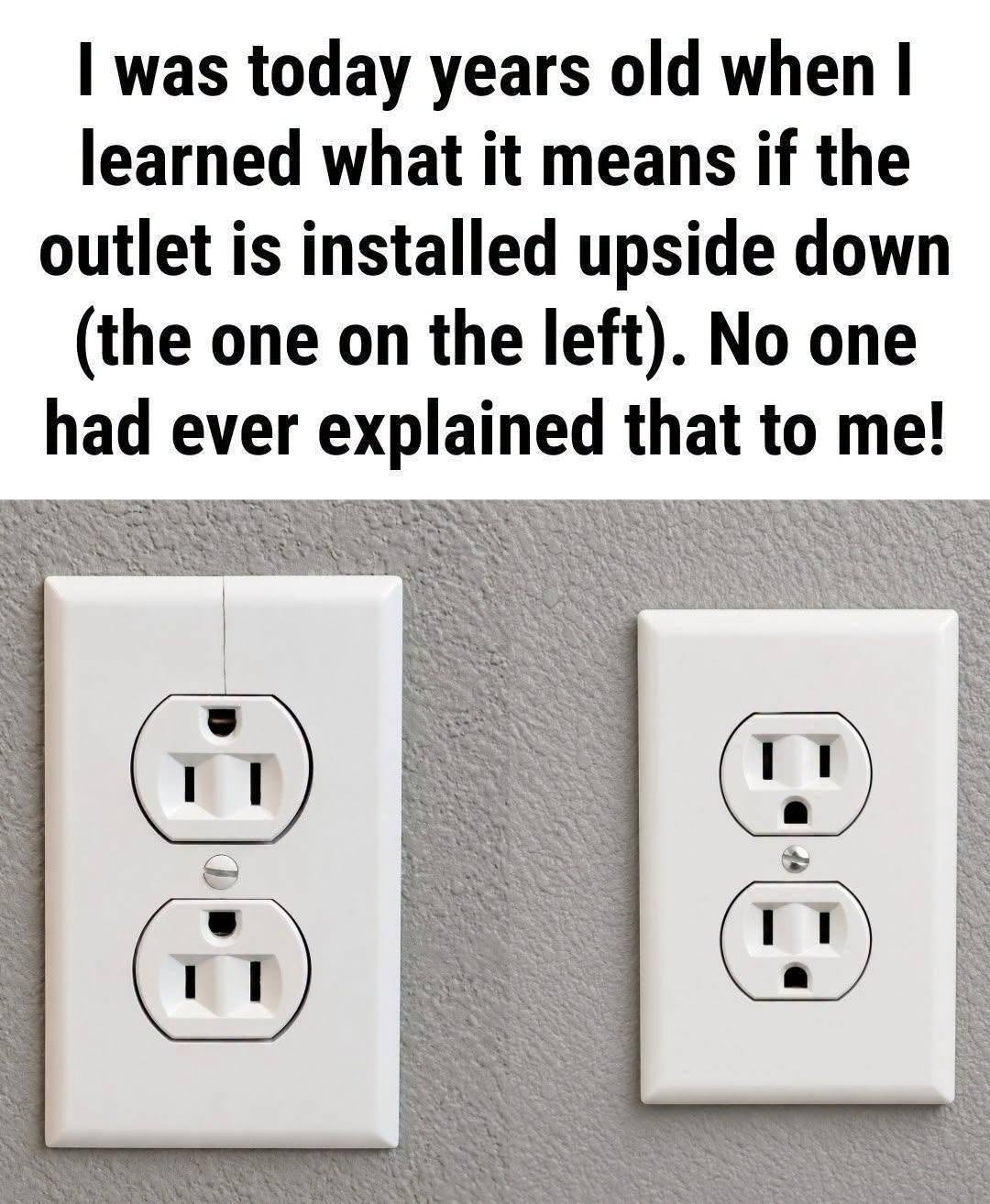
When walking into a bedroom, living room, or home office, you might occasionally spot an electrical receptacle installed upside down—with the ground pin hole at the top rather than the bottom.
A viral social graphic titled “I was today years old when I learned what it means if the outlet is installed upside down (the one on the left). No one had ever explained that to me!” highlights two electrical outlets side-by-side: one upside down (ground pin on top) and one standard orientation (ground pin on bottom).
While many homeowners assume an upside-down outlet is a construction error or amateur DIY mistake, it is actually an intentional installation choice with two primary purposes: identifying a wall-switch-controlled outlet and enhancing electrical safety.
Here is a full breakdown of what inverted outlets mean, safety code standards, and practical electrical tips.
2 Main Reasons Outlets Are Installed Upside Down
Electricians invert receptacles for specific functional and safety reasons:
+-----------------------------------------------------------------------------------+
|                        OUTLET ORIENTATION COMPARISON TABLE                        |
+-------------------+----------------------------+----------------------------------+
| Orientation       | Common Meaning / Purpose   | Key Advantage                    |
+-------------------+----------------------------+----------------------------------+
| Upside Down (Left)| Switched outlet / Safety   | Identifies switch control / Safety|
| Standard (Right)  | Always-on power receptacle | Familiar appearance              |
+-------------------+----------------------------+----------------------------------+
1. Indicating a Wall-Switch-Controlled Outlet (Half-Hot Receptacle)
In many modern home designs, bedrooms or living rooms lack overhead ceiling light fixtures. To compensate, builders wire a wall switch near the entryway directly to a specific wall outlet.
- Electricians often install that specific outlet upside down as a visual code to indicate to the homeowner that plugging a floor lamp or table lamp into that receptacle allows it to be operated via the room’s light switch.
2. Enhanced Safety Against Short Circuits
Electricians commercial and residential job sites often prefer installing outlets ground-pin-up for physical safety:
- If a plug is partially pulled out of the wall, exposing the metal prongs, an object falling between the wall and the plug (such as a metal ruler, paperclip, or picture frame wire) will hit the top ground prong safely.
- In a traditional orientation (ground at the bottom), a falling metal object lands directly across the active hot and neutral prongs, instantly creating a dangerous short circuit, spark, or fire hazard.
What Does the National Electrical Code (NEC) Say?
A common misconception is that the National Electrical Code (NEC) mandates a specific orientation for three-prong electrical outlets:
- No Official Up or Down Rule: The NEC does not strictly specify whether the ground pin must face up or down. As long as the receptacle is properly grounded and wired correctly (hot to brass, neutral to silver), both orientations are fully code-compliant.
- Commercial Building Standards: Many commercial buildings, hospitals, and industrial facilities mandate ground-up installation by default to minimize short-circuit risks.
Financial Impact: Energy Savings & Smart Home Upgrades
Understanding how switched outlets function offers practical home management benefits:
- Eliminating Phantom Energy Drain: Plug power strips or entertainment systems into switched outlets to turn off standby power draw completely with a single flick of a switch.
- Saving on Electrical Rewiring: Utilizing existing switched outlets for floor lamps saves hundreds of dollars compared to hiring an electrician to install new overhead lighting fixtures.
Fascinating Facts About Electrical Outlets
- Hospital-Grade Receptacles: In healthcare facilities, almost all outlets are installed with the ground pin at the top to protect sensitive medical equipment from accidental shorts.
- The “Third Prong” Purpose: The round ground hole carries no electricity during normal operation; it serves as a safety backup path for surge electricity to flow directly into the earth during a short circuit.
Conclusion: Intentional Design, Not Electrician Error
An upside-down outlet isn’t a mistake—it is either an electrician’s clever visual signal for a wall-switch-controlled lamp outlet or a deliberate safety design to prevent accidental electrical sparks.
Frequently Asked Questions
Q1: Is an upside-down outlet safe to use?
A1: Yes. Upside-down outlets are completely safe and fully compliant with the National Electrical Code (NEC).
Q2: Why does my wall switch control an upside-down outlet?
A2: Electricians invert switched outlets so homeowners can easily identify which wall socket is connected to the room’s entryway light switch.
Q3: Can I flip an upside-down outlet right-side up myself?
A3: Yes, after shutting off main power at the circuit breaker box, you can unscrew the receptacle unit, rotate it 180 degrees, and re-fasten it to the outlet box.
Q4: Which prong is the ground prong on a standard outlet?
A4: The semi-circular or rounded hole is the ground prong, while the shorter slot is hot and the longer slot is neutral.
Q5: Why are medical facility outlets installed ground-up?
A5: Hospitals use ground-up installation so that falling metal instruments cannot bridge the hot and neutral prongs on partially loose plugs.
