
Obsolete or vintage kitchen gadgets frequently go viral on social media as online communities attempt to guess their original purpose.
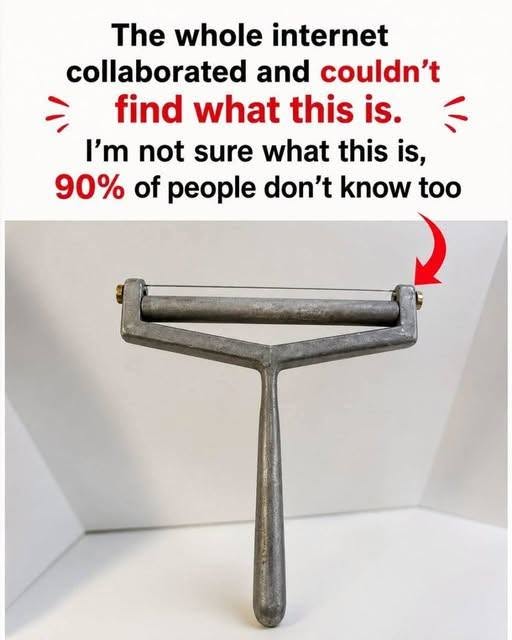
A viral social graphic—captioned “The whole internet collaborated and couldn’t find what this is. I’m not sure what this is, 90% of people don’t know too”—displays a handheld T-shaped metal utensil featuring a top roller and a thin horizontal wire stretched across the frame.
Despite claims of internet mystery, this item is a widely manufactured handheld wire cheese slicer (also known as a cheese cutter or wire plane).
Here is a full breakdown of how this tool functions, why wire slicers remain popular, and practical tips for using and maintaining vintage kitchen tools.
How a Handheld Wire Cheese Slicer Works
The simple mechanical design of a wire cheese slicer makes cutting uniform slices of cheese fast and effortless:
+-----------------------------------------------------------------------------------+
|                        WIRE CHEESE SLICER COMPONENT BREAKDOWN                     |
+-------------------+----------------------------+----------------------------------+
| Component         | Structure                  | Functional Purpose               |
+-------------------+----------------------------+----------------------------------+
| Cutting Wire      | Stainless steel wire thread| Cuts through cheese cleanly without|
|                   |                            | sticking or crumbling            |
| Support Roller    | Rotating metal cylinder    | Controls thickness & glides along|
|                   |                            | the cheese block face            |
| T-Bar Frame       | Heavy-duty cast aluminum   | Maintains taut wire tension and  |
|                   | or stainless steel body    | provides ergonomic leverage      |
+-------------------+----------------------------+----------------------------------+
1. The Wire Eliminates Drag and Sticking
Standard knife blades create friction when passing through dense blocks of medium to semi-firm cheese (such as Cheddar, Swiss, Gouda, or Monterey Jack), causing slices to tear or stick to the blade. A thin steel wire slices cleanly with minimal surface resistance, leaving smooth, clean cuts.
2. The Roller Regulates Thickness
The built-in cylindrical roller rests directly against the top surface of the cheese block. By tilting the handle at different angles while pulling the tool toward you, the distance between the roller and wire adjusts—allowing you to easily cut thin or thick slices.
Why Wire Slicers Beat Standard Knives for Cheese
Cheese connoisseurs and home cooks continue to prefer wire slicers over standard chef knives for several reasons:
- Consistent Thickness: The combination of the guide roller and taut wire guarantees uniform slices for sandwiches, charcuterie boards, or snacks.
- Prevents Crumbling: Aged semi-hard cheeses tend to shatter under a thick knife blade. A thin wire applies concentrated pressure along a razor-thin line, preserving structural integrity.
- Minimal Effort: Pulling a wire slicer across a block requires significantly less wrist force than pressing down with a standard blade.
Financial Impact: Buying Blocks vs. Pre-Sliced Cheese
Using a dedicated cheese slicer offers clear financial advantages for food budget management:
- Cost Savings on Block Cheese: Buying bulk block cheese is up to 30% to 50% cheaper per ounce compared to pre-sliced packaged cheese.
- Extended Shelf Life: Blocks of cheese retain freshness much longer than individual slices, which tend to dry out faster due to increased surface area exposure.
Fascinating Facts About Vintage Kitchen Tools
- Scandinavian Invention: Wire cheese slicers and cheese planes were heavily popularized in Nordic countries during the early 20th century (most famously the Norwegian ostehøvel invented by Thor Bjørklund in 1925).
- Replaceable Wires: Many traditional metal cheese slicers feature small brass or stainless steel end screws, allowing users to replace the cutting wire easily if it snaps after years of use.
Conclusion: A Simple Tool Solves Everyday Kitchen Tasks
Far from being an unsolvable mystery, this tool is a classic piece of kitchen engineering designed to make slicing cheese simple, uniform, and effortless.
Frequently Asked Questions
Q1: What is the official name of this tool?
A1: It is commonly called a handheld wire cheese slicer, cheese cutter, or wire cheese plane.
Q2: How do you adjust slice thickness on a wire cheese slicer?
A2: Adjust the angle of the tool relative to the cheese block. Holding the handle flatter yields thinner slices, while tilting it up creates thicker slices.
Q3: What types of cheese work best with a wire slicer?
A3: Medium to semi-hard cheeses like Cheddar, Swiss, Gouda, Provolone, and Colby work best. Extremely hard cheeses (like Parmesan) can break the wire, while very soft cheeses (like Brie) stick to the roller.
Q4: Can you replace the wire on a cheese slicer if it breaks?
A4: Yes, replacement cheese wires are widely available online and can be attached by unscrewing the end tension knobs on the frame.
Q5: Is this tool dishwasher safe?
A5: Vintage aluminum models should be hand-washed to prevent metal discoloration, while modern stainless steel models are generally dishwasher safe.
